Monday, July 11, 2022

Manu National Park

When we first talked about coming to South America, visiting rainforests was high on our list. When you think of Brazil, you think of the Amazon. I looked into many incredible expeditions there, but when we decided to save Brazil for another time, we still had a goal of seeing the intriguing creatures and greenery of the rainforest. I researched many options. Bolivia has many of its own rain forests, but getting to them came with added difficulty, so we ruled those out. Peru has so much to offer! There were options in the north and options a short plane ride from Cusco. The options in the north meant actually spending time on the Amazon River, the possibility of seeing pink dolphins and greater guarantee of seeing animals because of a rescue center. The south had unique opportunities and many that seemed a bit more authentic. We wanted to spend a few days in the rain forest, but not an entire week. We found some reasonably priced options (remember, we are teachers), but adding on flights increased the price and made timing even harder to perfect. Our dream adventure of a treehouse in Laos had spoiled us, and we had searched for treehouses in Peru only to find ones that were way out of our price range. Then, one day, I somehow typed in the right option in the search box and all the pieces fell into place.

As one can imagine, jungle experiences are not next door to big cities. One must travel a relatively long distance to be in the thick of things with exotic animals surrounding you. When I found Manu Treehouse Inn, all the uncomfortable feelings I had had about which rainforest experience went away, and my gut instinct told me this was the place for us. We would be driven from Cusco, and although it was a great distance, it could be done in a day, AND we’d have the opportunity to stay in another treehouse!

Jessica and I felt like royalty. (Remember, we’re teachers, so we didn’t spend a fortune!) We were picked up early in Cusco by our guide, our chef and a driver (or perhaps I should just go ahead and call him our chauffeur). Yep, three people who were there to take care of the two of us. We’re not accustomed to that, but we’re grateful for the opportunity to be spoiled. As it turns out, once again, I think that’s just how the cards played out about with who booked at the same time we did.

We stopped for breakfast in a small town, and our guide, Moses, helped us to find headlamps which were very helpful! Soon after, he asked if we liked beer or pisco or wine. We said of course, and he asked if we had ever drunk a Hit. Having no clue as to what he was talking about, he said we’d stop for some. In the next small village, we went into a small market and purchased a few of these drinks, for our dinner, we assumed. A few minutes later, at about 10 am, bee-bopping down the road, our three caretakers each popped open a bottle. Yep, even our driver.

Now, I must say that after having one of the drinks at dinner, it tasted like koolaid with only a slight amount of alcohol. Also, I would have trusted our driver on those roads even blindfolded more than I would have trusted myself. Plus, blindfolding me would have been the only way you could have gotten me to drive on them or perhaps it would have taken some liquid courage for me to get behind the wheel as well. We went from Cusco, at a height of near 10,000 feet above sea level to nearing sea level in a matter of hours. We did this on single-lane dirt roads that hugged the sides of mountains on one side and plunged deep into the valley below on the other. Despite the evidence I’ve provided you with, our driver was skilled and cautious and navigated the roads with precision. 

The landscape quickly changed as we descended from dry, desert-like areas to lush, green forests. We stopped periodically to walk along the road and look for animals. Our guide, Moses, who is in his mid-twenties has a greater knowledge of this area than I could ever hope to learn. He grew up not far from here and is passionate about the rainforest. Somehow, he could spot green birds (in the rainforest) at a distance of 100 yards. He rattled off Spanish, Latin and English names of plants and birds with confidence. Now, sure, he could have made up whatever he wanted and I would have believed him, but I believe he truly knew what he was talking about. He could mimic dozens of bird calls, monkey calls and even the caiman we were seeking. When wandering through the jungle, he could point out a variety of trees and tell us how the natives used these for home remedies. You would think Moses could part the seas or something. But then again, when you gave him a machete and set him loose in the jungle, he was a ten-year-old boy. His evil laugh gave way when he killed a cannibal ant and watched mass chaos ensue on the rest of the heard. He would tease us about seeing snakes, cut vines so he could swing on them like Tarzan and he used the machete whenever possible on any out of place stick.

He had said we would have a picnic on our first day. What do you picture? Sandwiches? Maybe some meats, cheeses and fruits? What about a hand-prepared meal on the side of the road by our personal chef? Soup, rice, chicken, vegetables, fresh fruit and even fresh passion fruit juice. Not sure what happened, but we are living our best life here, for sure.


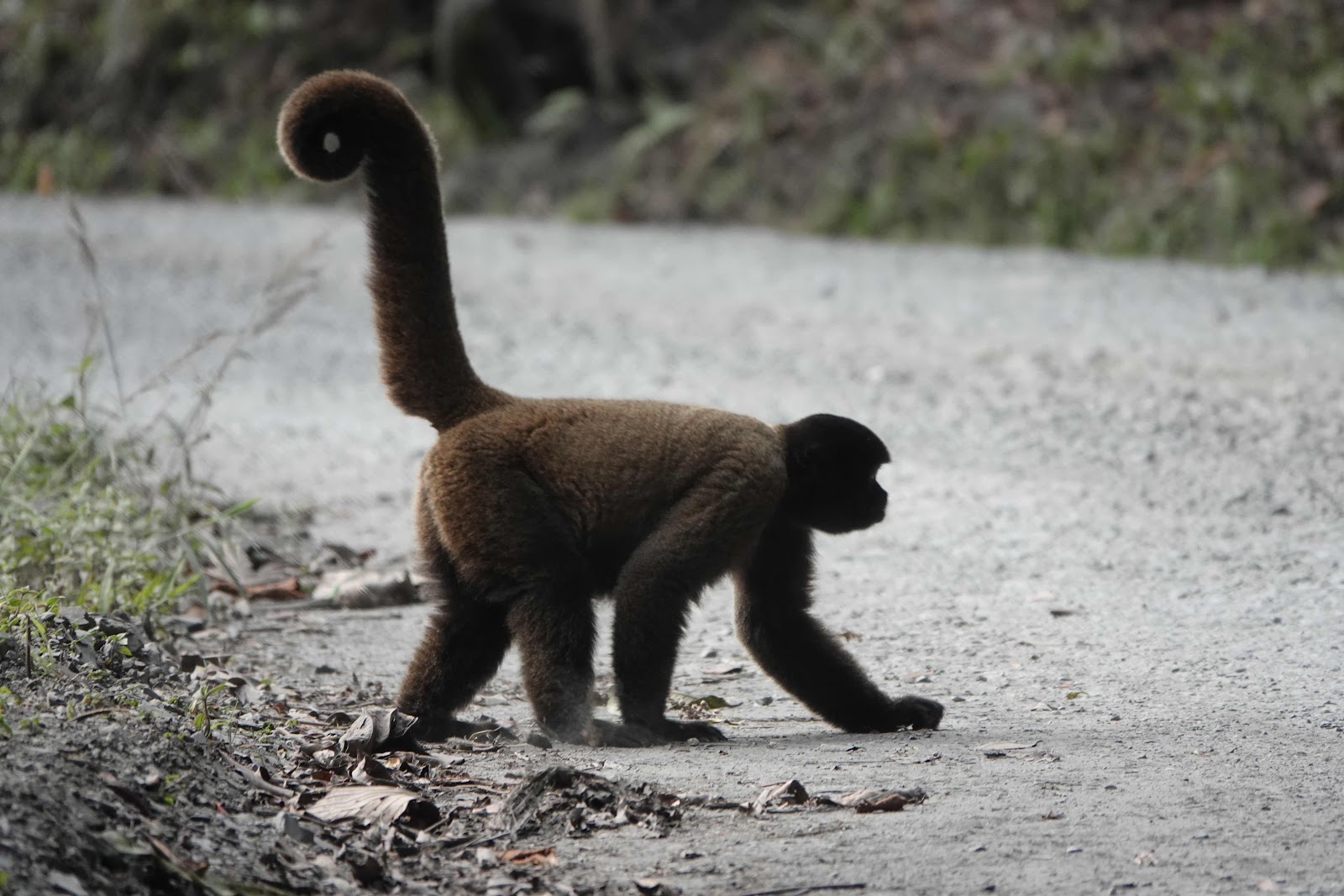
We spotted wooly monkeys along our journey and stopped on the side of the road to watch them. Monkeys are always one of the most fascinating, entertaining creatures at the zoo. Is it because they are so much like ourselves? Their hands and facial expressions are so similar. They leapt from branch to branch with ease, gathering seeds and hung upside down by their tails. We waited long enough and even got to watch them cross the road, looking like agile cats with their tails high in the air.




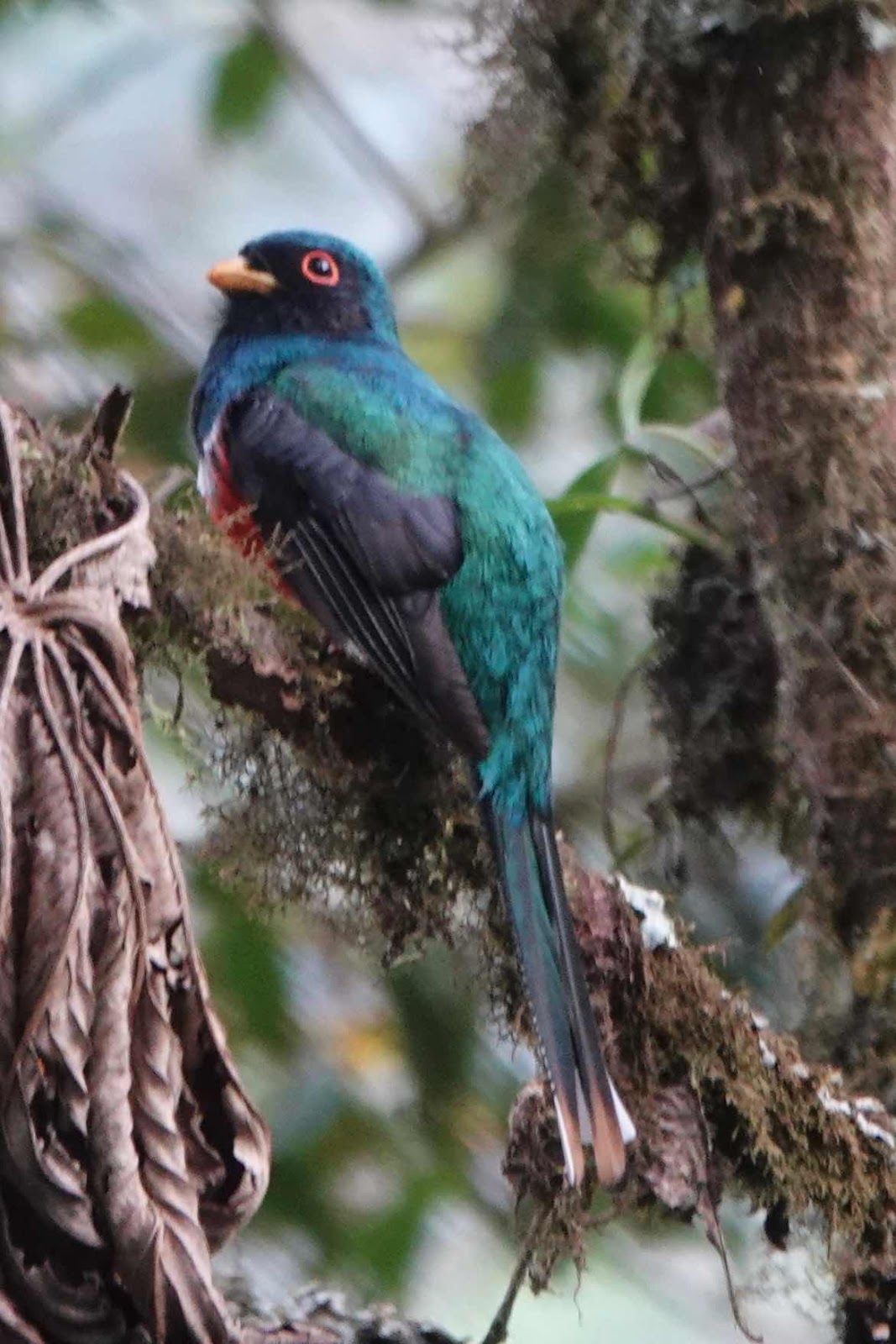
We searched for a long time in a specific part of our journey for the famous red bird of Peru. We only got small glimpses of him, but he was in the middle of his dancing ritual, showing off for the ladies, so watching the competition was very entertaining.

The first night, due to the long journey, was in a simple lodge not too far from the river. We slept in beds with mosquito netting, but never had any issues and had a nice simple bathroom to ourselves. Of course our personal chef prepared an incredible dinner and breakfast.


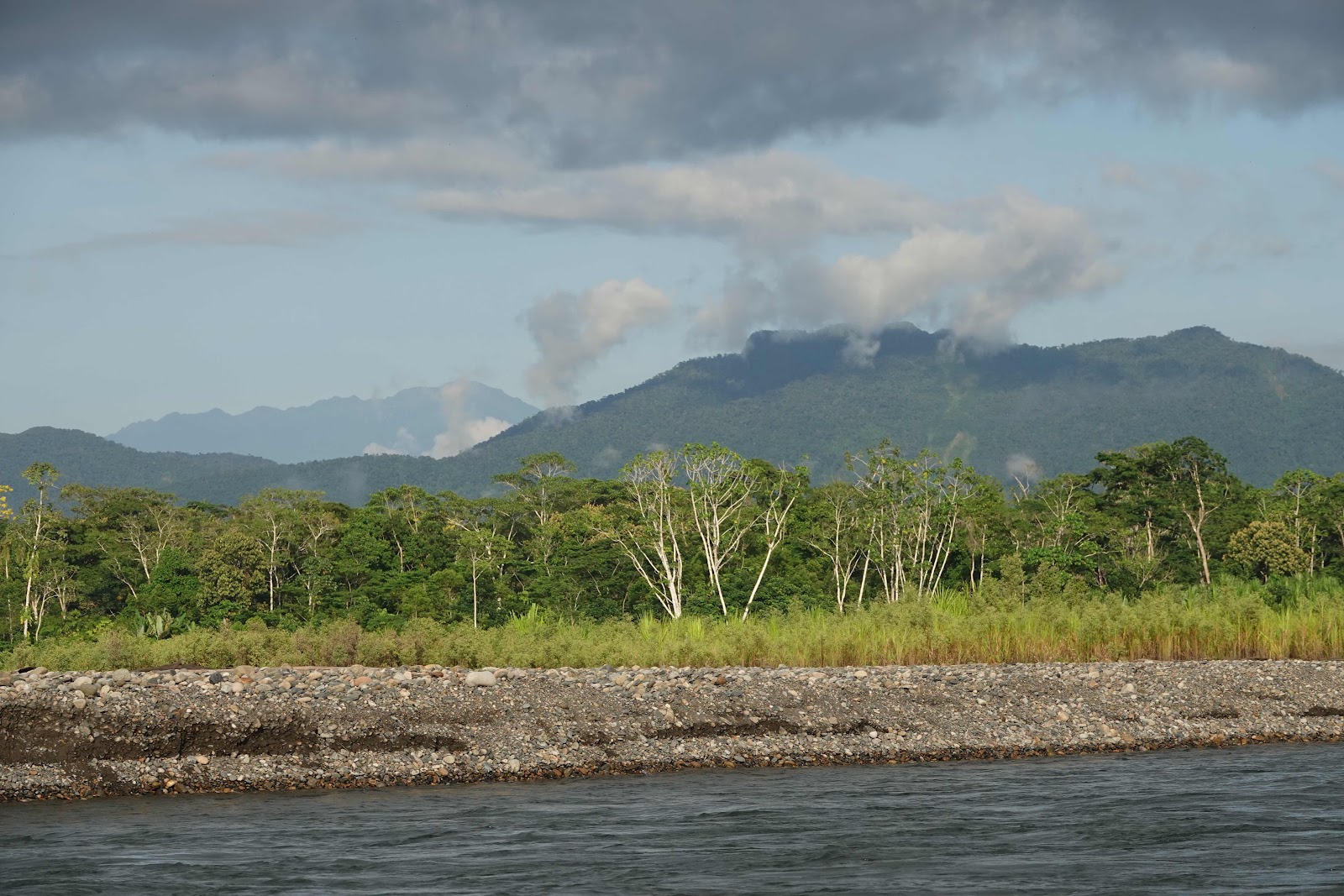
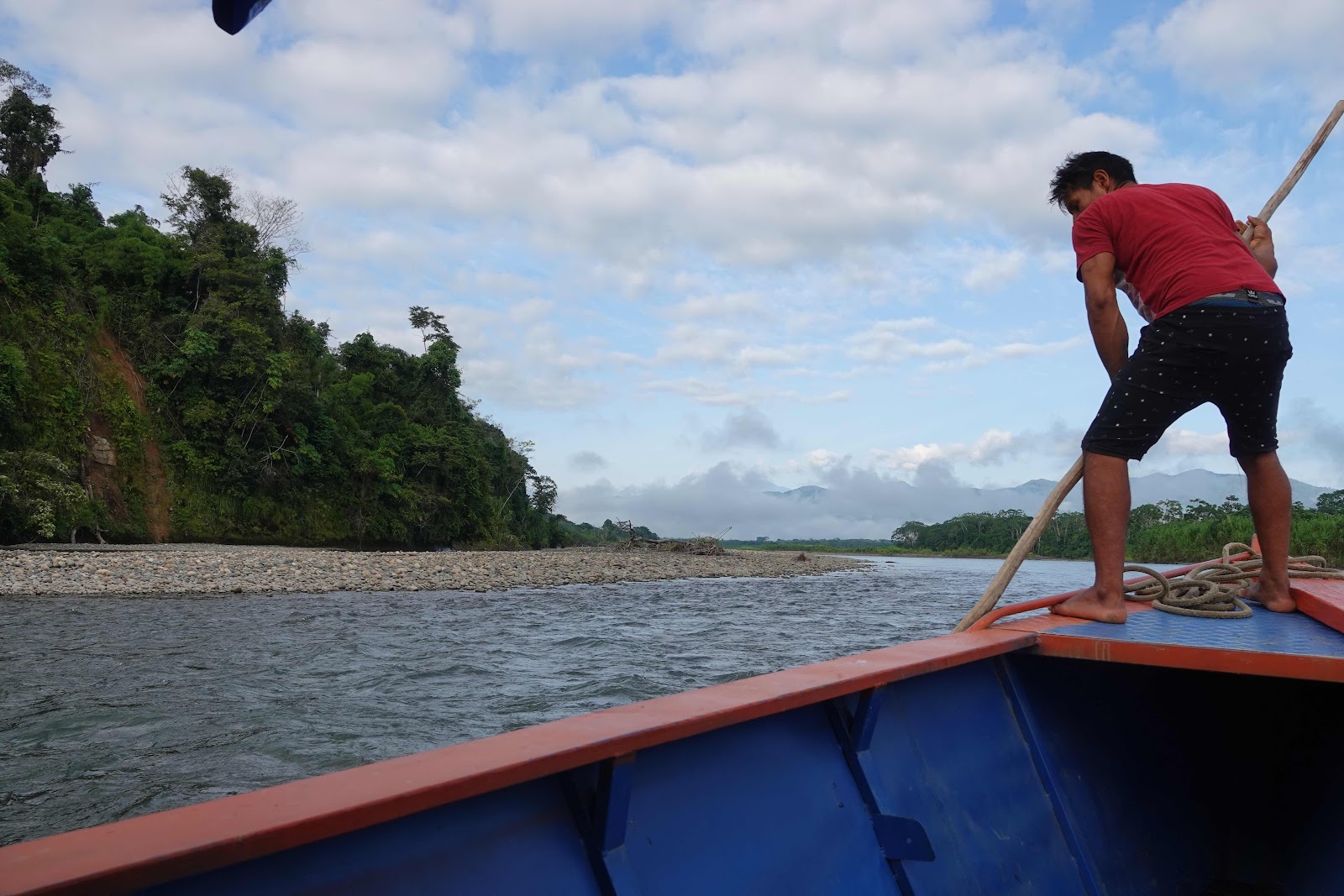
The next morning, we made our way to our boat ride and for the first time on our month long journey, we saw rain. We were in fact entering the rain forest, so I guess it makes sense, but still, it was an odd sensation. Thankfully, our first boat downstream on the expansive river was covered and relatively comfortable. On the boat our guide, our chef, a boat captain and a “stickman” were all there to guide us on our journey. Our second one, a smaller one as we were on a smaller river, was not covered, but the rain had let up. Here we only had one, new captain, and our guide and personal chef. We are not on the Amazon River here. It is in the north of Peru, but as with any major river, most water across the continent flows to or from the Amazon. So, it is fair to say that we are on one of the tributaries of the Amazon and can consider our location to be part of the Amazon Rainforest.


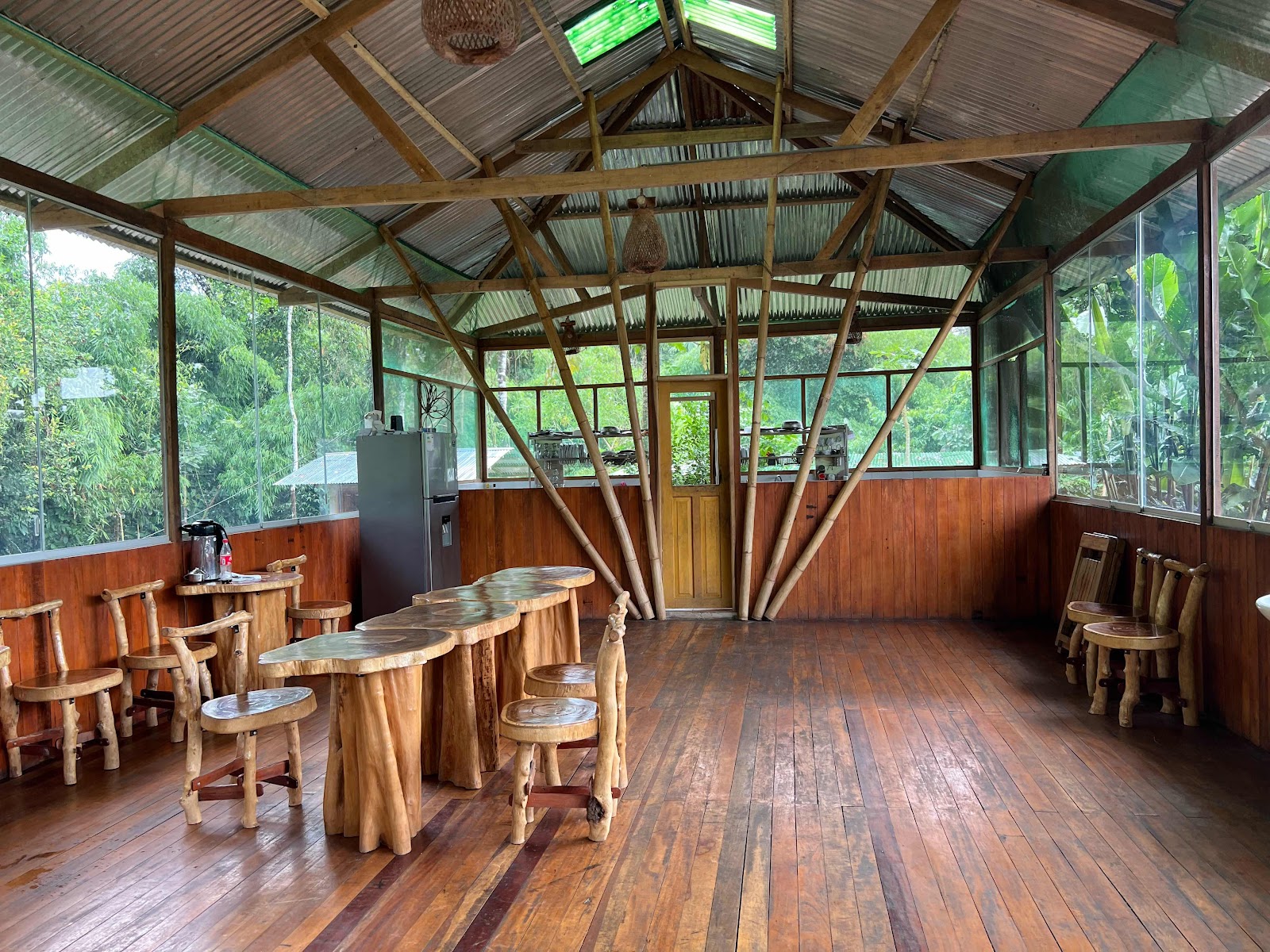
After about two hours of boating, far from where cars can travel, far from any civilization or even any other lodges, we arrived at the treehouse lodge. The dining hall or main lodge are right on the river, which was perfect because although we only arrived with a small backpack, our chef brought boxes and bags worth of food and serving utensils. It was more like how we’ve traveled in the minivan the past two summers. Our treehouse, one of three, is set off just into the forest up a steep set of stairs. It’s adorable. Two trees hold the house up and inside are two twin beds with mosquito netting, a toilet, sink and a hot shower (temperamental, but it does provide hot water). It’s not fully separated from the forest around (as Jess can attest to seeing as a mouse tried to share her pillow), but it protects us from most bugs and provides glorious shelter.


We spent a lot of our time wandering in the jungle. There were trails leading out from the treehouses, never wandering too terribly far, but rather in large circles. And oh, how thankful I was that Moses was assured of where he was going because deep in the forest, my good sense of direction was useless. Who knows, we could have walked in small circles the whole time. While the weather was very similar to home (I must admit that part of me was thankful to feel humidity and heat again), but deep in the forest the weather was fairly pleasant. Bugs were certainly present, but when we remembered to put on bug spray, they were not much of a problem.

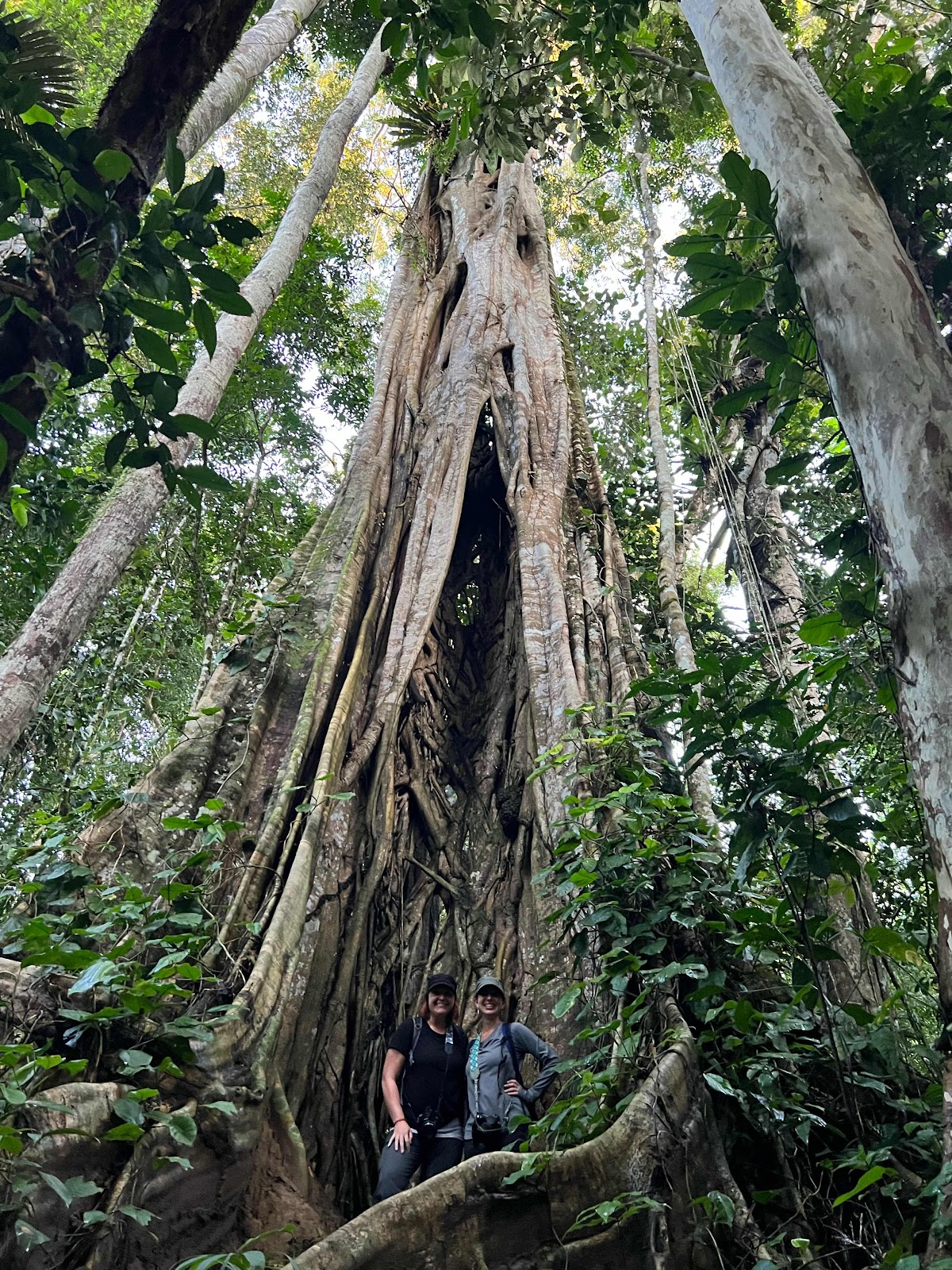


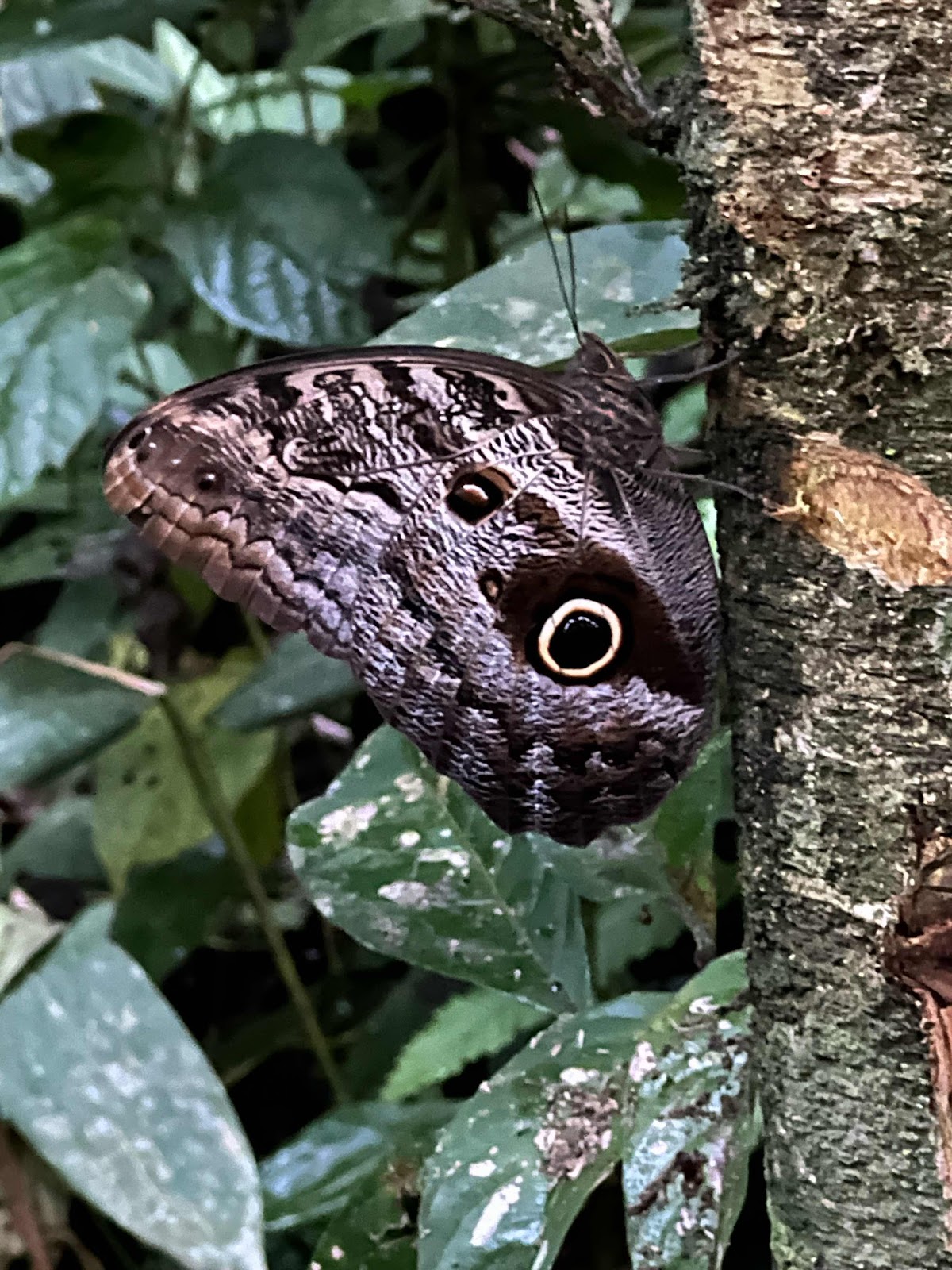
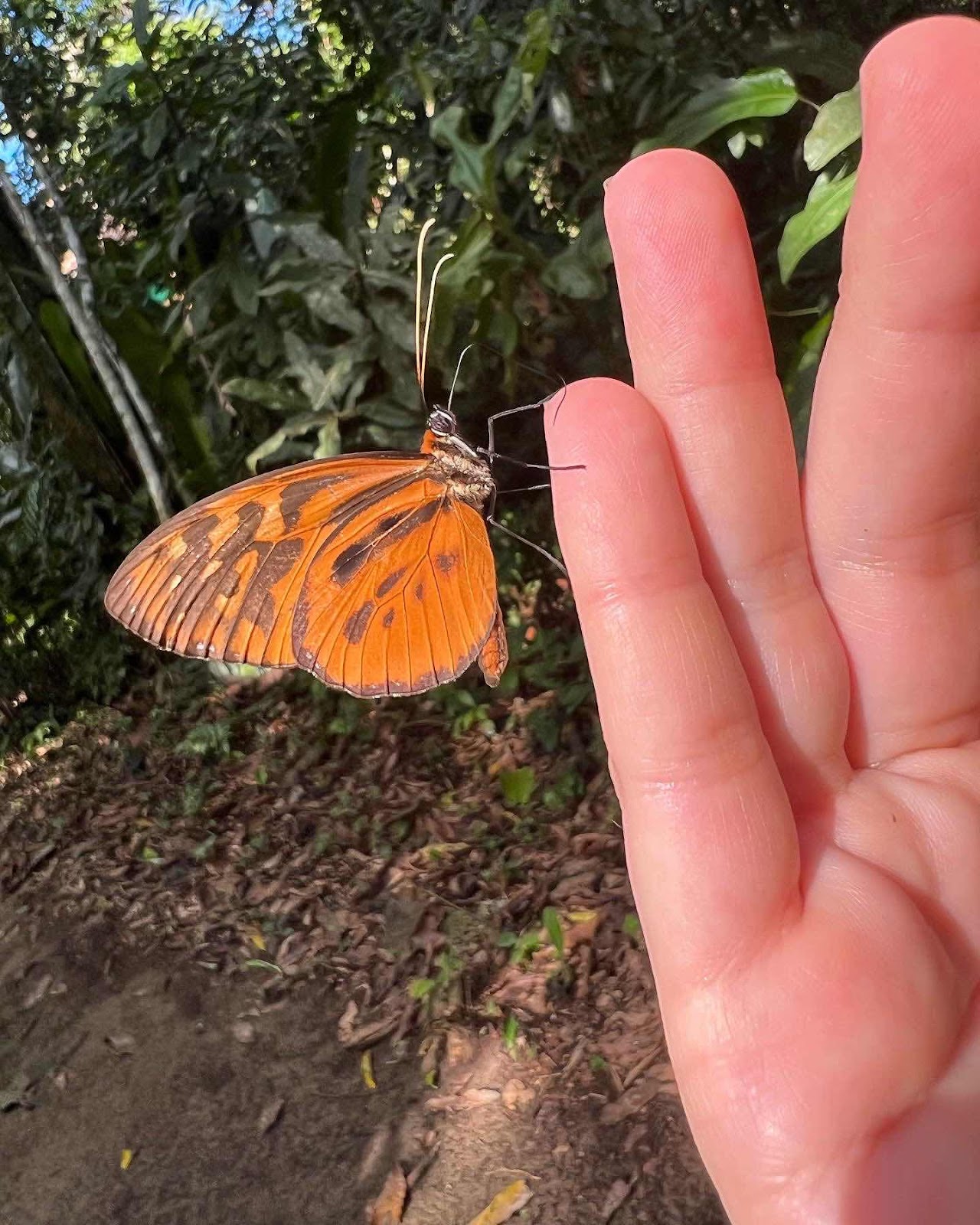
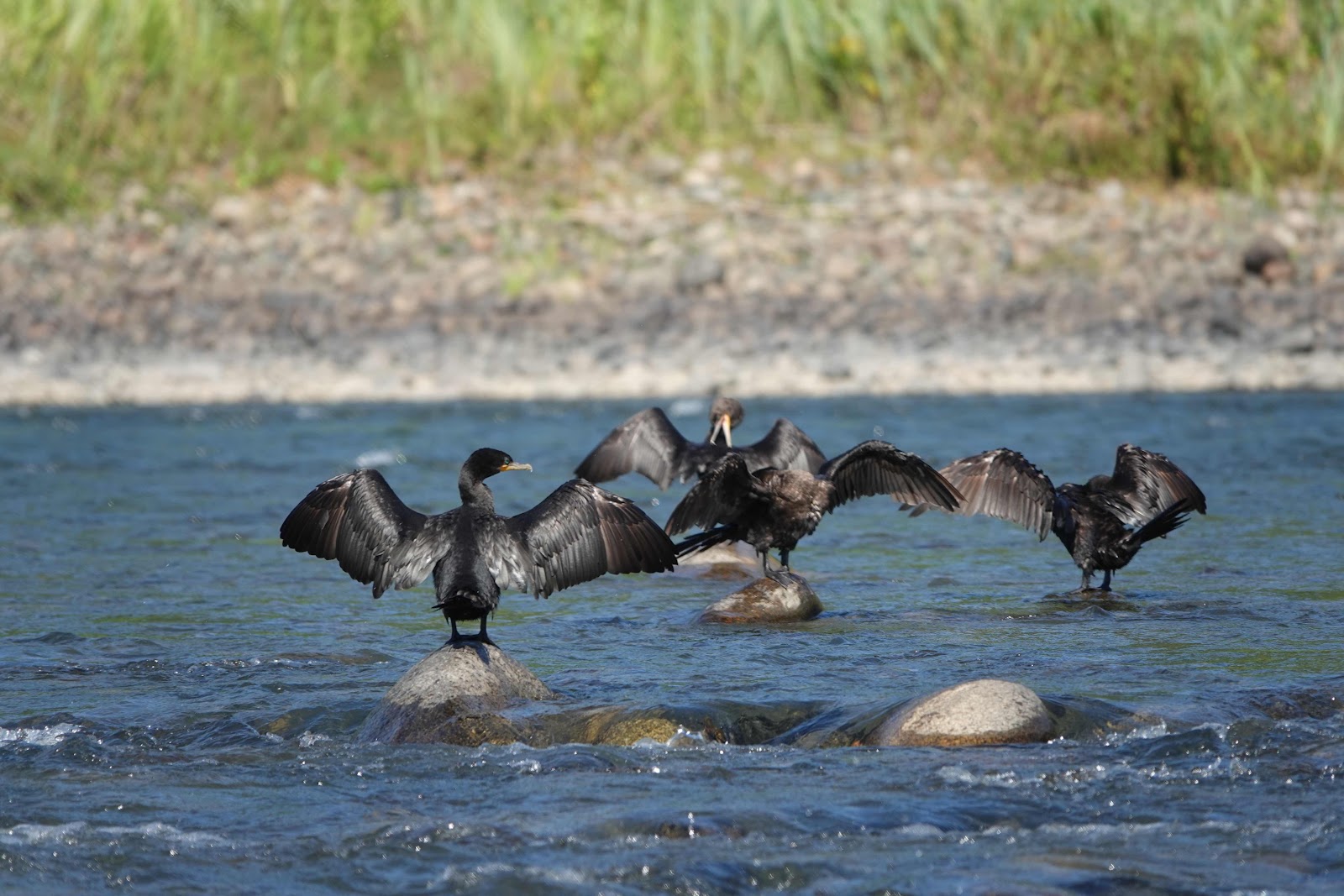
The trees and the thick canopy were incredible. After being around dry climates for the past month, the lush greenery was such a joy to be a part of. Unfortunately, we did not see a ton of animals as all who venture here dream of doing, but we were reminded that it was not a zoo, so seeing any in their natural environment was a treat! We learned to take Moses’ excitement with some hesitation as his excitement level was the same for frogs and squirrels as it was for monkeys. By the river, we spotted a couple of otters. There were lots of frogs of varying sizes and all sorts of insects. The ants and termites were both fascinating and terrifying. Colorful butterflies and moths with a wingspan of about nine inches were never far from us. 

This guy would probably cover FDR’s head on the dime, but not the entire dime.


This is an ant colony or ant “hill”.

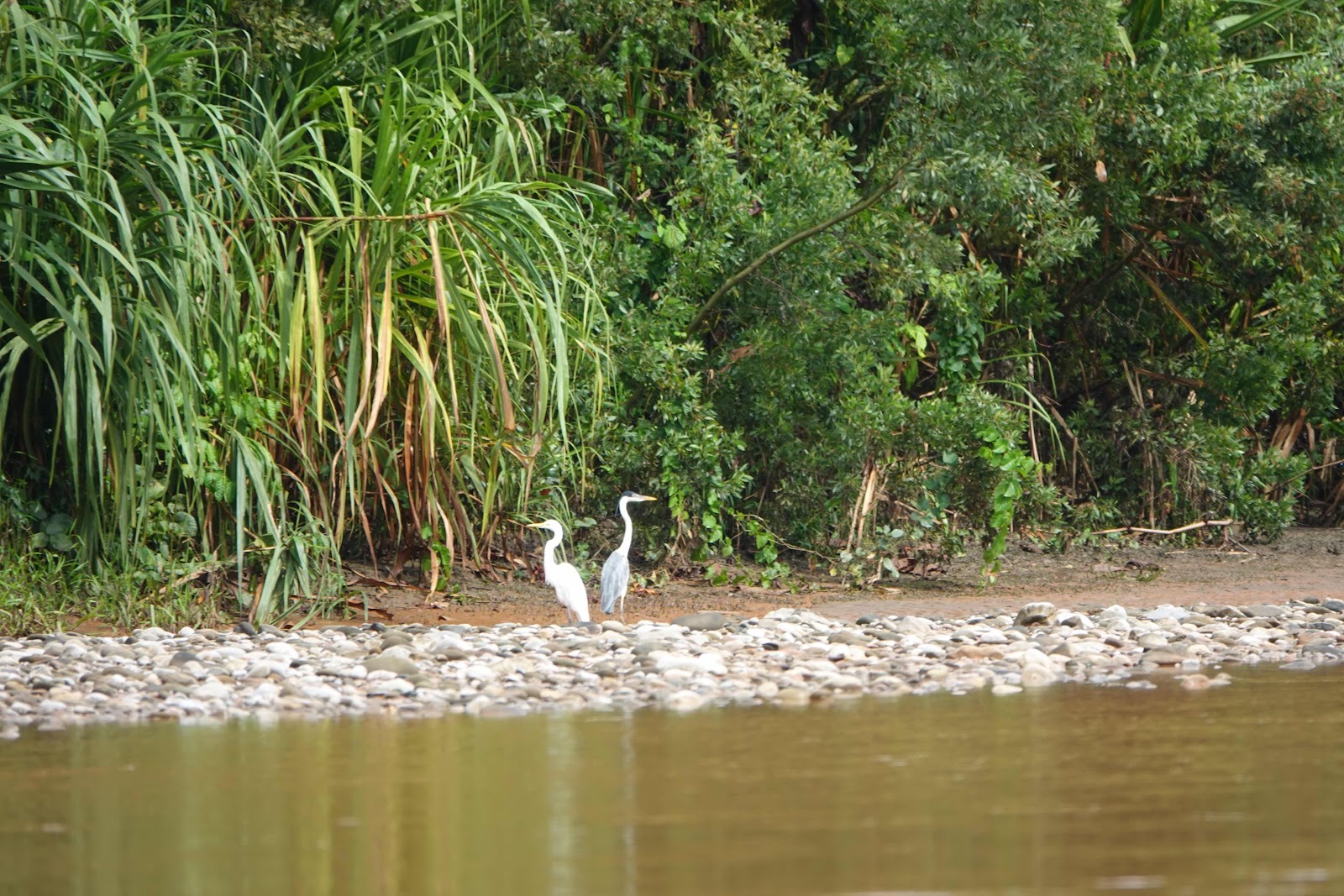
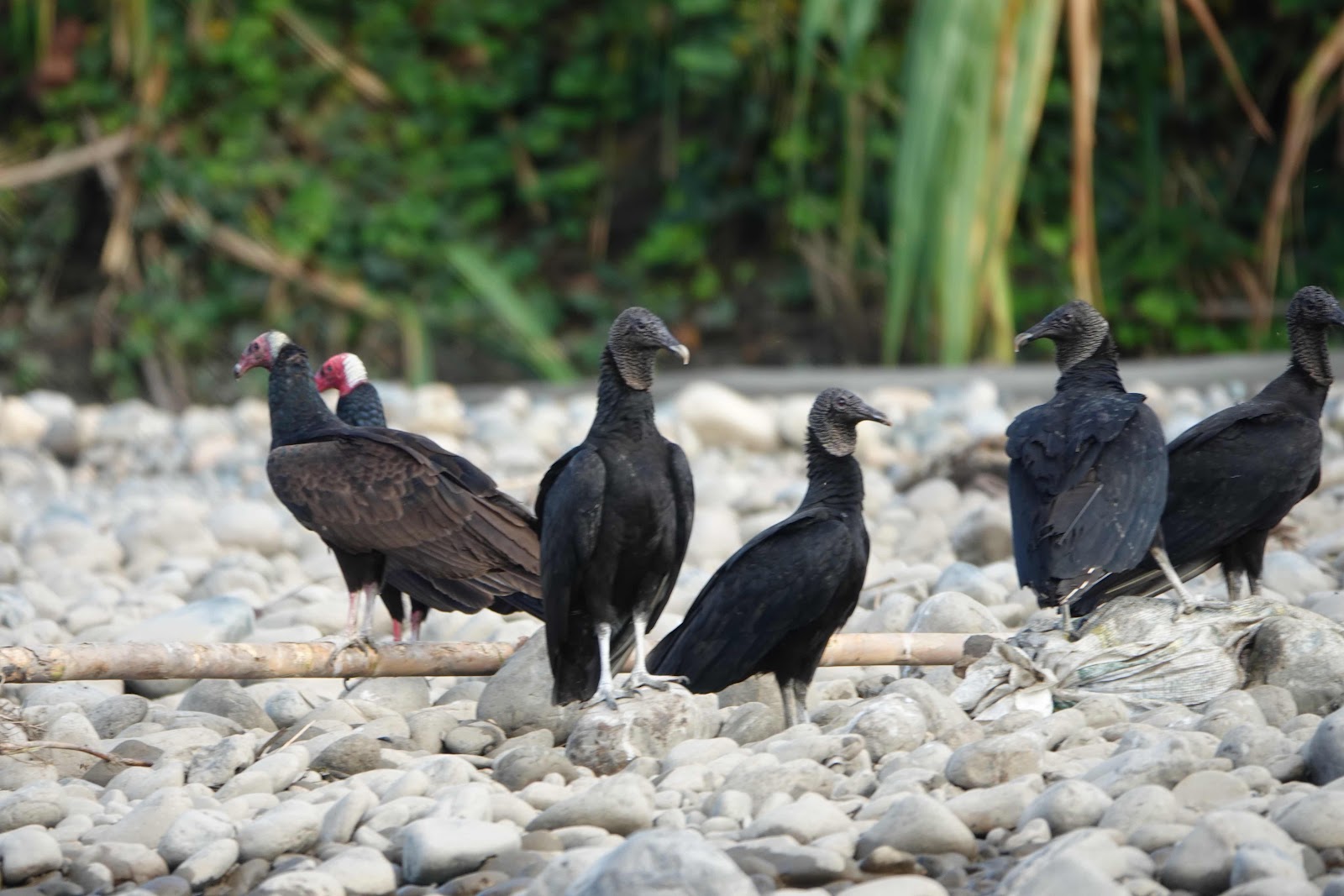
We saw lots of brightly colored birds and even learned one of their unique calls. There were toucans, parrots, macaws, kingfishers, hawks, swallows, herons, egrets, vultures and dozens more that I didn’t recognize. 


We only caught glimpses of small monkeys carefully climbing through the treetops, but we were often overwhelmed with their loud cries that sounded like they belonged on a much larger creature. On our night hike we spotted large spiders and a scorpion. Our ears were filled with the sounds of frogs and even oversized jungle rats (ROUSes anyone?). Thankfully, we only ever HEARD these. The small pond close by provided us with a small glimpse of a caiman, or at least our flashlights spotted his shiny eye that he winked at us. 

I spotted dozens of sloths! Well, actually, I spotted dozens of clumps of moss and dead leaves that very closely resembled sloths. And you know how in jungle movies there is usually a scene where someone thinks they are grabbing a vine, but it’s actually a snake? Well, we saw tons of vines that easily could have been snakes. I sort of wanted to see a boa or anaconda (from a safe distance), but part of me was glad our paths never crossed.

Both mornings, we woke up early to go to the clay licks. There is a cliff side along the river where, as the sun rises, parrots and macaws get minerals and nutrients from the muddy cliff. Although we were at least fifty yards across the river from them, and couldn’t see details, their bright colors and loud cries were a joy to see and experience.


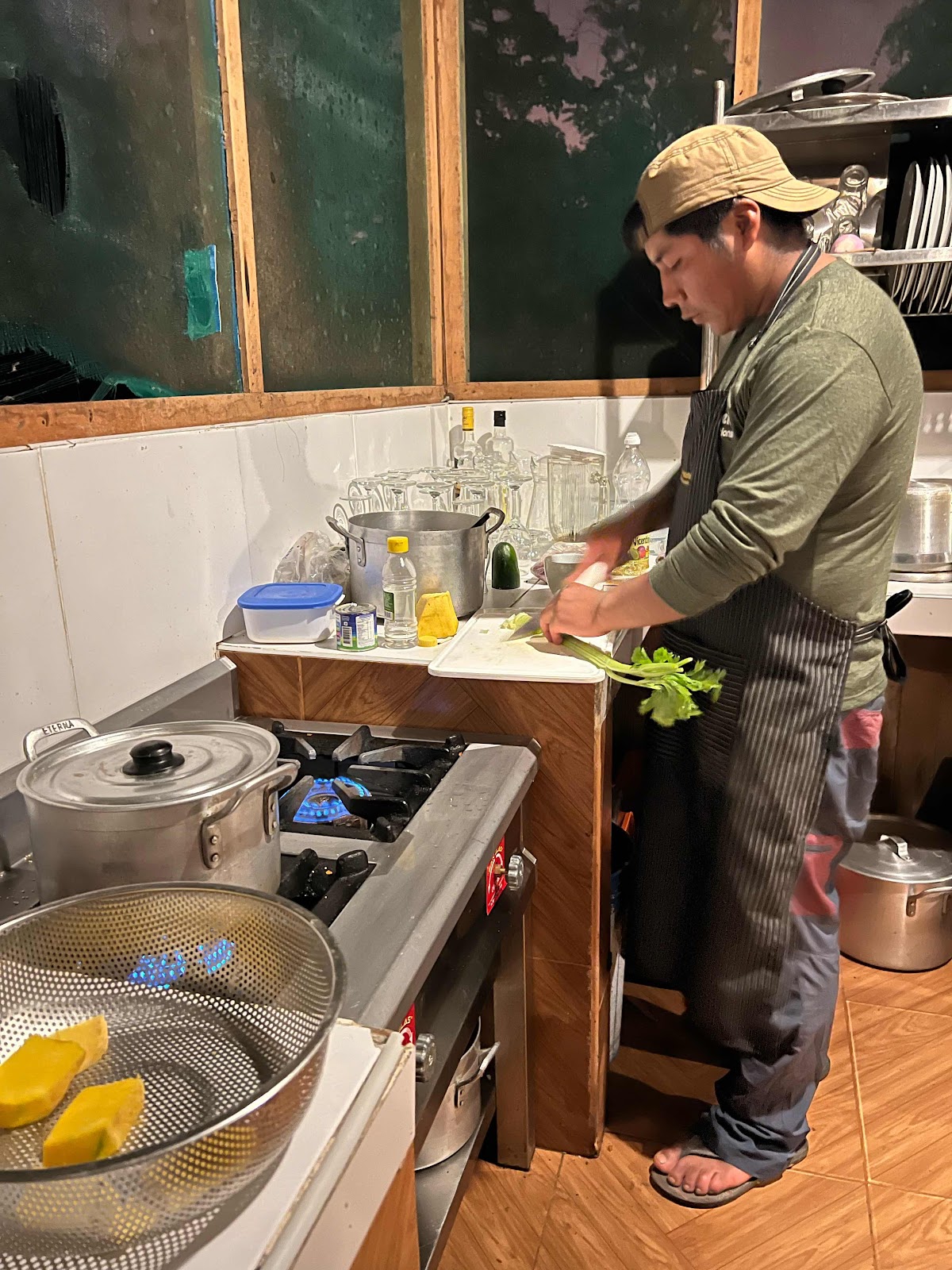
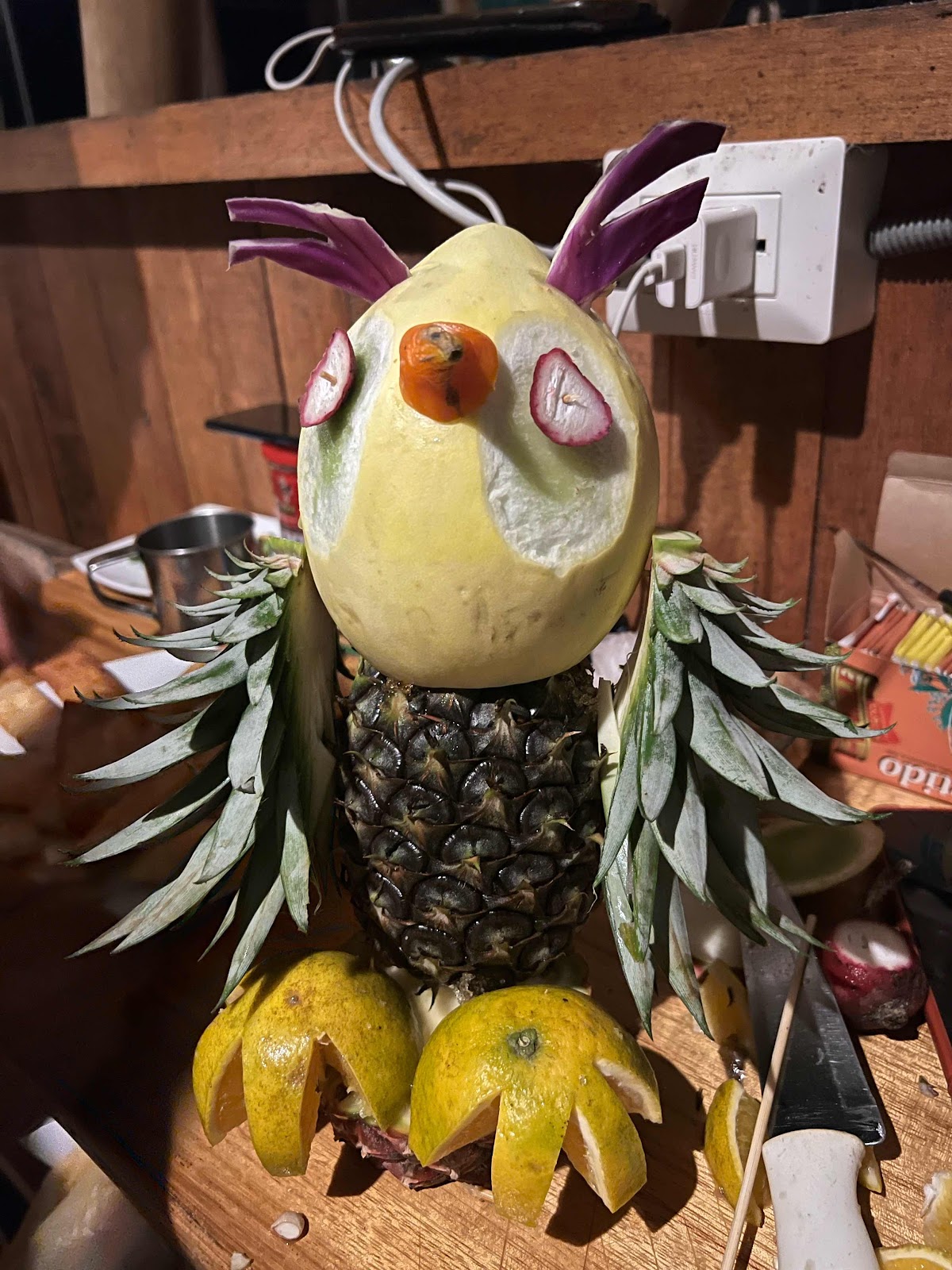
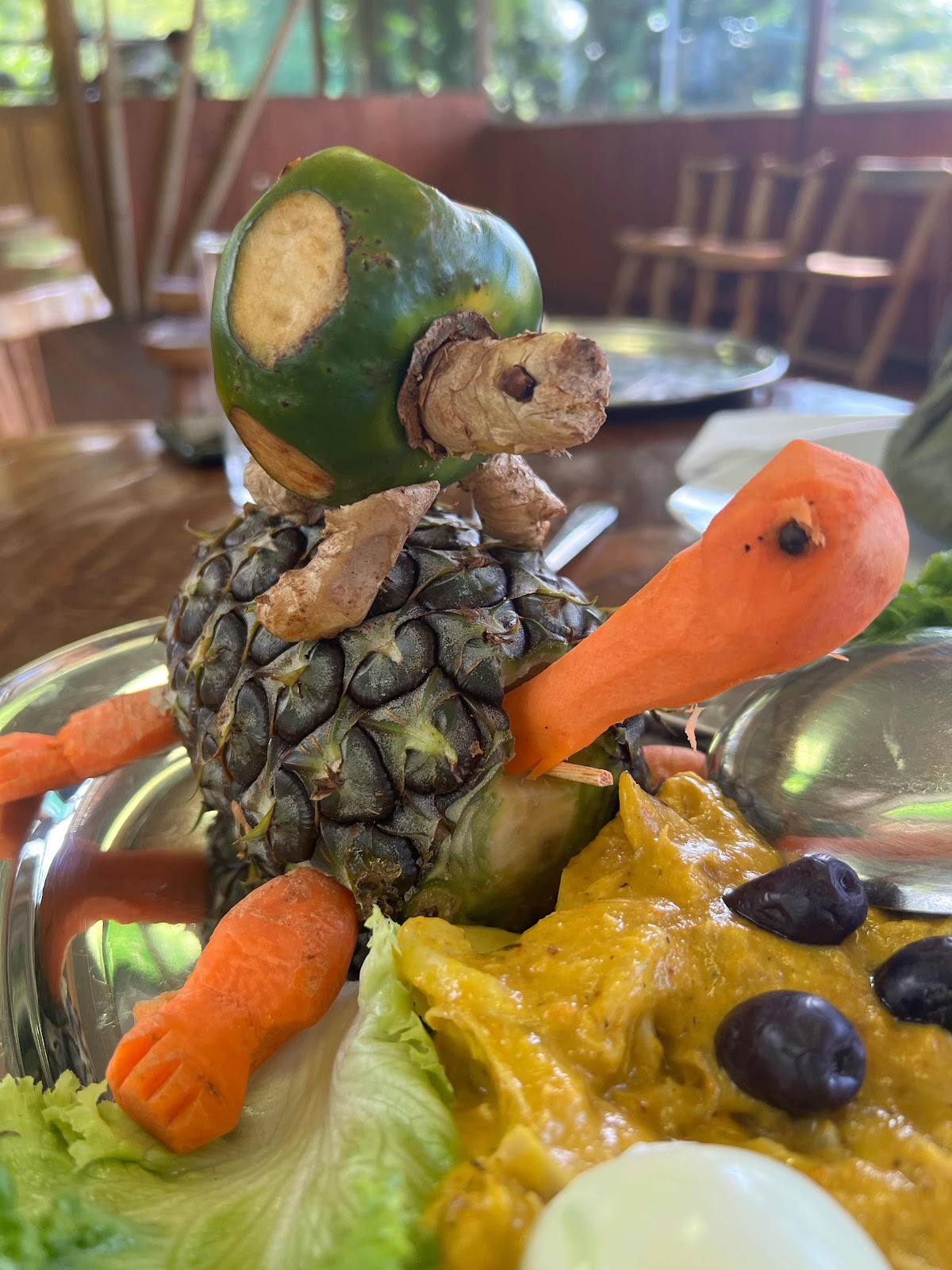
In the evenings, I asked Grimaldo, our chef, if I could watch him work. He was thrilled. I loved watching him work at lightening speed to prepare half a dozen dishes just for Moses, Jessica and I. We enjoyed trying to speak each other’s language or making small connections and understandings over the names of food. He cooked over two small eyes with gas we had brought with us, and spent a lot of time looking for items he needed in one of the many bags or boxes. Our first night there, another couple was staying at the treehouse as well. But they also had their own personal chef. The kitchen was also where all who worked there gathered in the evening, sometimes sneaking small treats, but also watching in fascination at the speedy knife skills. They helped to clean up and sometimes chipped in. I even got to snap some beans, scramble some eggs and separate large peas from their pod and outer skins. Grimaldo not only prepared an overwhelming amount of food three times a day, but he was also an artist. At every meal, he created a work of art (or two or three) from some fruit in no time at all. There were swans, turtles, humming birds, owls and he even, after hearing of Jess’s adventures, cackled when he made a small mouse.
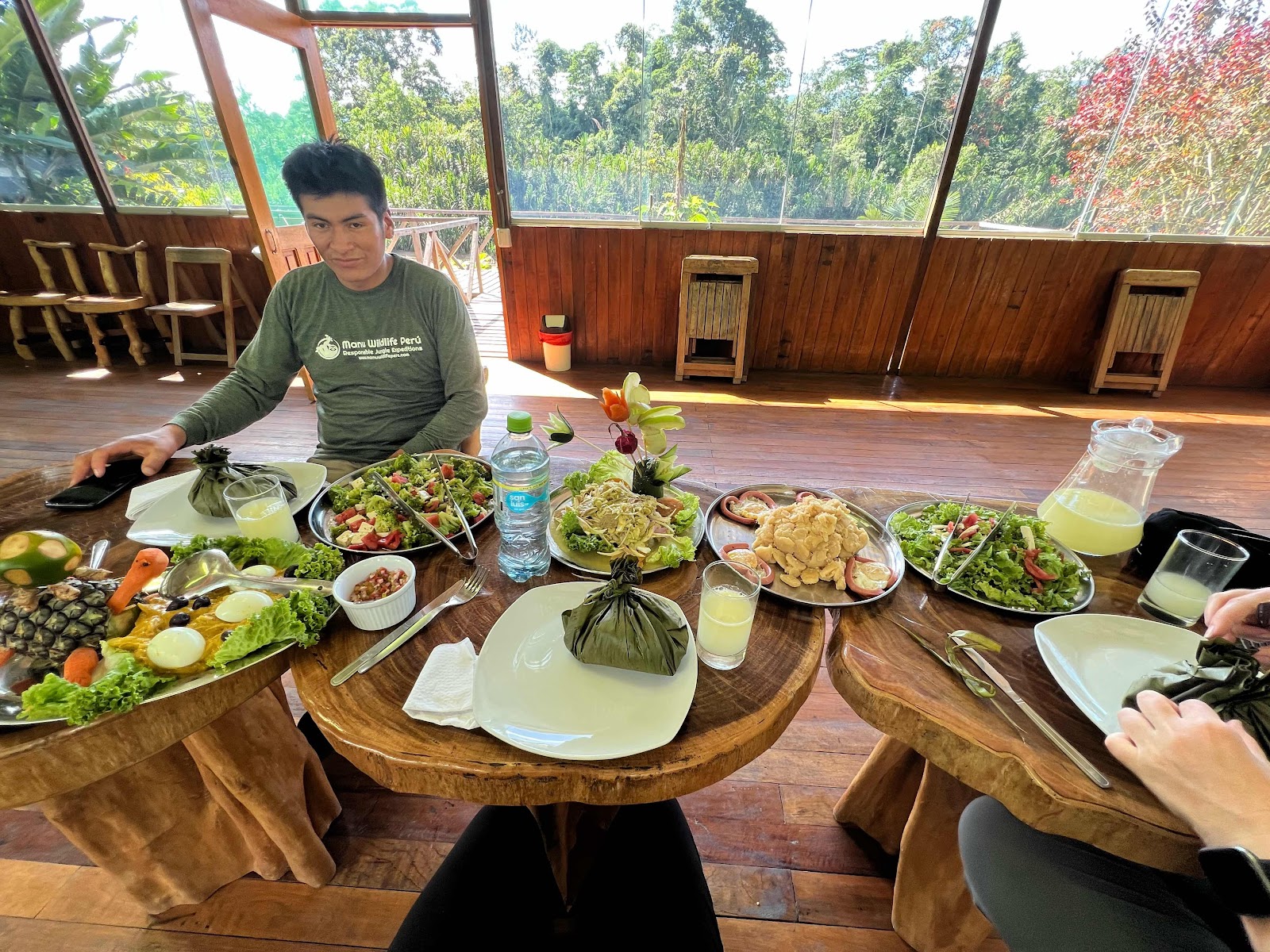
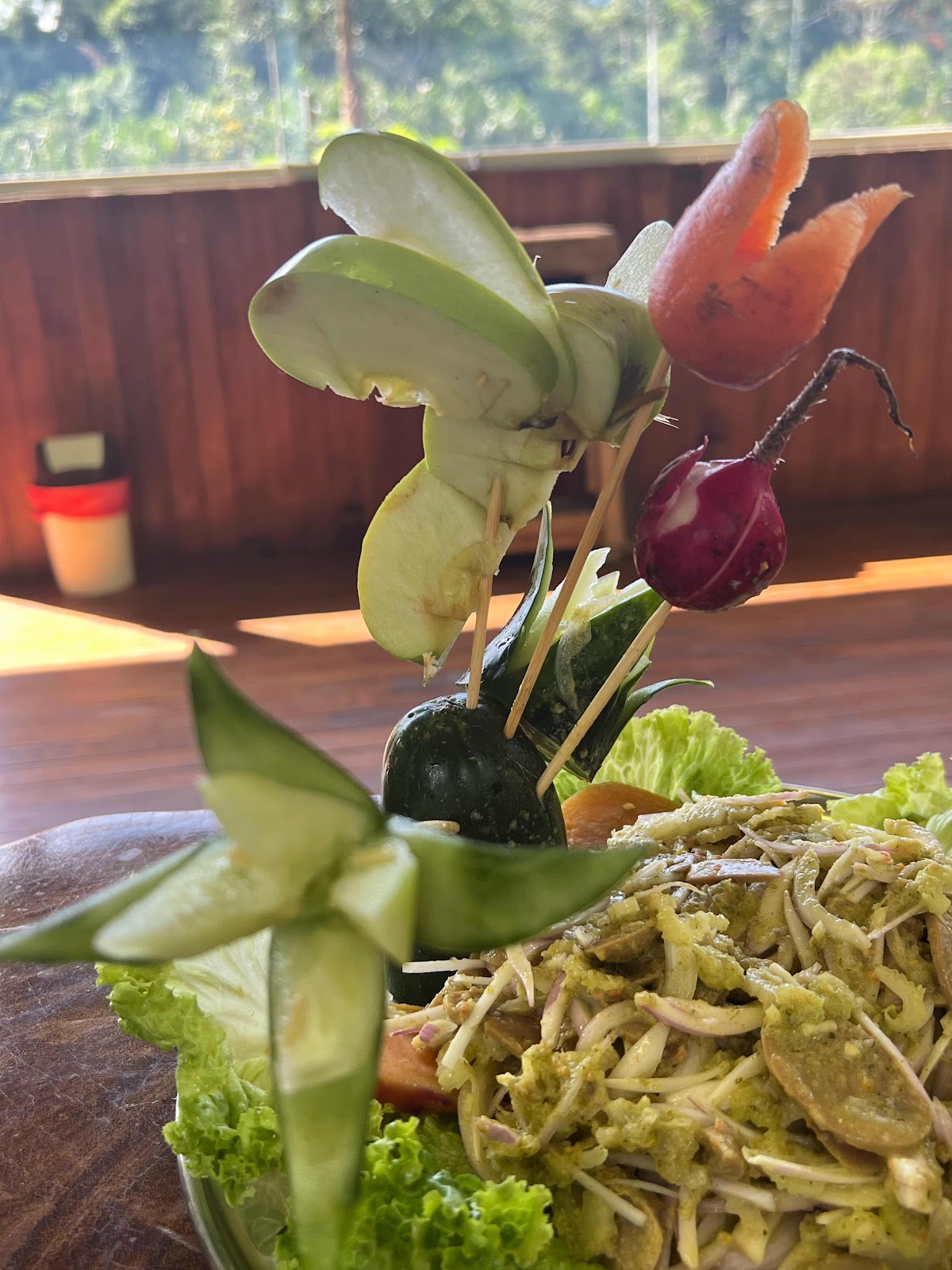


On the first afternoon, Moses asked if we wanted to swim in the river. As you can imagine, we were a little hesitant. Plus, after the rains, the river was mud red. But, on the second afternoon, after being reassured, we decided we’d give it a try. He said the alligators and piranhas were only in still water, and as the current was fairly swift, we felt comfortable. He said there were only some catfish, not to worry. The water was fairly clear and shallow, so we decided to try. (Side note, the next day he pointed out a large dead fish on the side of the river that was very similar to a sting ray. He said, oh, yeah, these are in the water, too.)

When we gave the word, it was like the whole staff jumped up. Five of the six people who were working there (the two of us being the only guests) ran out with bathing suits on and grabbed a tube. We jumped in the boat to go up river a bit, and at one shallow point, all the boys jumped out and practically carried us over, despite our assurances that we could walk. We stopped at a deep section of the river to swim and play for a while, and the water was truly refreshing, especially due to the heat, bug spray and sweat. The boys, for here I can call them nothing else, had so much fun and we seemed to take on our usual role of teacher/chaperone. They had contests for who could stand on their tube the longest, threw mud at each other and asked us to count as they challenged each other to stay under water for the longest amount of time.

We were about ready to tube down when a person showed up. I realize a person showing up is not an odd occurrence, but I can’t reiterate how far away we were from people. We had traveled at least an hour by water without seeing a home or a lodge anywhere. So, a person wandering up, while not frightening was surprising to say the least. Then, Moses said, “Do you want to go to his house and try a drink?” I know this will be shocking, but Jess and I said no. Without a moment’s pause, all the boys took off running about a quarter mile away, leaving Jess and I in the river, alone for about a half hour. They did return, but there was sometime in between where we felt we had been abandoned in the jungle. I must say that while each and every one of our guides has been kind, knowledgeable and returned us all in one piece, there has been a difference than in what we expect to get in the States. But then again, as Americans, we are spoiled rotten and probably have become accustomed to expecting too much. So, perhaps what we’ve experienced has just been a good reminder of that.

Anyway, after our adventures, we sat in the tube and the current quickly carried us away. There were some small rapids that felt a bit more like a log ride and there was the shallow spot where even the tubes got stuck on the rocks, but it was a thrill. A truly pleasant way to travel, and such fun memories of our time in the jungle.


After having a fun afternoon with the boys, I watched Grimaldo cook again. As always, what I watched him prepare was more than what Jess and I could ever hope to eat. I asked Moses if we could all eat together. There were some odd looks, as for whatever reason, this did not seem customary, but the eight of us did sit down to enjoy the meal together. Yes, eight. Jess and I were the only guests. The table was rather quiet, as there were not just two languages spoken here, but three. Many of the locals, those who live in small communities within the park speak the native tongue of Quechua. But the smiles, warm feelings and empty plates abounded. Should we have done this earlier on our trip? Had I not asked the right questions earlier? (We had asked Grimaldo to join us each time and our chauffeur when he was with us even though there were always just three place settings for Jess, Moses and myself.) I don’t know, but should you ever be in a similar situation, push for the inclusion and camaraderie. 

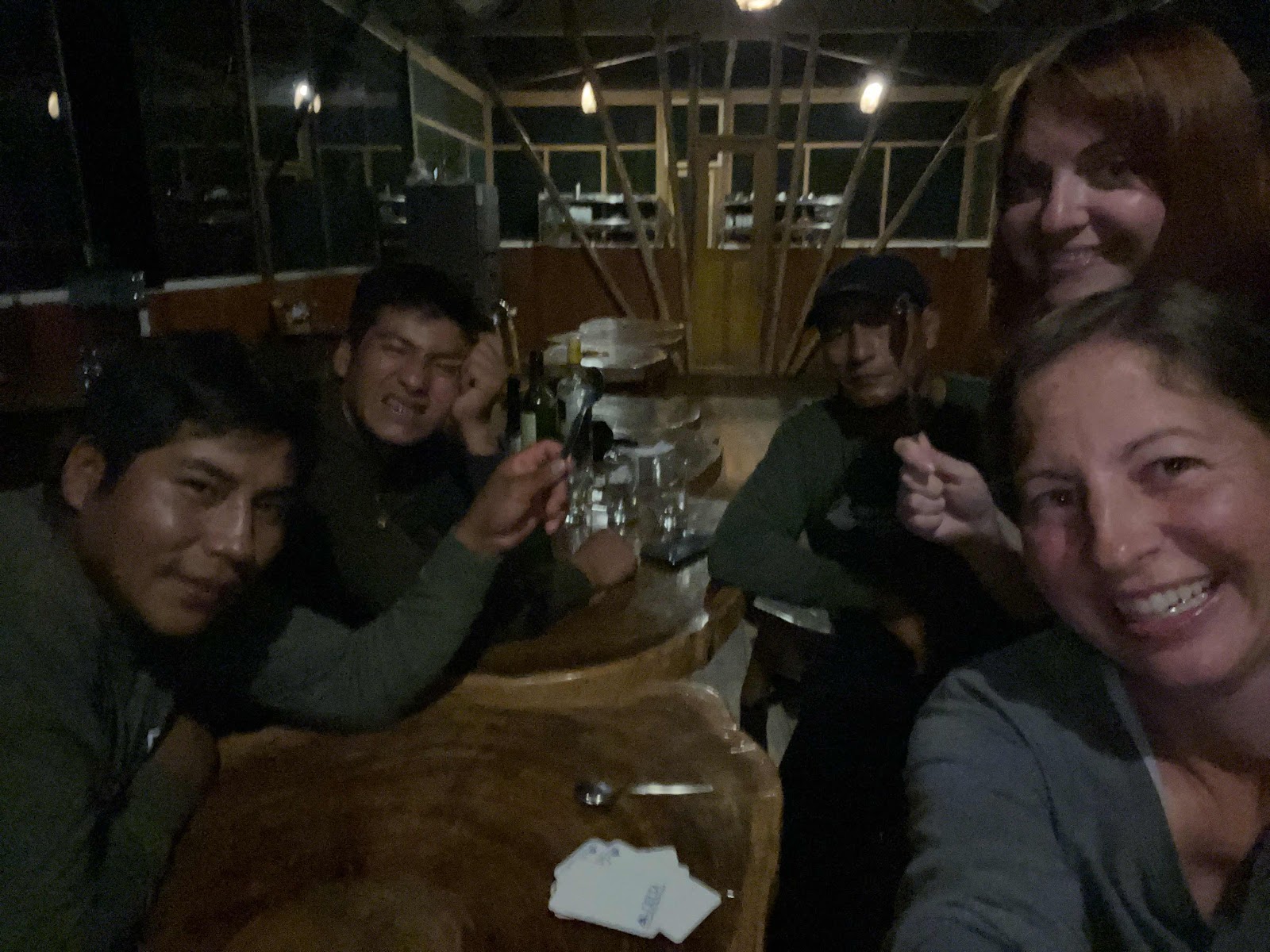
After dinner, Moses, Grimaldo, one of the Treehouse hosts, Jess and I opened a bottle of wine and we taught them a game that goes well beyond language barriers. Spoons takes so little thought and even so little explanation, that we were all quickly laughing. It took a minute for them to get the high pace of the game, but once they did, they didn’t hold back. Somehow, Grimaldo always ended up with a handful of cards, and Moses often had four of a kind, but rarely a spoon. But we could all enjoy the hilarity of the simple game.

After watching the parrots feed on the clay licks the next morning, we boarded our small boat down river to meet up with the larger boat that would take us up the next river. The stickman was vital as we traveled up shallow waters. Then, we were back in the van for much of the day on the curvy, bumpy, one way roads.


I’m not sure what to do now without a crowd of people taking care of me and preparing my meals for me. I guess I’ll have to try my hand at a lottery ticket when I get home. For now, though, I’m full of happy memories of our time in the Treehouse in Manu!

Wednesday, July 6, 2022

SkyLodge

I follow a lot of travel sites on Instagram. It is always fun to see incredible, unique, stunning places around the world. Typically, I look at them with wonder, then move on. A couple of months ago, Jess found one and sent it to me. I had the same reaction and then looked closer. Wait, where is that one? When you realize that one of those out-of-this-world opportunities is actually in the realm of possibilities of your travels, you jump at it. Well, when it involves heights, first, you give your trustworthy travel partner who loves adventure and cool opportunities but has a fear of heights the opportunity to think about it. Then when she says yes, you jump at it!

We were picked up by minibus on the afternoon of July 4th and driven back into the Sacred Valley. The scenery is truly awe-inspiring with mountain peaks surrounding valleys of patchwork quilt farm land with sheep, cows and llamas. The valley itself, with the river running through it is quite green, but the surrounding countryside, during this dry season is more tones of yellow and brown.

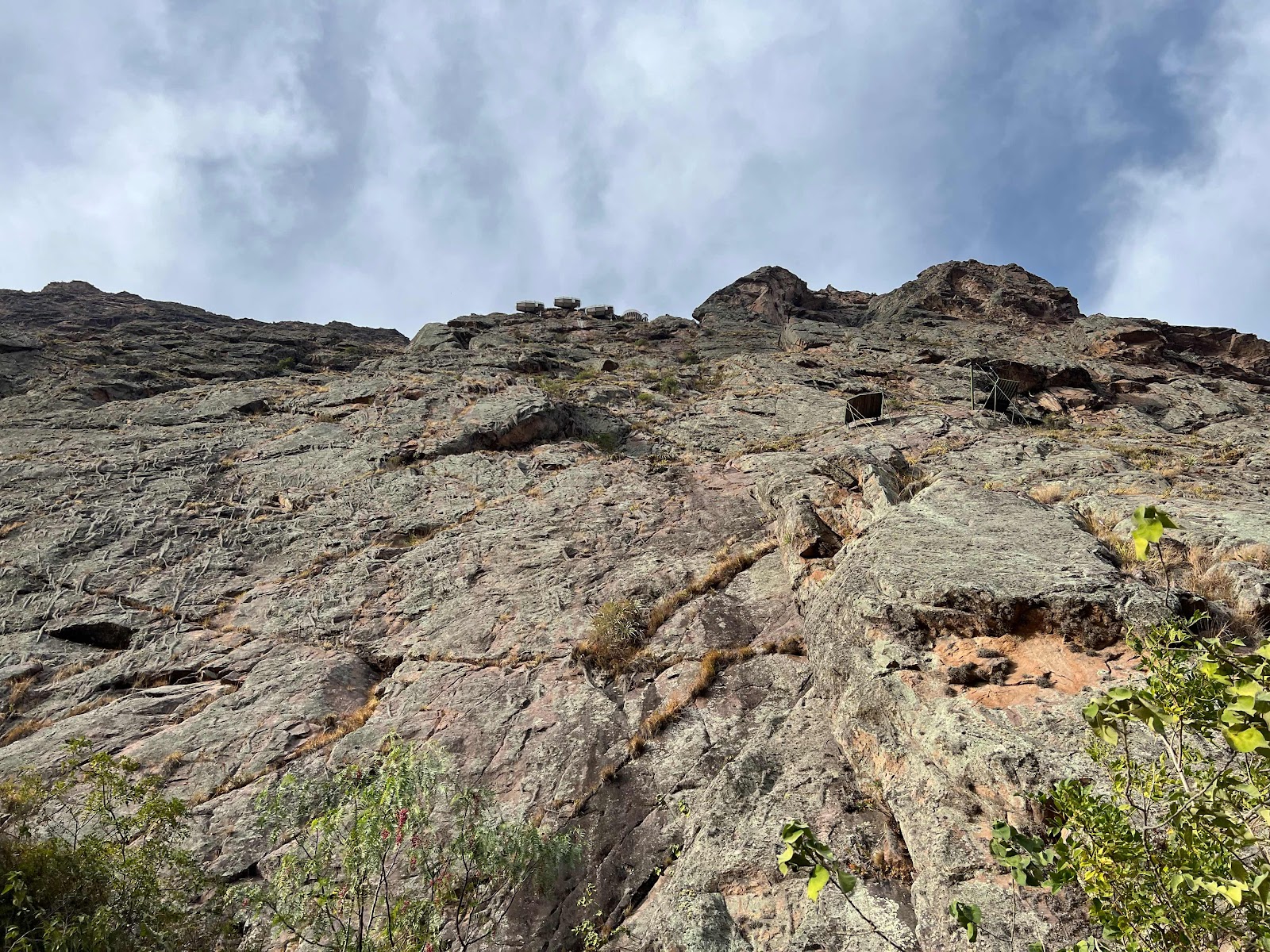
We stopped on the side of the road at a small office next to the sheer side of a mountain. If you craned your neck back far enough, you could get a sneak peak of our accommodations for the night. 


Yep, look closely. See those capsules? That’s where we climbed to and where we slept for the night. They hang 1,000 feet from the valley floor as a true feat of engineering and ingenuity.

How does one get to the pod? Well, there are a couple of different options. You can hike up or you can climb up. Are we mountain climbers? Absolutely not. Did we choose that option? Absolutely!


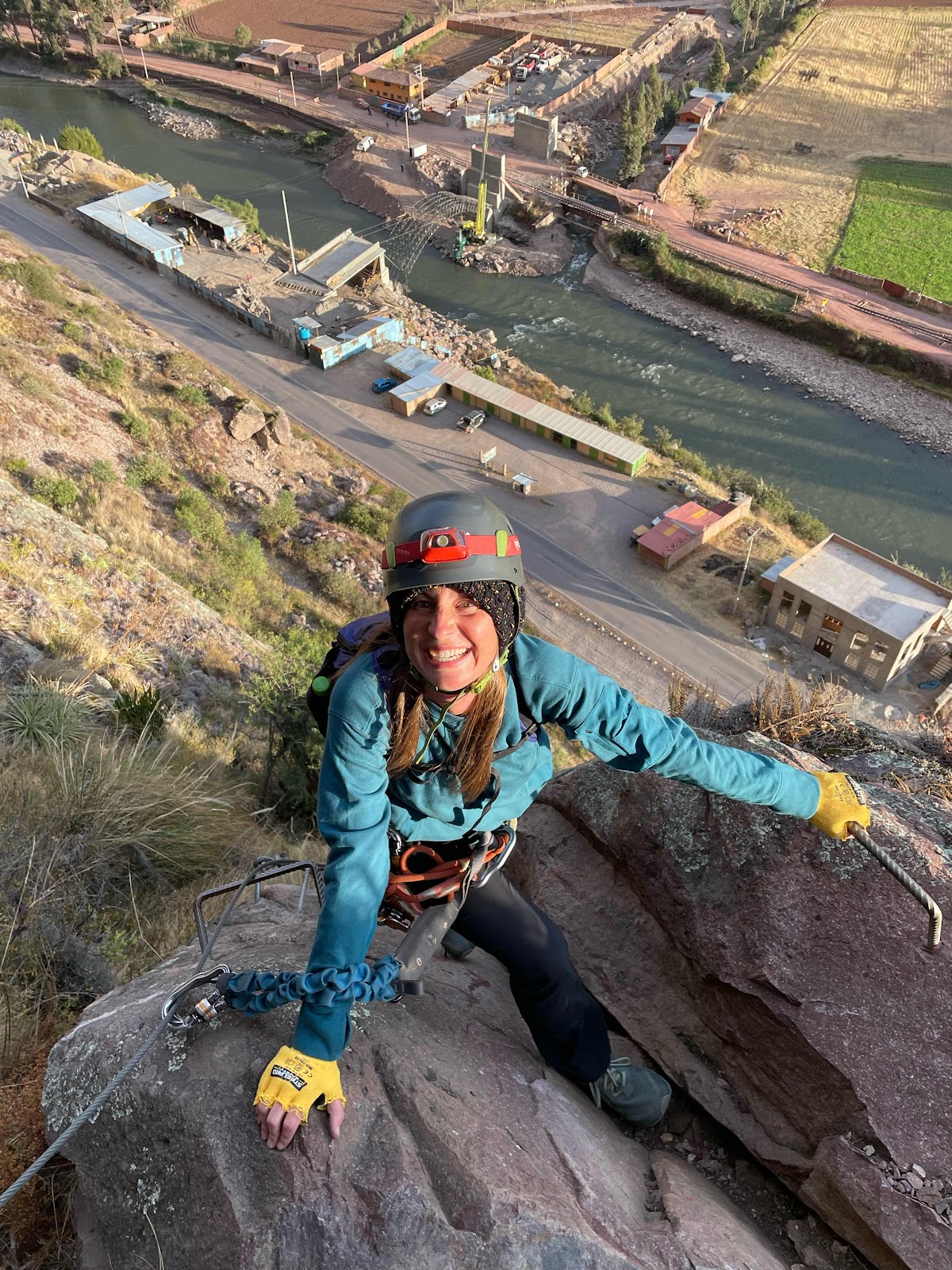
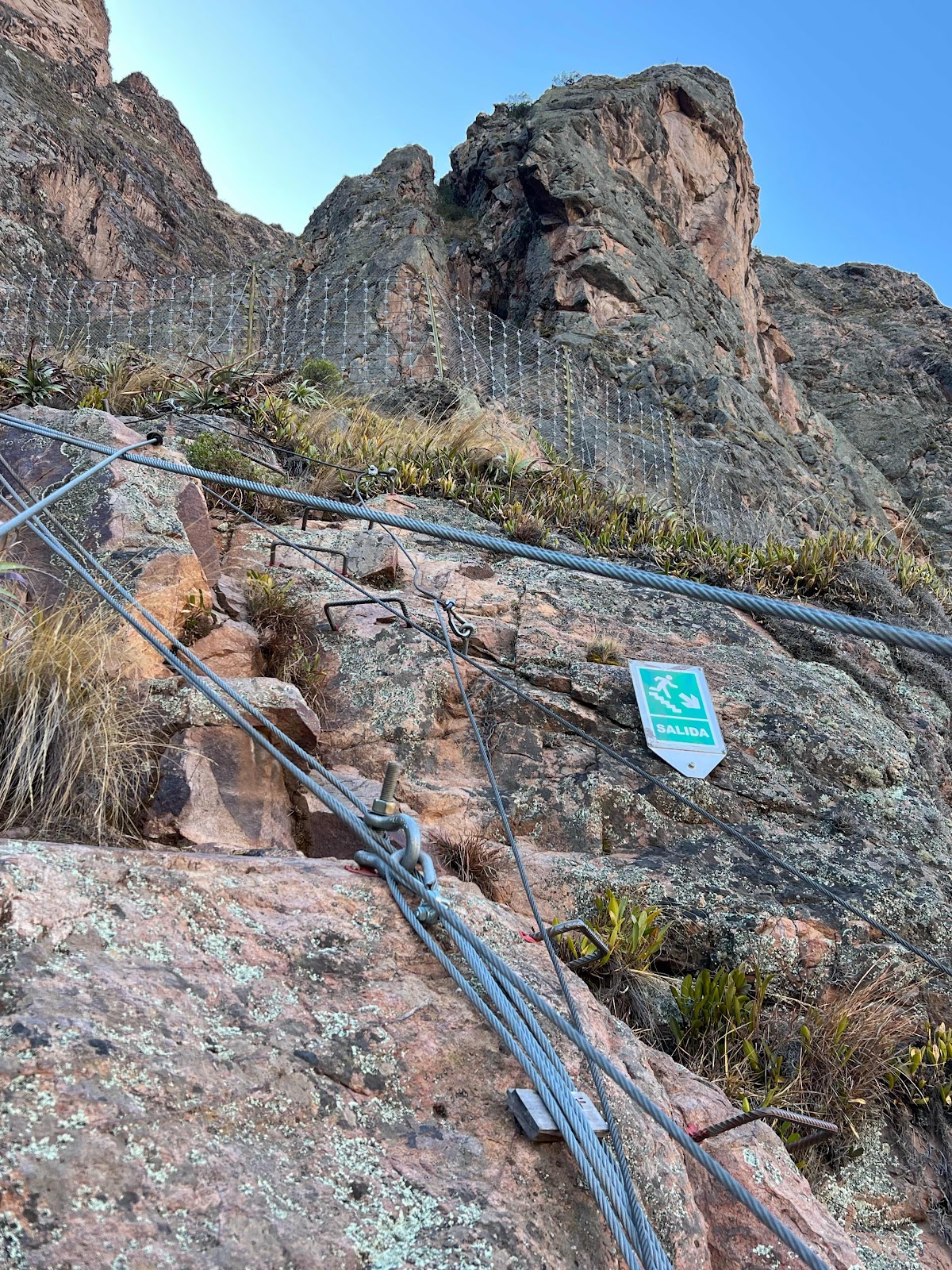
After a brief safety talk and harness and helmet fitting, we were off! Most of the climb was sort of like climbing a ladder that was built into the face of the mountain side. The C-shaped metal rods were drilled and secured into the mountain face and provided places for your hands and feet to climb upward. You were clipped into an accompanying metal cable so if you missed a step (which thankfully neither of us did!), you didn’t fall too far. Every six feet or so, you would change your clips to a new section so that you never had too far to fall.

Some parts were incredibly tricky, because of course a rock face isn’t perfectly flat. So, sometimes, it felt more like straddling a boulder looking for rungs on either side. Or there were the times that the rock hung outward a bit and so you were climbing at a bit of an upside down angle and well, that was quite a struggle. Our knees are currently black and blue from hitting the rungs as we ascended, but it was a small price to pay!


At one point, halfway up, there was a “bridge” to cross. I confess that I felt at an advantage here. Growing up in the country with lots of space to play, I was very fortunate that my parents took time to build me a playground. There were two swings, bars, a balance beam, seesaw and a treehouse. Do you know what gets played with the most, even to this day? It is the two ropes tied to trees across a ditch. On this “river over death” you put your feet on the bottom rope and hold on to the higher rope. This bridge halfway up our journey was incredibly similar! Although, it was five hundred feet up a rock cliff, and I was strapped in for safety. But, it was a lovely feeling of home all the same. 

A bus load of people stopped on the road below us and cheered us on from afar. I asked our guides if they paid people to do that. They just grinned. 

Our climb continued upward for a total of about an hour and a half. As we neared our destination, the clouds at the end of the valley began to brighten into pinks and oranges. We arrived into the dining pod just as the sky lit up and the sun bid us farewell behind the distant peaks.


Our two guides doubled as chefs and prepared us a beautiful, four course meal of pumpkin soup, salad, chicken with mashed potatoes and vegetables, and an apple dessert with melted chocolate and cookie crumble. The more amazing part to me was exactly how they got all of this up there. It was either carried in backpacks earlier in the day or in their backpacks as they hiked with us. Incredible! We toasted to our Independence Day with our five fellow companions, also Americans and decided this was the perfect way to celebrate our freedom.

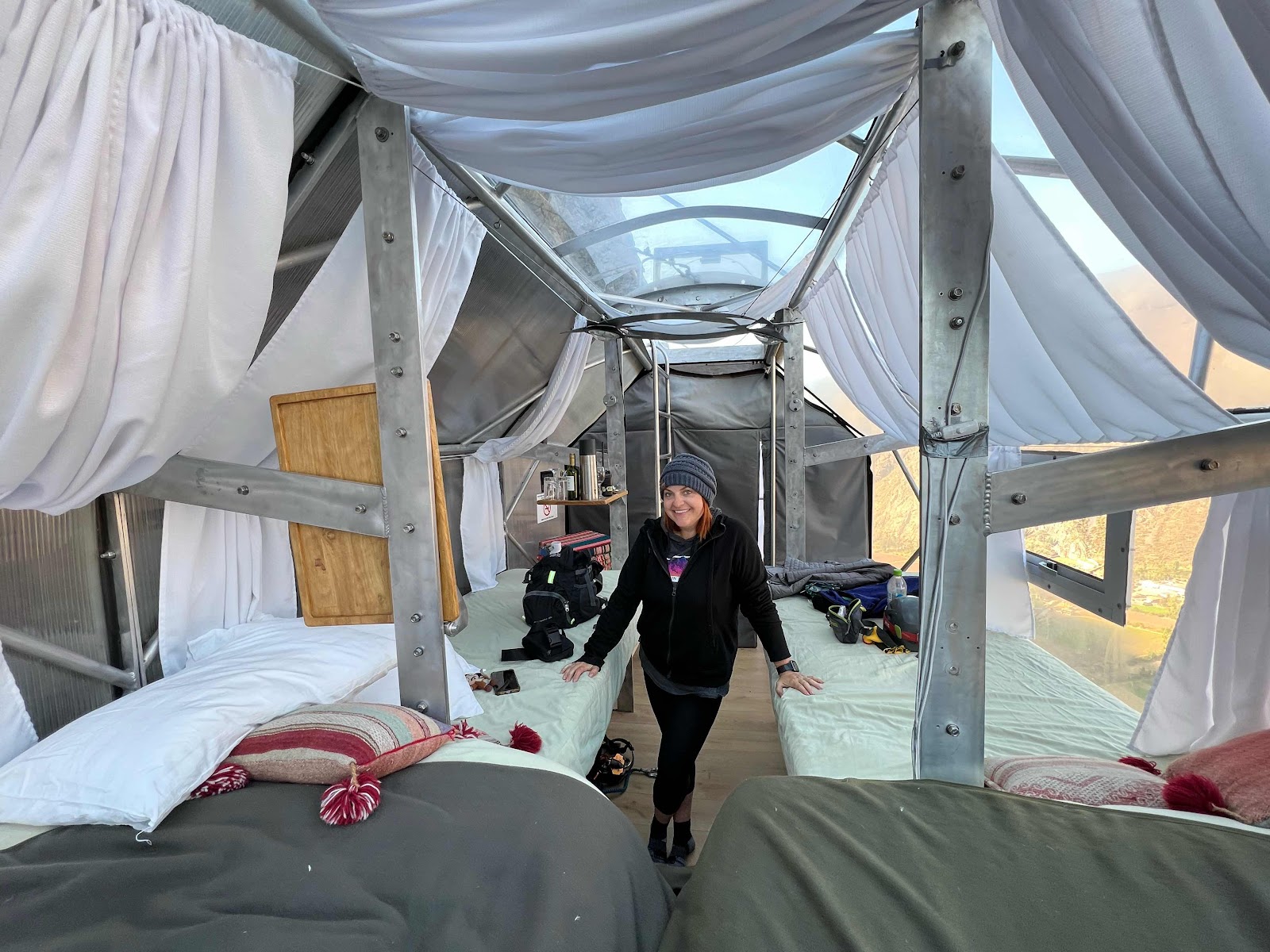
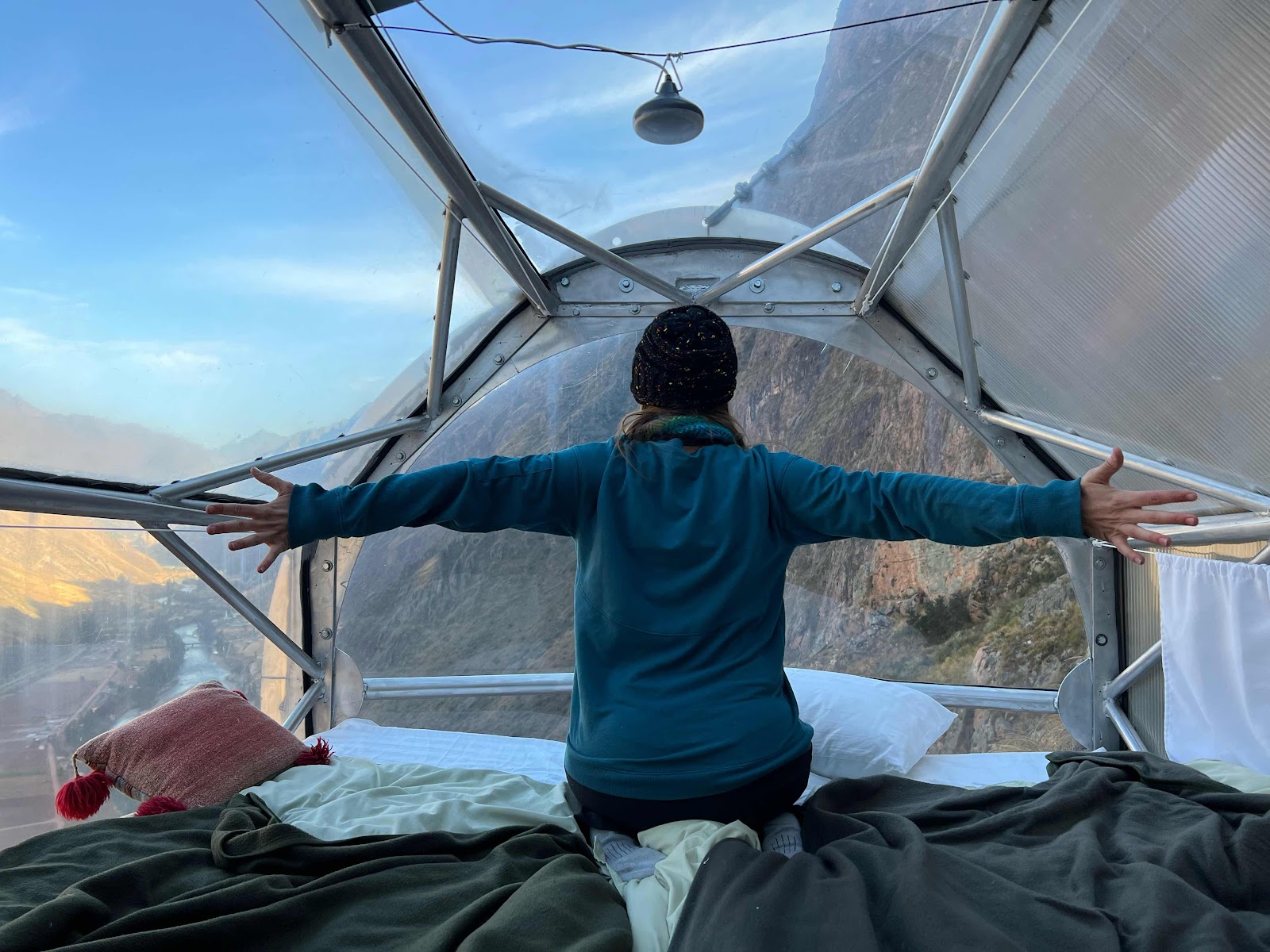
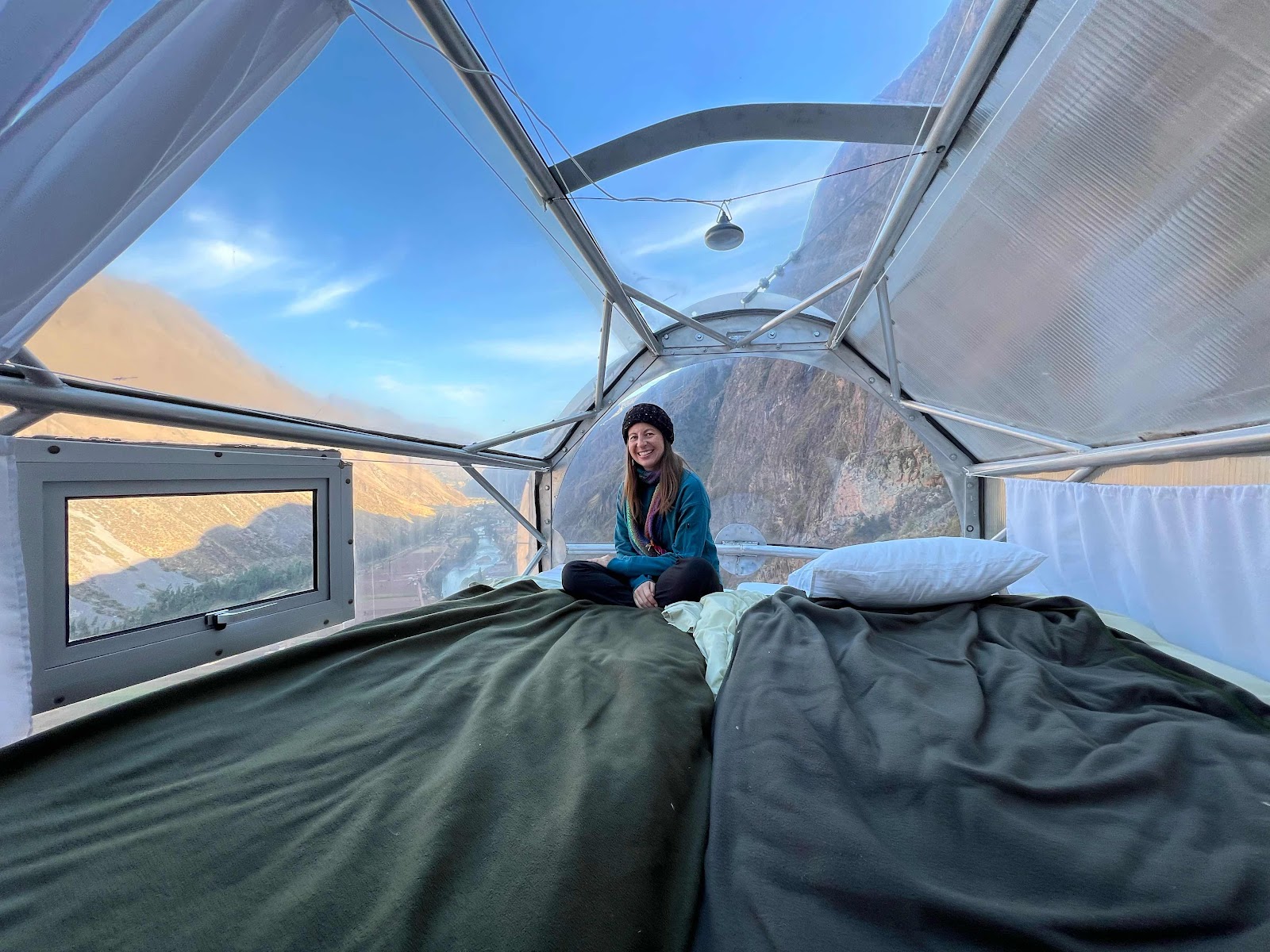
After dark, it was pitch black outside and we needed to make it to our pod. With headlamps on and guidance, we bid our climbing companions goodnight and each headed to our own capsules for the night. It was a bit of a struggle to get there without the sun’s help, but it wasn’t terribly far. Our pod actually had four beds in it and even came with a thermos for tea, wine glasses to finish our bottle from dinner, dominos and a deck of cards. All parts of the pod had curtains which we quickly opened to the sky and out into the valley.


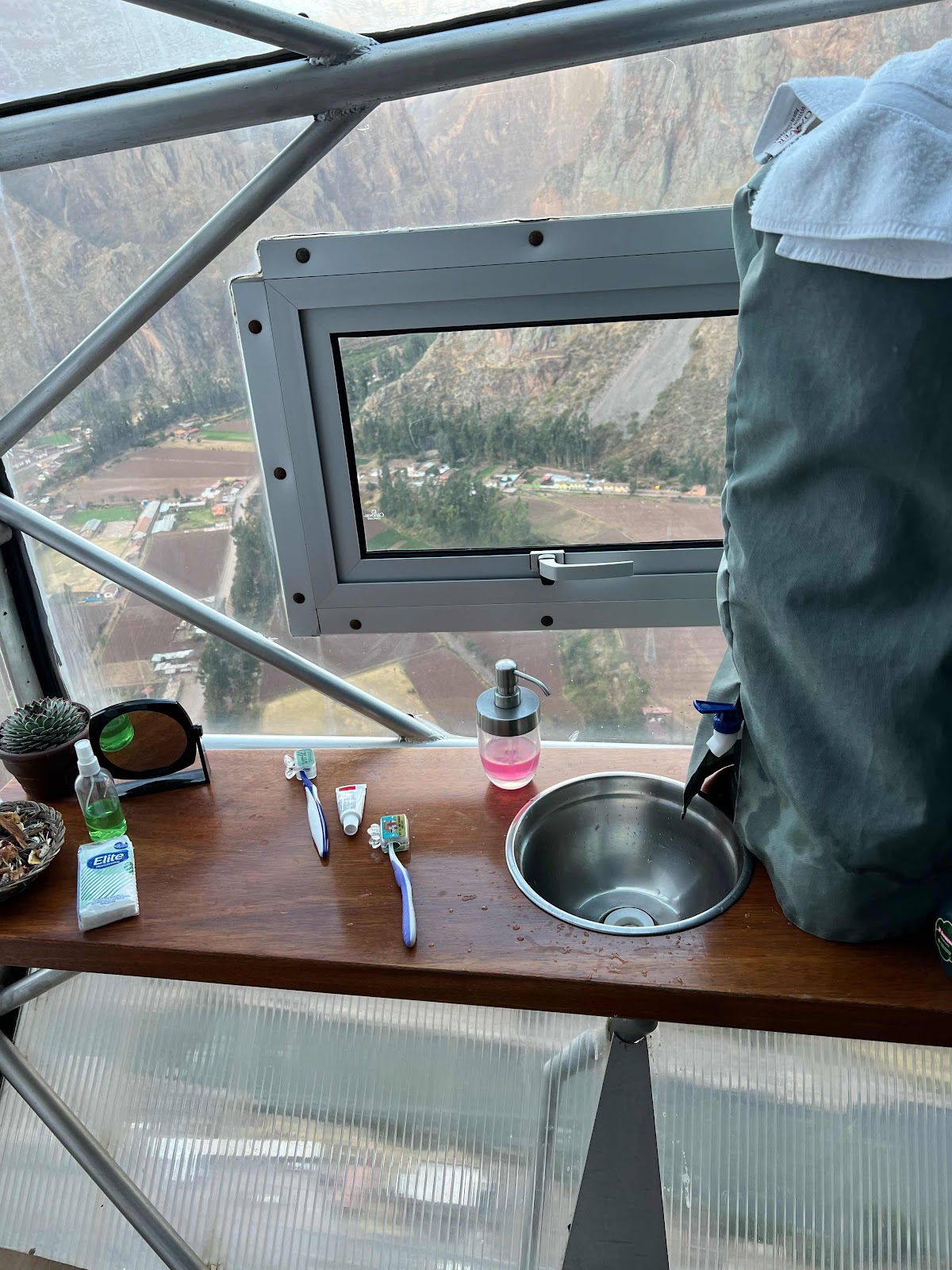
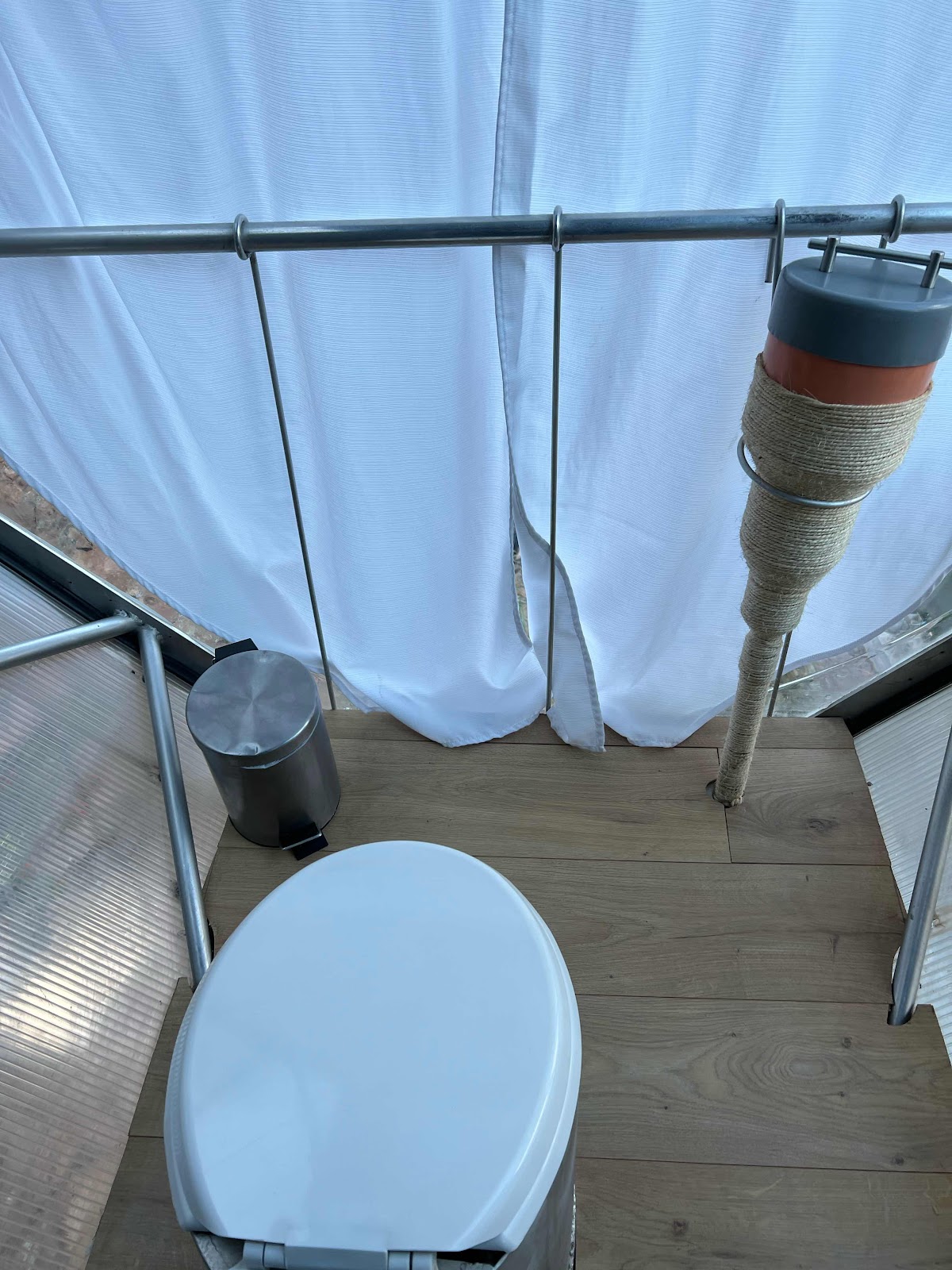
I know what you all want to know about, so I’ll share. What about the bathroom? There is a bathroom! And after some of the questionable places we’ve relieved ourselves along this journey, I must say, this was one was quite nice! A small sink was adjacent to a jug of filtered water, so for the first time on this trip, I was able to brush my teeth with the “sink water”. The toilet had a pot in it. We girls sat on the pot and then dumped it into the sort of urinal in the bathroom, then sprayed everything with disinfectant. For more solid bathroom issues, there were plastic bags that you lined the toilet with, then tied them up and dropped them down the hole in the toilet. Where did these two things go? I don’t really know. It certainly was not all the way down the mountain. There must be some sort of reciprocal just under each pod.


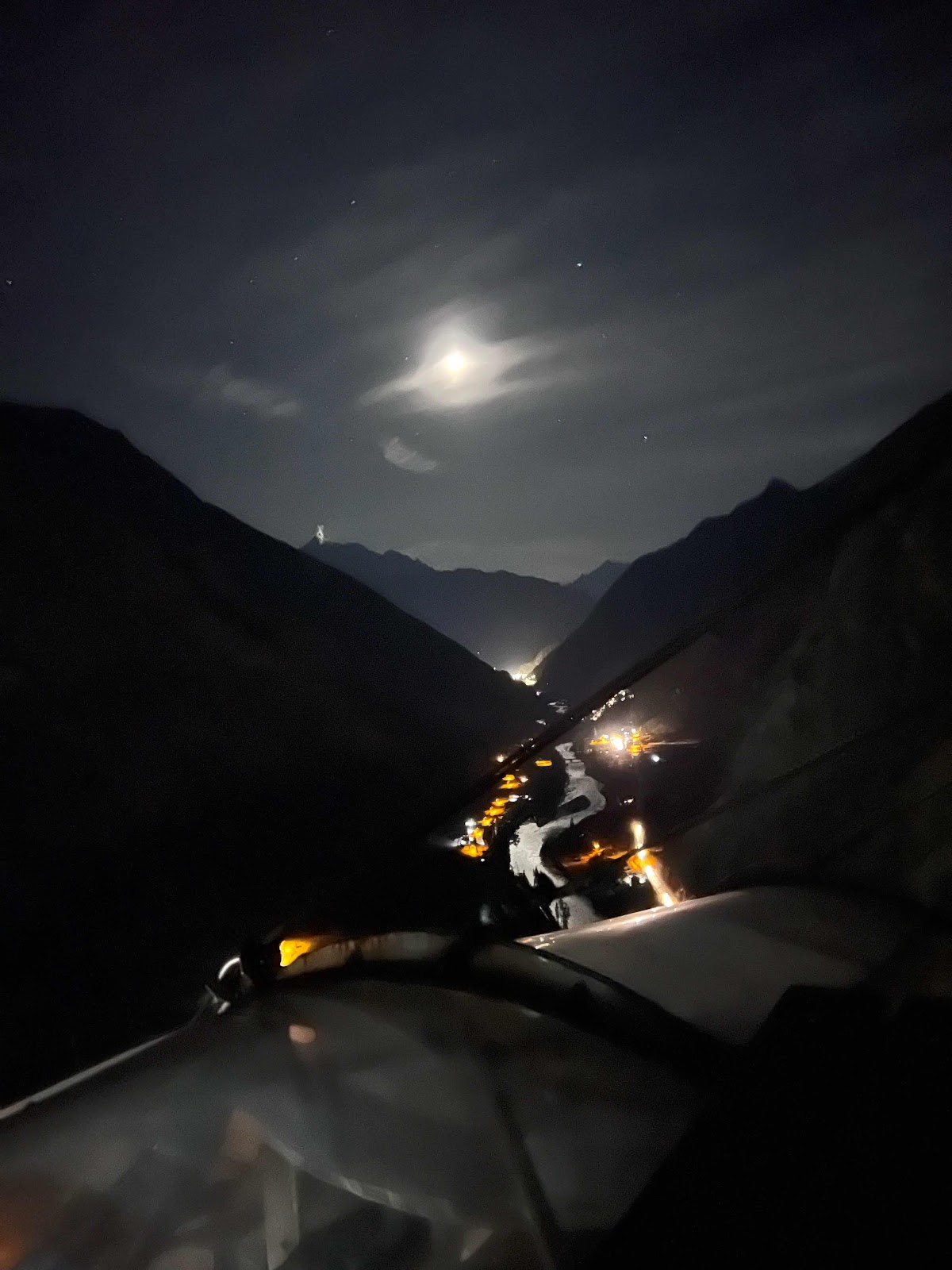
After settling in, we went the the platform just above our pod to watch God’s fireworks. The stars were stunning. While I can’t say the sky was huge like I’ve seen in Utah, because we were inside a valley between two peaks, but the few lights from civilization were far below us and did not deter from our viewing of the stars. We looked for familiar constellations and found none. Research has told us that the northern and southern hemispheres have different stars, but also some overlapping and so depending on seasons, we should be able to spot some of the same constellations, but it may also have to do with the season. Perhaps it was the mountains or the seasons that kept us from finding Orion’s bright belt.


Though we watched carefully through the chilly winds for quite sometime, we never spotted a satellite. (If you have an answer for this, I’d love to hear it!) But we did see a few shooting stars. What is it about shooting stars? Are they just reminiscent of the magic they bring spotting them as a child? Is it a mystical connection with the universe beyond? For me, I am always reminded of the classic story, A Wrinkle in Time, where we learn that in fact, these were stars that were giving up their life fighting evil. In the world we live in, I like imagining those bigger, greater things also fighting our battles alongside us, helping us to make the world better. I do love fireworks, but I must say, this 4th of July light show was one I won’t soon forget.

Our beds were comfortable and warm despite the chilly temperatures. We both slept a bit restlessly, most likely due to our odd location, but thankfully there were no nightmares of falling to our deaths.

We awoke to the light slowly creeping into the valley, with varying colors of sky. We (with some difficulty) made our way back to the dining pod where we were greeted with tea, coffee, orange juice, fruit, eggs, toast, granola and yogurt. Once again, so very impressive, especially in this setting.


We had a little bit of free time before our descent. Jess and I paid the extra money to have their photographer video and photograph us. We haven’t seen the evidence yet, but I believe it was well worth the extra cash! That meant we didn’t have to try to take pictures while climbing and during this free time we had a photo shoot in our pod. Cheesy? Sure. But this opportunity was a once in a lifetime kind of thing so might as well get photographic evidence of it.


The way down was equally as exhilarating as the way up, but so much easier and a lot more fun! After a short climb and a short hike, we made our way to the first of six zip lines that took us down the hill in sort of a switchback set up. The longest was about 600 meters long along the side of the mountain, dangling high above the valley below. The guides were great! They were helpful and encouraging, making it easy and fun. The last zip line ended on a platform on the roof of the small office we had started our journey on.


The SkyLodge was everything I had imagined and more. It was memorable, challenging and truly remarkable. I’m incredibly thankful we came upon this opportunity and that we jumped at it when we could! So, will these two mountain climbers start a new hobby? That’s a major NO. But I’d do the SkyLodge again in a heartbeat!

Sunday, July 3, 2022

Machu Picchu

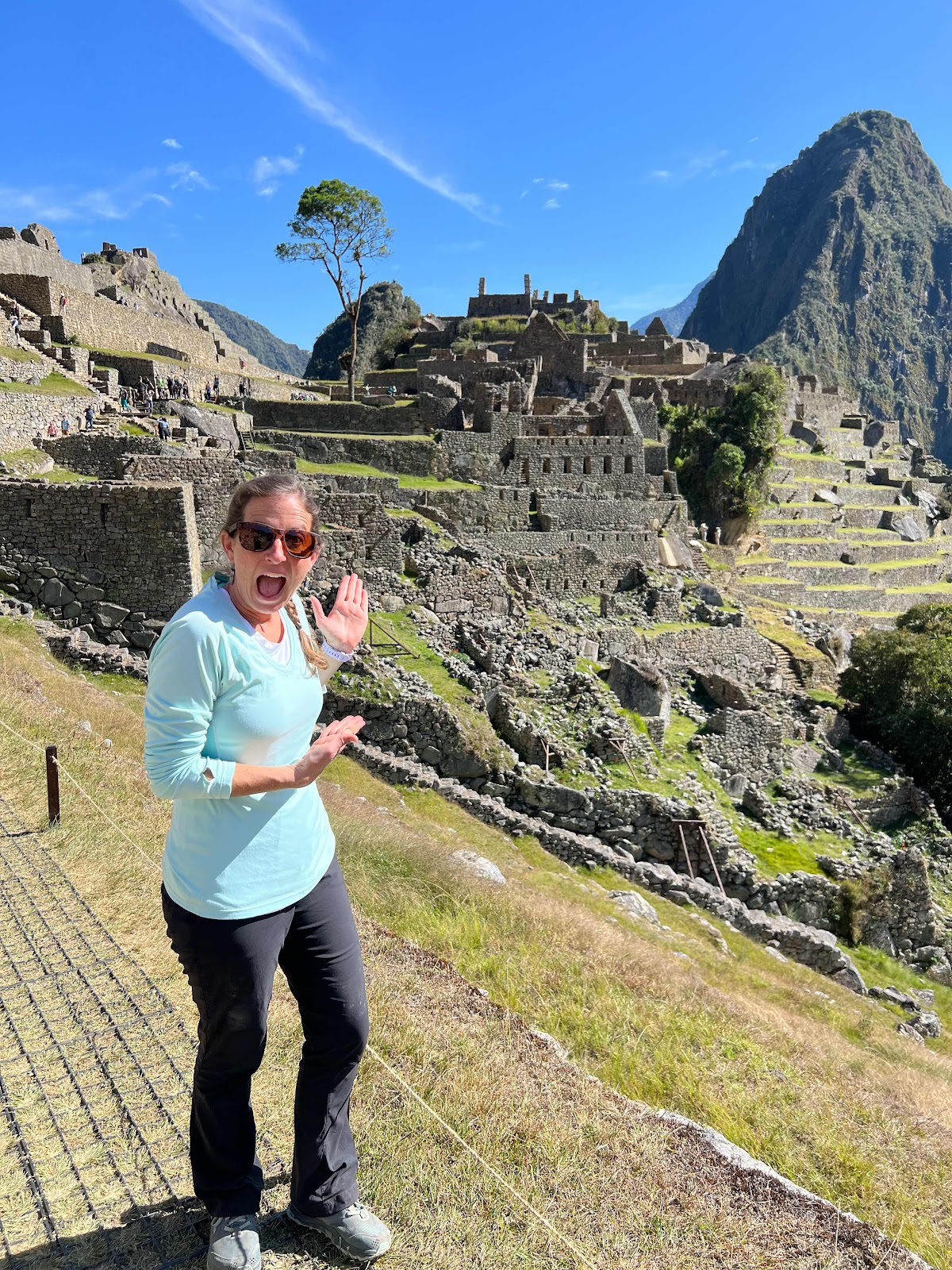
Sometimes, when you’re anticipating something, it disappoints you. Sometimes, it perfectly meets your expectations. And on those rare occasions, like the last two days, your experience far exceeds your expectations. 

When planning this trip, I will admit that Machu Picchu was sort of an after thought. I know, I know. It had been on my bucket list, but it was more of a fleeting dream rather than a top destination. Instead of a goal, it was more one of those “it would be neat to see” places. In fact, it was more of an after thought even after I had chosen our countries of destination. Now that I’ve been in the presence of the majesty of the holy city of the Incas, let me encourage you to move it up on your own bucket list.

There are lots of options when visiting Machu Picchu, and it also isn’t as straightforward as it may appear. There are a limited number of tickets each day as they work to protect this treasure for future generations. So that it is never too crowded inside the holy city, even tickets are sold to different “circuits” so that visitors actually only see parts at a time and no one actually sees the entire place. (Note to future travelers: ensure your ticket is either circuit 1 or 2 or you will not see the overview of Machu Picchu.) 


We had heard of the Inca Trail and wanted to have the opportunity to be on at least part of it, which also has a limited number of passes each day. There are options for a varying length of time on the trail. Although I’m confident we would have loved it, Jess and I opted for the two day version rather than the four day version which includes sleeping in tents along the way and having porters carry your things. I cannot recommend the two day version enough! You’ll see why as I continue.

Let me start with a little history, which our phenomenal guide, Fredy, gave us along the way and of which, I ashamedly knew incredibly little. Five thousand years ago, there was a great civilization in South America, one that built pyramids. Through disease and natural disasters, this civilization broke apart and the people scattered forming small communities. About a thousand years ago, one such community, the Incas, slowly began to acquire other groups, becoming one larger group. This was done through violence, of course, but in large part through religion. As they went, they adopted religious beliefs of other groups, melded them into one and so it was easier for their newly conquered people to become part of the Incas. They grew in power and their “golden century” is known to be from around 1350-1450. As incredible architects, astronomers and farmers, they grew and created an empire that covered several countries and included, at its peak, millions of people. Cusco was the center of the Empire.

It is believed that soon before this golden century, a king of the Incas awoke from a dream and said the gods wanted him to build a holy city. He had cartographers begin to look for the perfect spot. Machu Picchu (Old Mountain) was on a high, flat area, surrounded by mountain peaks with a source of water, and so the work that took sixty years to create began.

All that is known about the town is hypothesized through theories and archeological evidence. The Incas do not have a known form of written language (although their ingenuity suggests they do, but rather we just do not know how to interpret it). Stories vary as to whether the city was abandoned before the Spanish arrived due to earthquakes (there is a fall line that runs through the middle) or if it was a last rendezvous for the escaping Incas who abandoned it as they escaped from the Spanish.

The Inca Empire was already weakening before the Spanish arrived due to a civil war between royal brothers as well as disease and natural disasters. When the Spanish arrived in the early sixteenth century, their advanced weaponry meant they fairly quickly conquered the Incas. We know that the Spanish never found the holy city. Machu Picchu, in the middle of the jungle, quickly became overgrown and was lost to the world until an American explorer in search of the “Golden City” or the “Lost City of the Incas” found it in the early twentieth century.

Now, back to my pilgrimage to the city. Fredy picked us up at our hotel at 4 am. Yes, 4 am. We drove about an hour and a half out of town where we boarded a train that would take us to our destination. (There is a train that goes from Cusco all the way to the town adjacent to Machu Picchu.  I’m still not totally clear why we drove the first half of the journey, but the company has been organizing travel groups for a long time, so I’ll go with their expertise!)

The train ride took us through the Sacred Valley. It is so called not only because of the history of Machu Picchu, but because the area that receives practically no snow has several glaciers atop the rocky peaks. Also, the life-giving river that flows through the valley creates fertile land where farmers harvest crops, mostly corn, for much of the year. The surrounding mountains protect the valley from weather extremes and the valley stays relatively mild all year long.


Diversion story… an energetic college girl traveling with her family sat next to me on the train. She was from Colorado and so quickly connected with Jess. When I said I was from Alabama, she said her roommate was from Alabama. She couldn’t remember exactly where, but she knew it was near Birmingham. Saying her name, I immediately recognized it as a Shades Cahaba student and could picture the bright smile and talented athlete I knew many years ago. What a small world!

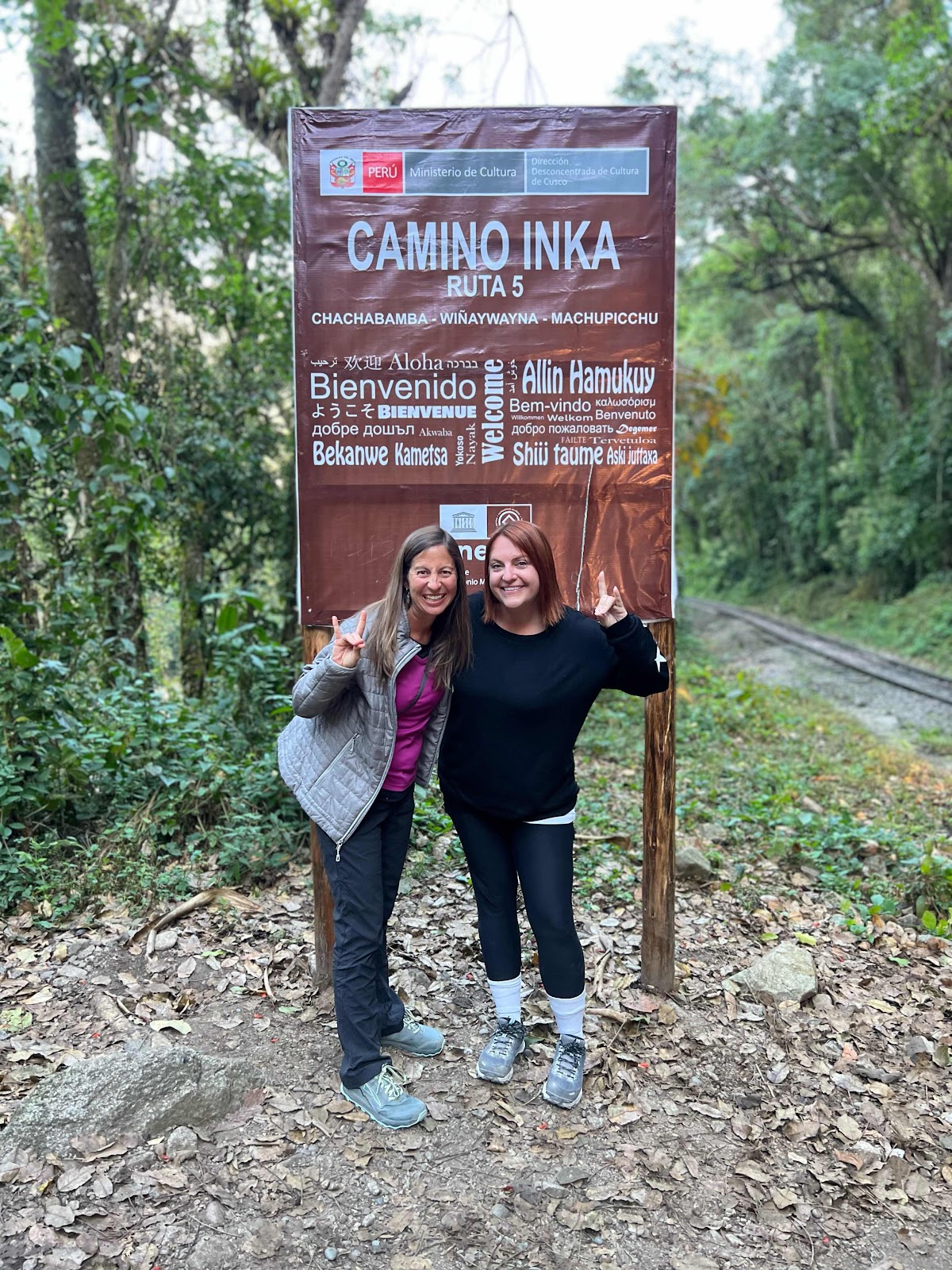
The train stopped a couple times along the way, and I was so thankful Fredy was with us, for we got off the train in the middle of no where. Yes, there was a sign and a bridge that crossed the river, but no buildings of any sort that we could see. This was not the start of the Inca Trail, but rather where we were to start on it. Jess and I felt like quite the celebrities because, while the trip was not inexpensive, we had NOT paid for a private tour. But as no one else had used this company for the same tour on these same dates, we had a private tour with our own guide. The groups are often six-ten people. So, since it was just the three of us, we got to ask all sorts of questions, outside of the historical ones, and set our own pace. What a treat!


We started at a checkpoint where passports were checked, and everyone who enters the trail must be with a licensed guide. Fredy walked us just out of the checkpoint to a small Inca ruin where we spent about an hour getting some background information. Fredy reminded us that Machu Picchu was built as a holy city. At its peak, it probably supported around five hundred people but they were only the chosen few, the elite, the skilled artisans and religious leaders of the empire. Those who took the trail into the holy city were on a pilgrimage. Legend has it that they took their valuables with them on this pilgrimage. People once thought that meant they took gold and silver, but now they understand that people were taking their family members there to be buried. Again, it was only the chosen ones who could make this journey and who could be buried there. Fredy helped us, even with some essential oils, and moments of meditation to imagine that we, too, were on some sort of a pilgrimage, whether religious or not.

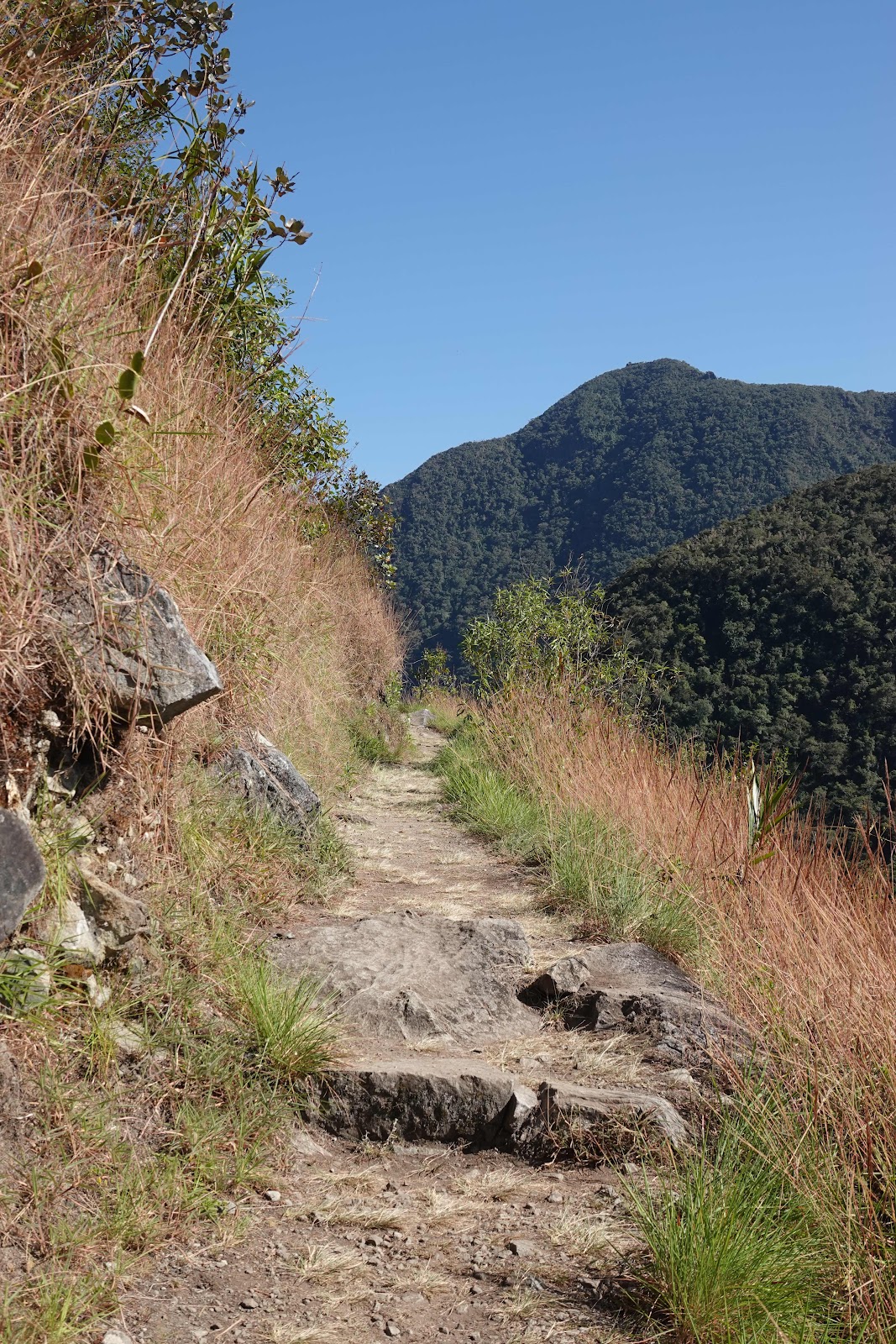
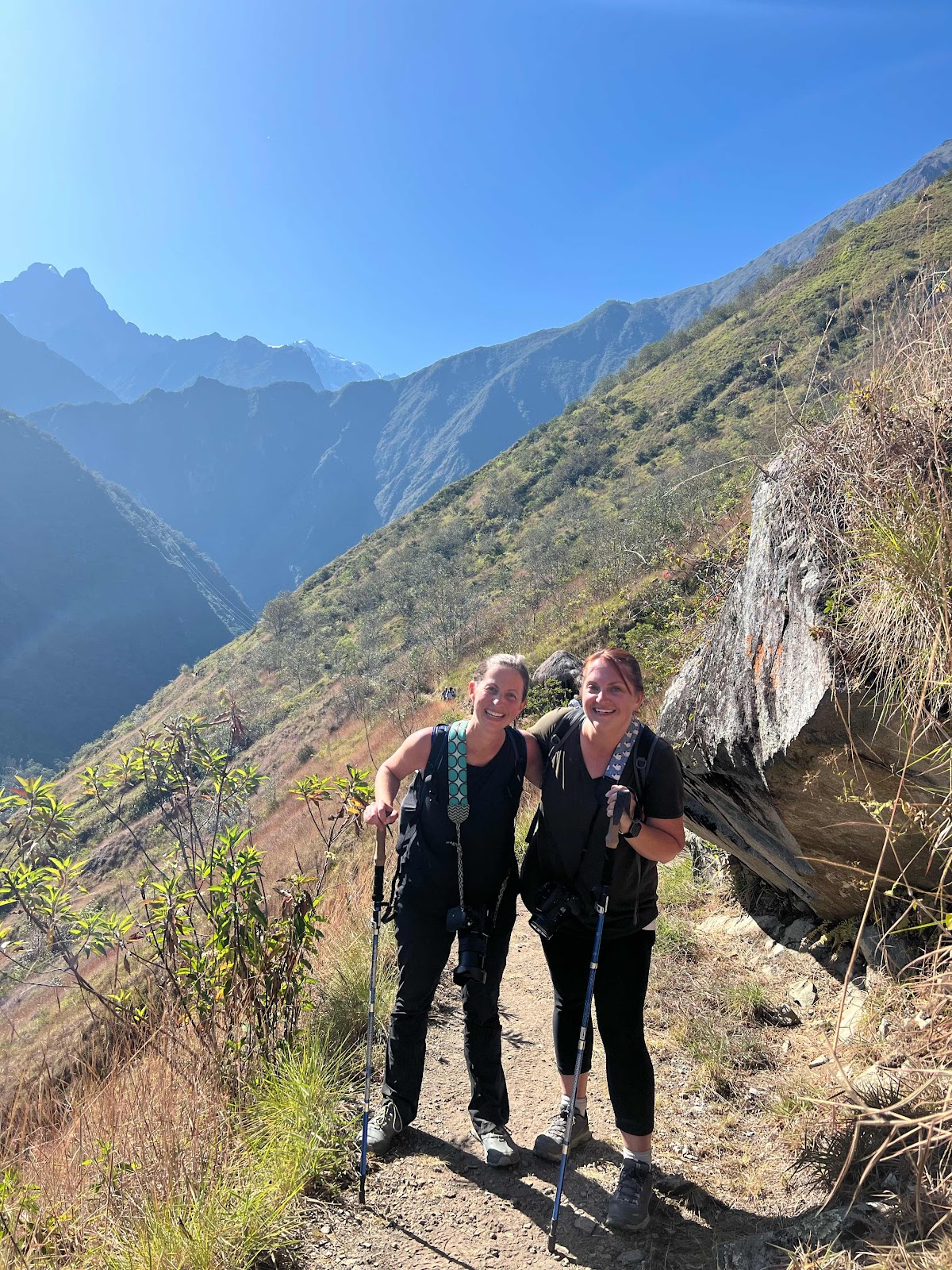
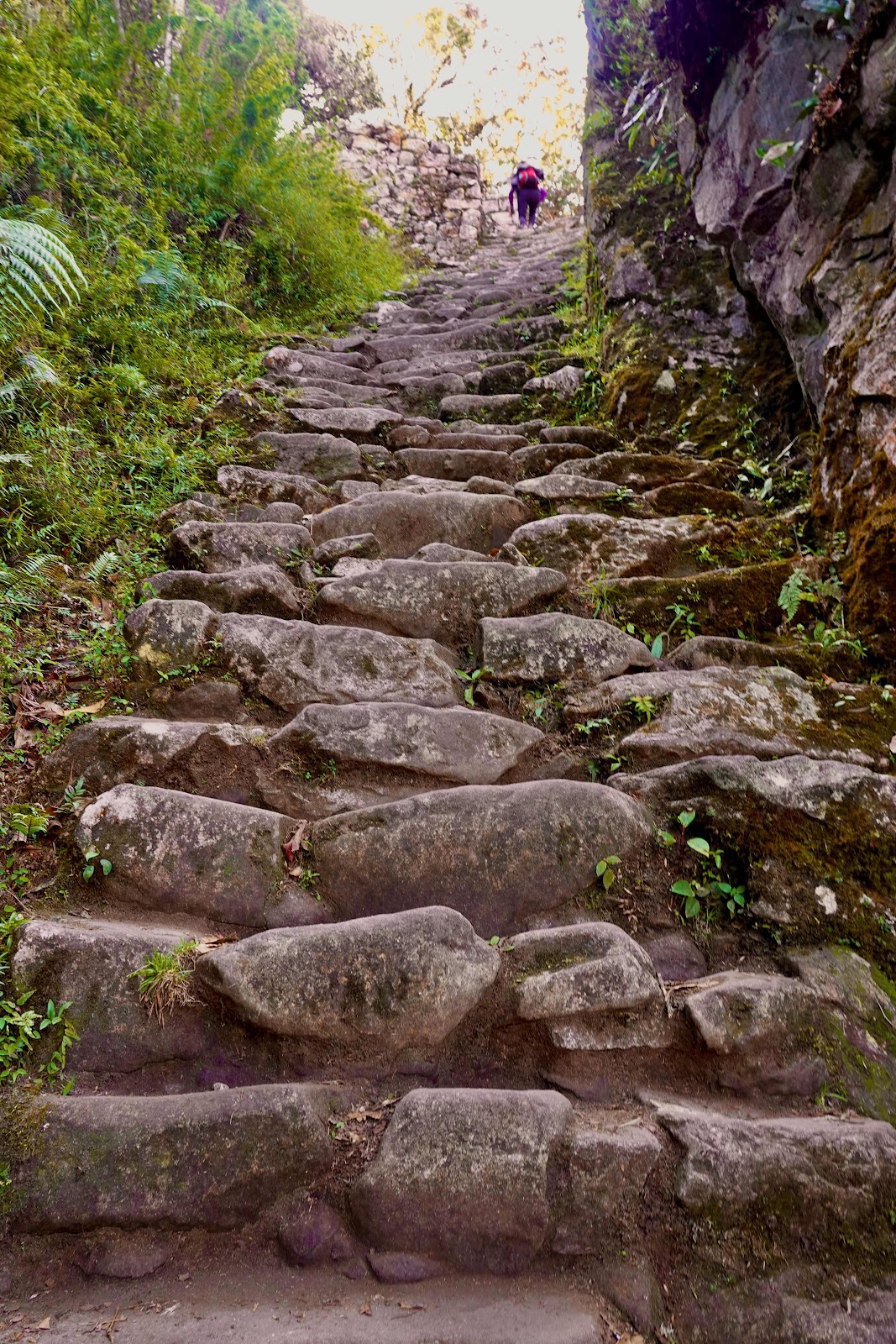
Fredy had warned us that the hike included a lot of up hill, and well, he was not wrong. We started even with the river and hours later the river looked like only a small stream. The path was narrow, on the side of a mountain, but rarely was it terrifying. The steep rock stairways scattered throughout the journey were breath-taking at a high altitude, but with short photo breaks that Fredy indulged us with, it never seemed like too much of a struggle.


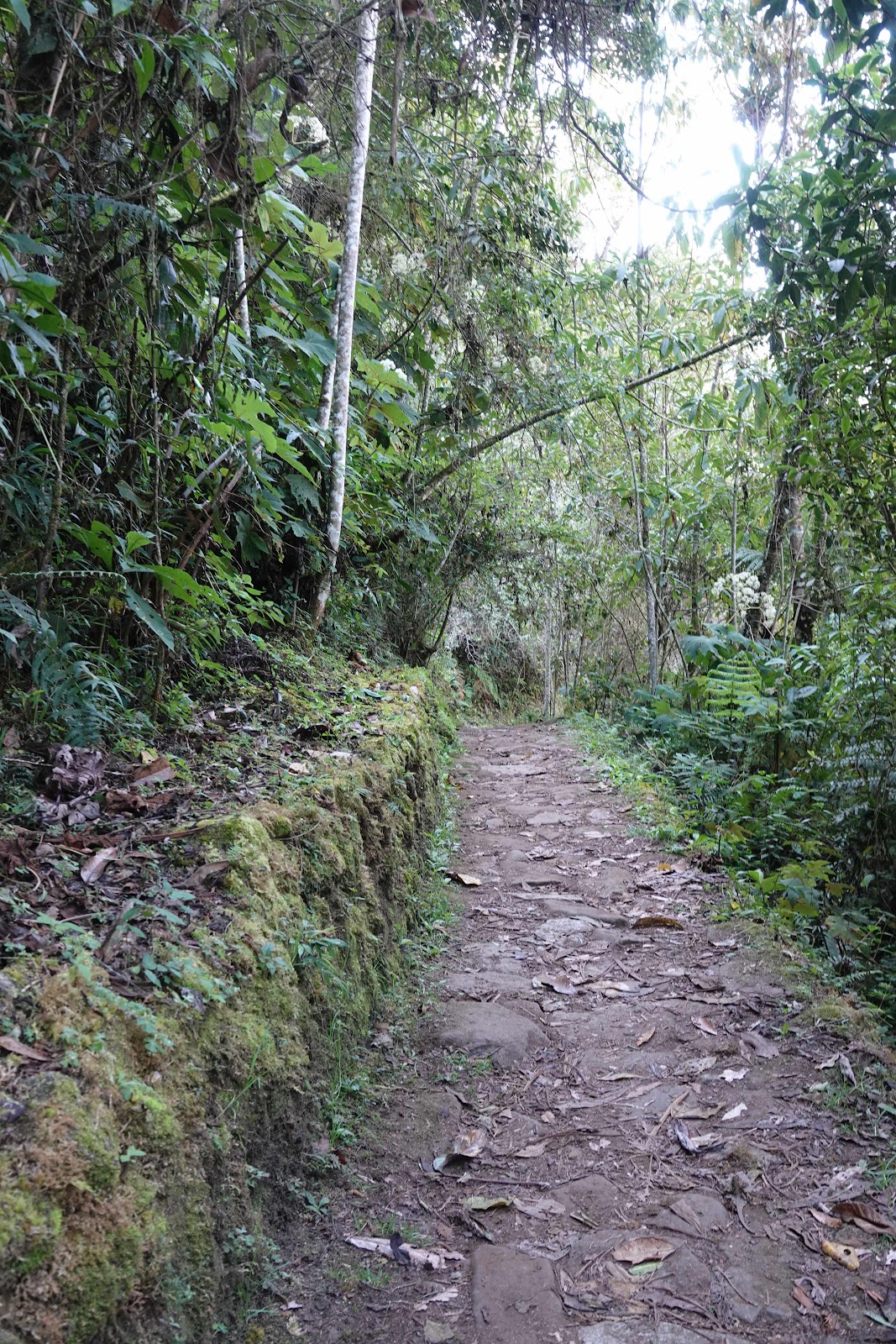
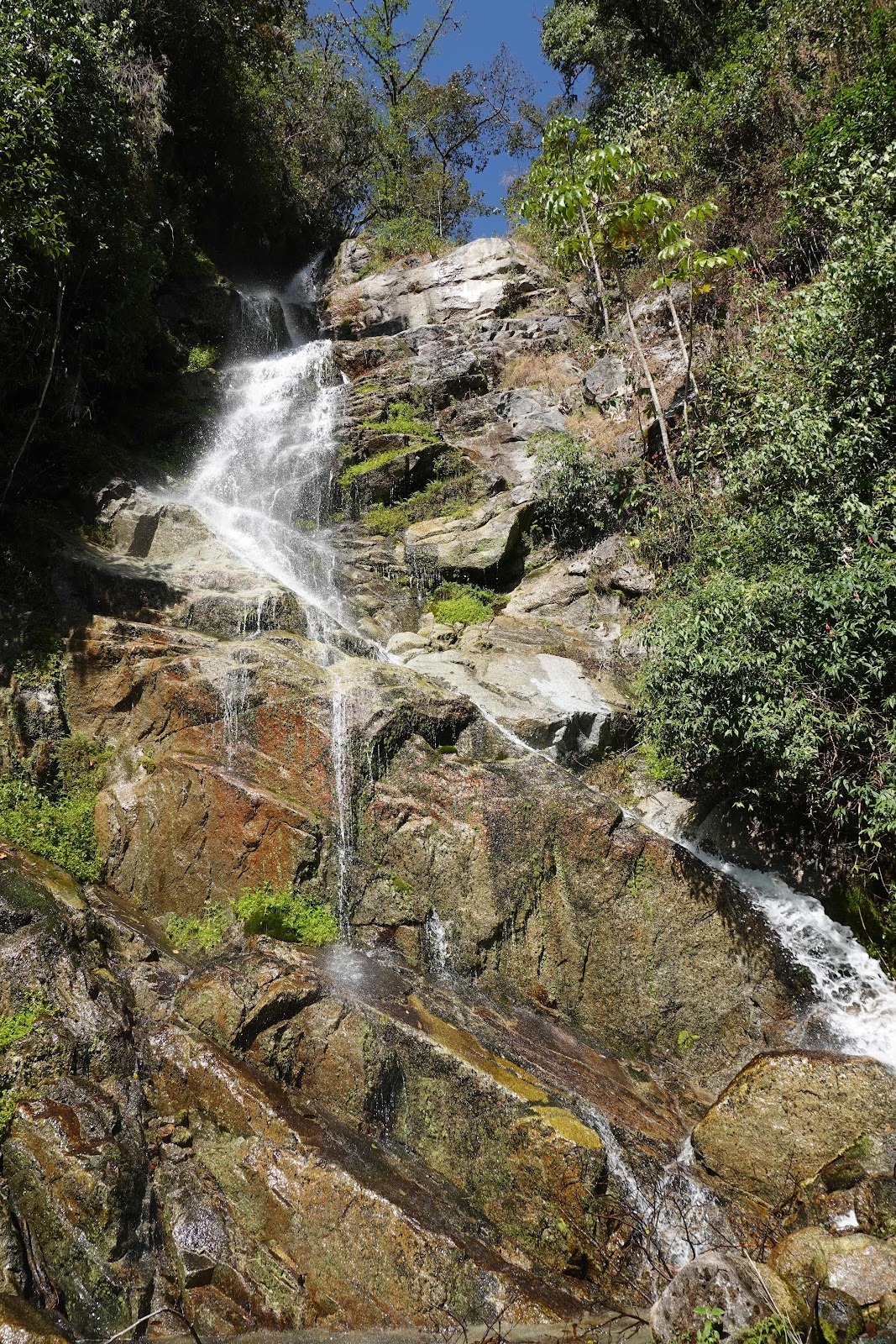
The amazing part was how the greenery changed as we traveled. At first, the landscape was dry, desert like. Cacti were scattered around us and yet also small orchids. Then, after a turn, we moved into greenery much more similar to a rainforest with moss and ferns taller than me, (hold the short jokes please) with damp ground despite the lack of rain. Fredy said it was the geography of the mountains that moved us from a cloud forest to a rain forest. The drastic change in such a short period of time was incredible. Along the route, when the trail was in the direct sun, there were a few spots where small shelters had been built to offer weary travelers a moment of rest. A lovely waterfall, once in the rainforest was also a welcome respite. (I will confess, particularly to my Alabama friends, that this was the first time I’ve felt humidity since leaving home. I know, I’ll get plenty of it upon my return!)


After a particularly steep climb on rocky stairs, Fredy had us stop in what appeared to be a huge arena built into the side of the mountain by the Incas. He told us about their wide depth of knowledge, in particular with rocks, plants and the calendar. The area we were standing in was actually an expansive greenhouse where the Incas would cultivate crops allowing them to grow at different altitudes. The rocks around them, collecting the warmth of the sun acted as our clear roofs today would act. What incredible scientists and engineers they were!


We stopped for lunch at a large campsite that is used for people doing the four day trek and from there the trail was relatively flat until we neared the end of our seven and a half mile journey. The stone steps at one point were closer to a ladder than steps and were affectionately called the “gringo killers.” Thankfully, we are still here to tell the tale.


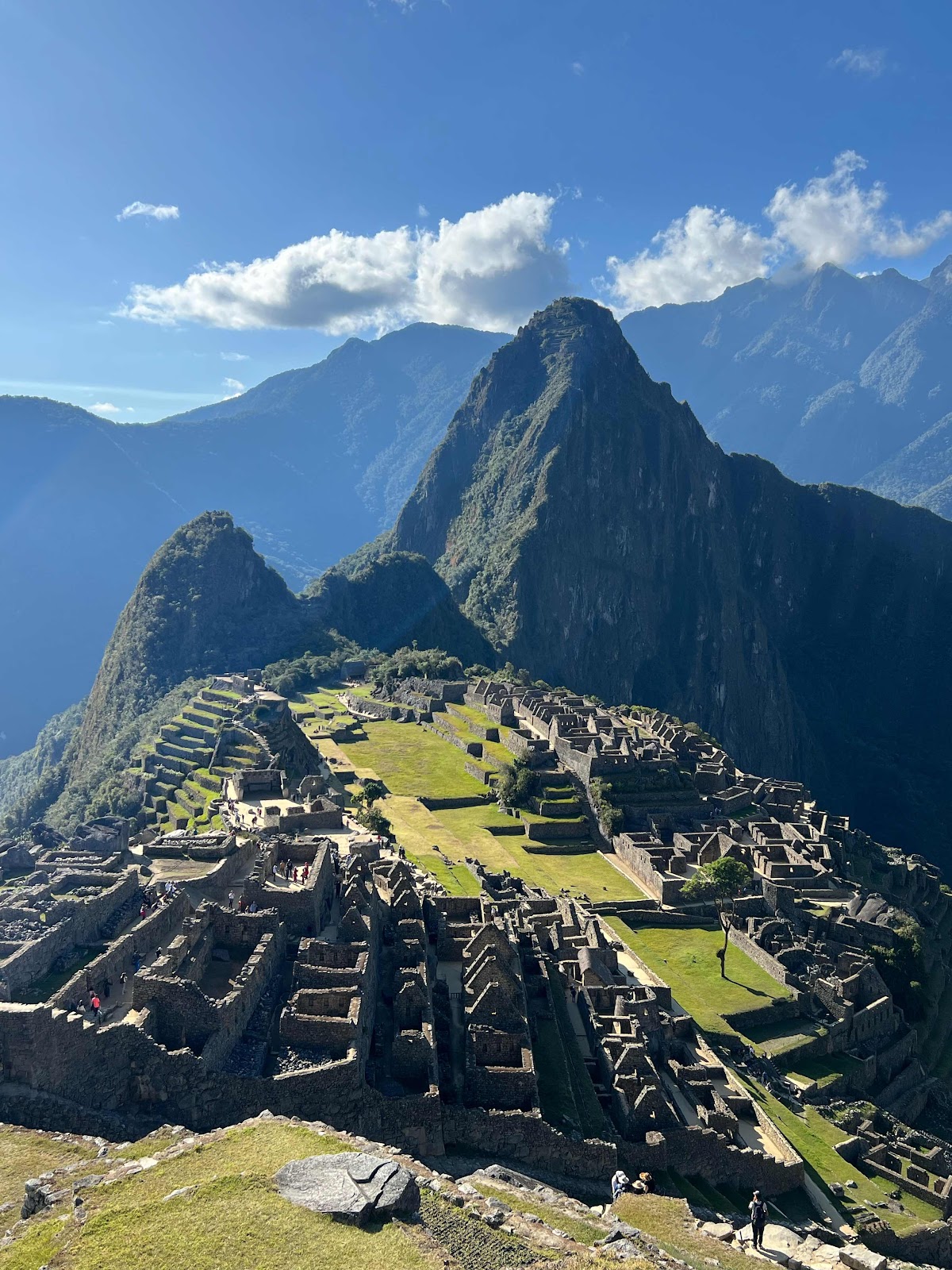
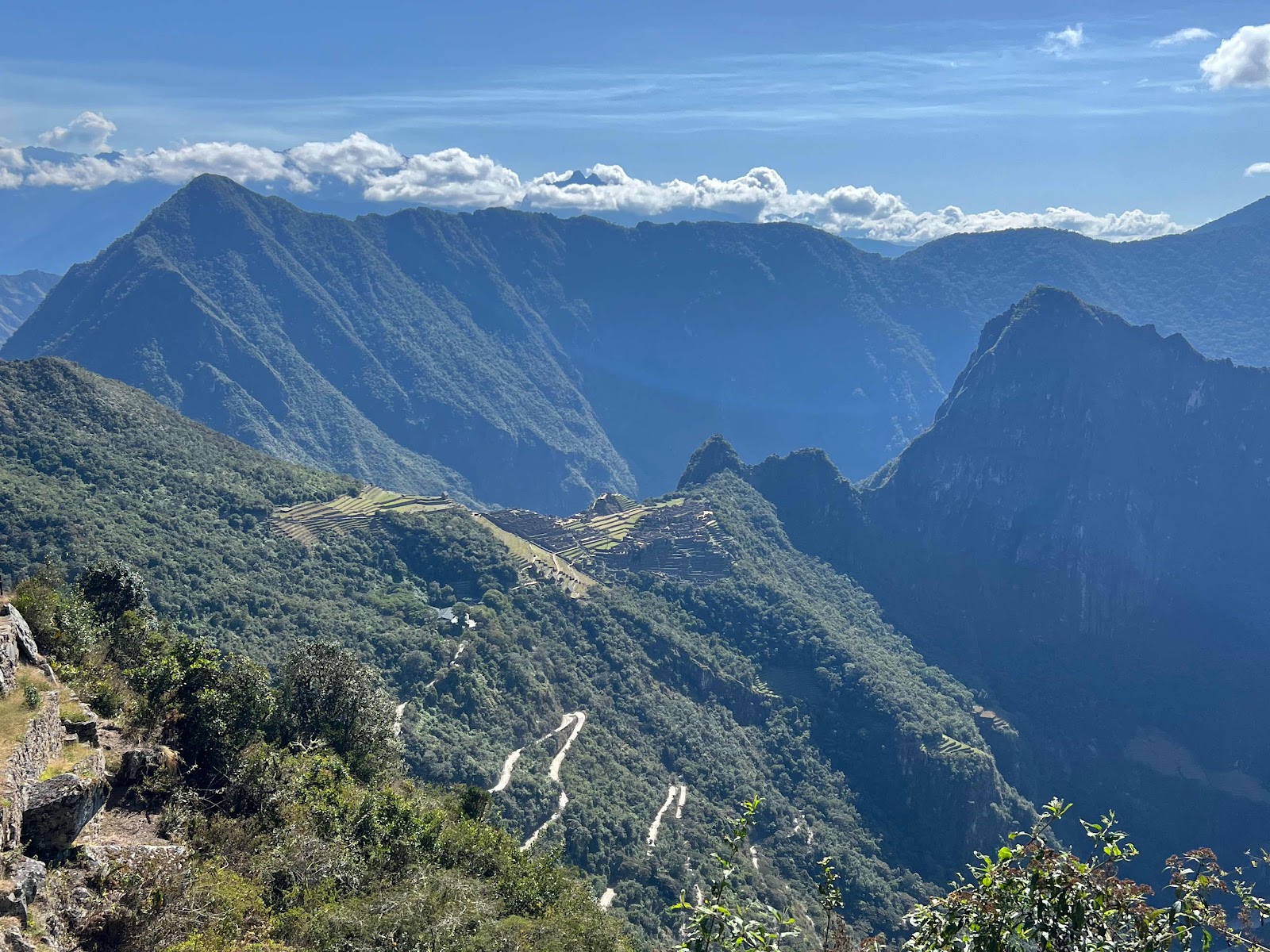
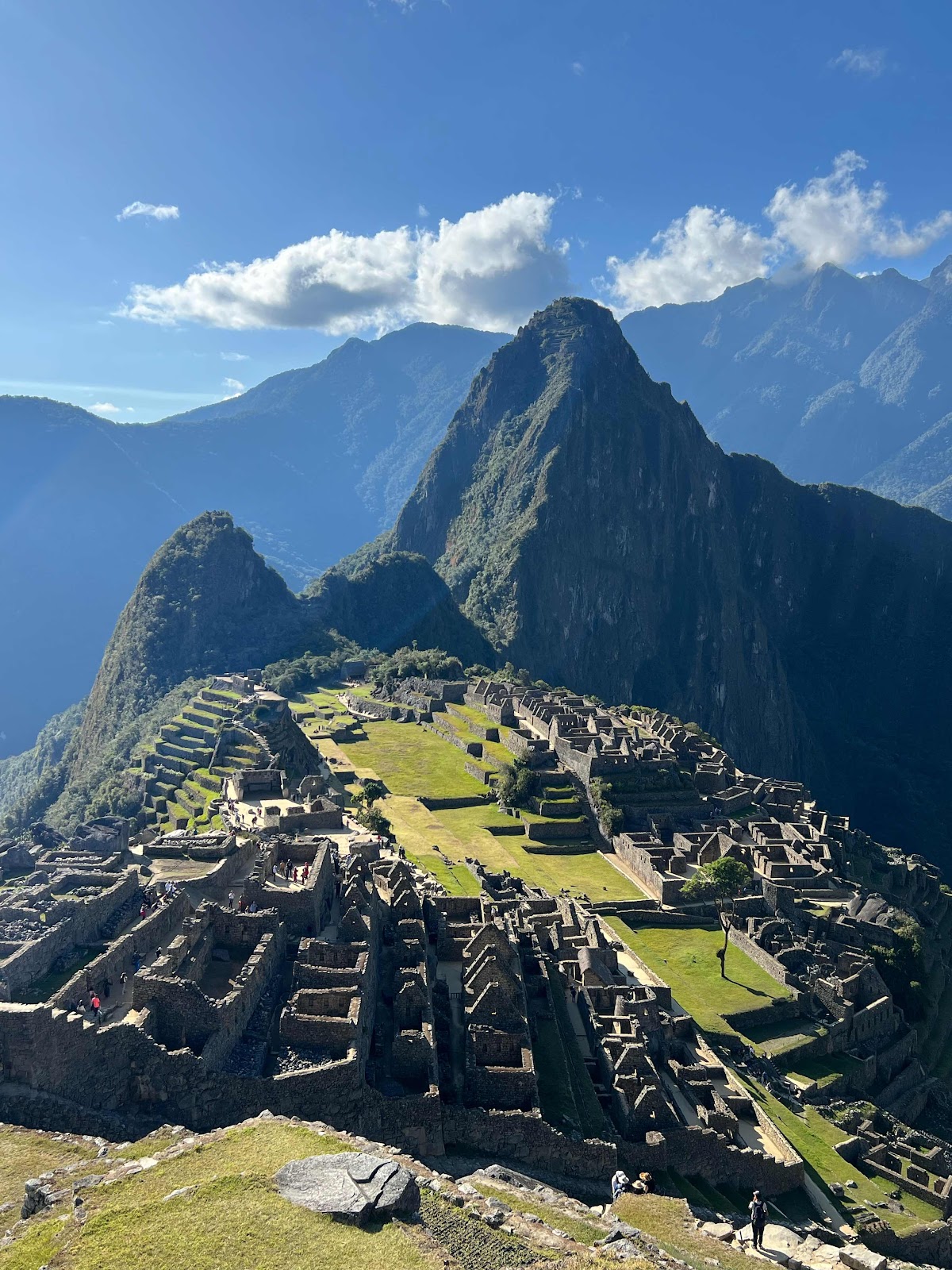
Then, in the distance at the top of a slow incline of stairs, we saw a structure. Fredy’s face lit up, as he watched our faces grow with recognition and understanding. We had reached the Sun Gate, the spot where during the summer solstice, the sun rises through bringing light to Machu Picchu. We had reached the gate that would offer us our first views of Machu Picchu just as the weary travelers would have approached the city hundreds of years ago. 


It was breathtaking, stunning, rewarding and worth every struggle along the way for that moment and that view of the sun shining on the holy city down below. When seen from that distance, its placement makes even more sense.


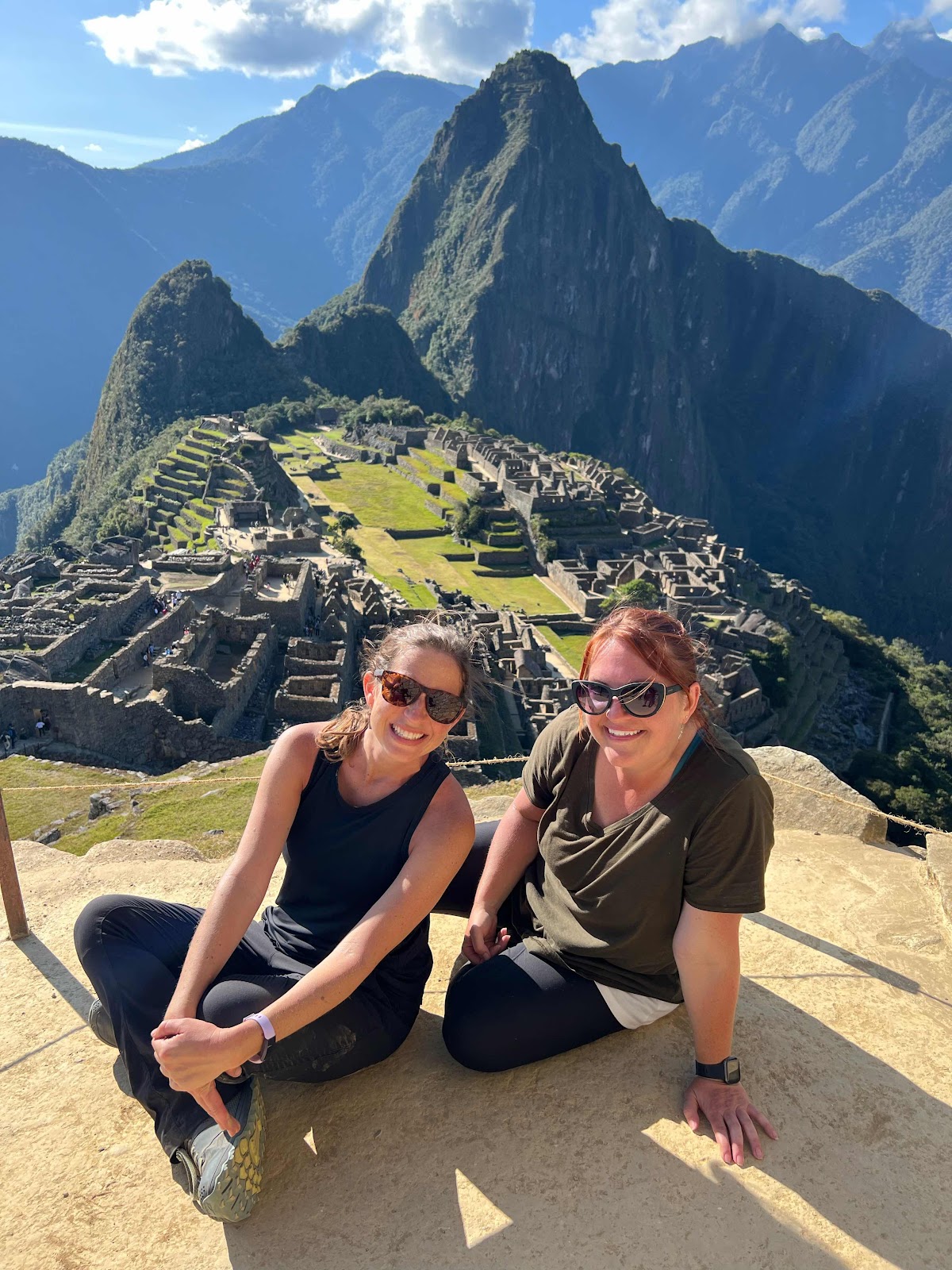
It was still a bit of a hike down to Machu Picchu, but it was down, so it was quite the relief to the up we had done so much of during the day. One of the great benefits of doing the two day trail is not only feeling like you “earned” Machu Picchu, but getting to see Machu Picchu two days in a row. When you enter from the Sun Gate, you enter from up above and don’t really have to show a ticket. So, upon entering the park, after several photo shoots and an unbelievable amount of photos of the same thing (man am I thankful for digital), we just sat atop a stone wall in awe of the city below us. We sat in wonder of the incredible talent of the people who had been here so long ago and of the meaning this city had given to so many. 


A harrowing bus ride of tight switchbacks takes you down the mountainside into the neighboring city of Aguascalientes that grew up because of tourists seeking glimpses of the holy city. It was a cute itty bitty town, but it also has the feel of being a tourist capital, understandably of course. Prices tend to show it and I felt we heard more American accents in this tiny town than in all of our travels so far combined.

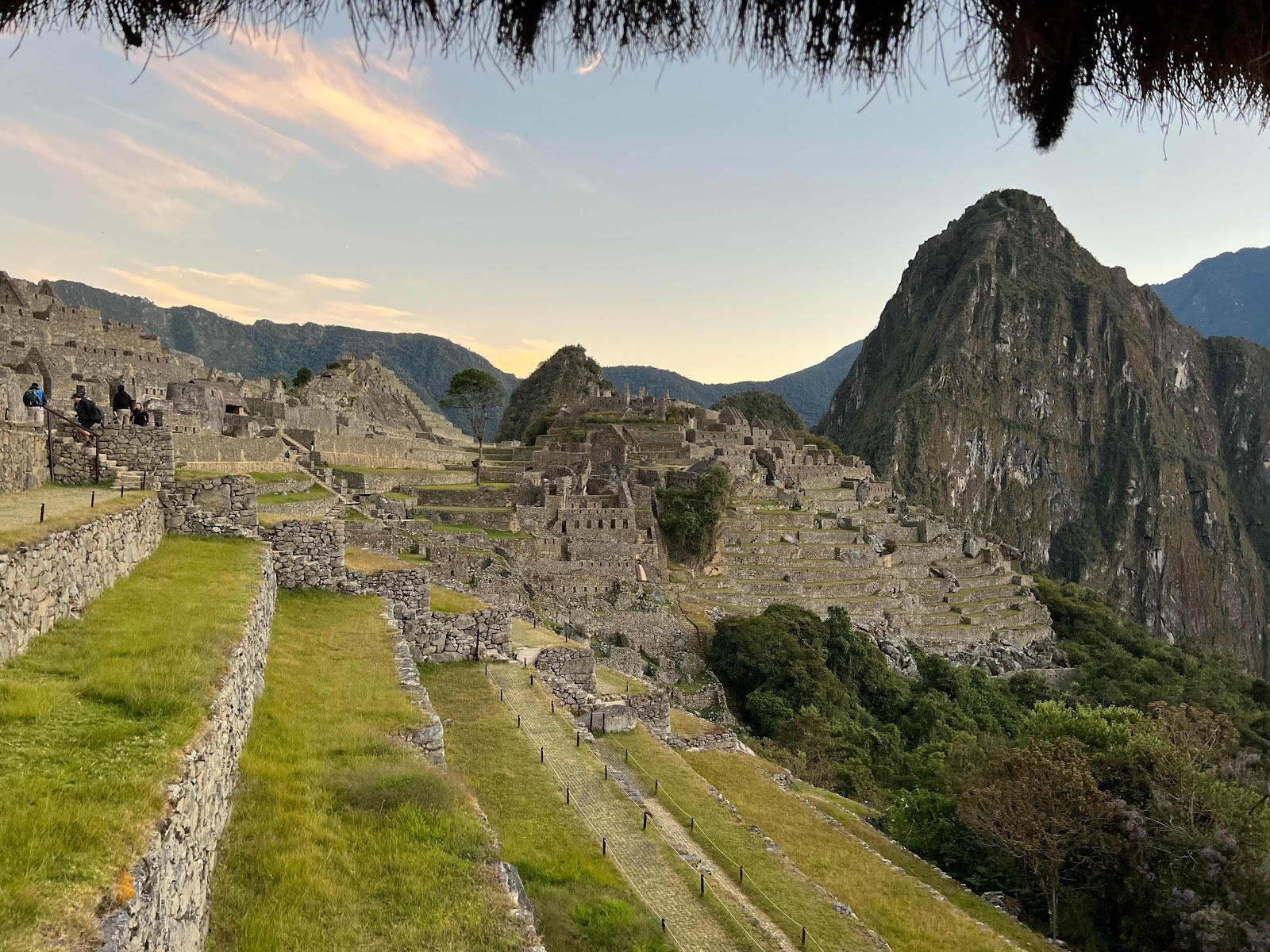
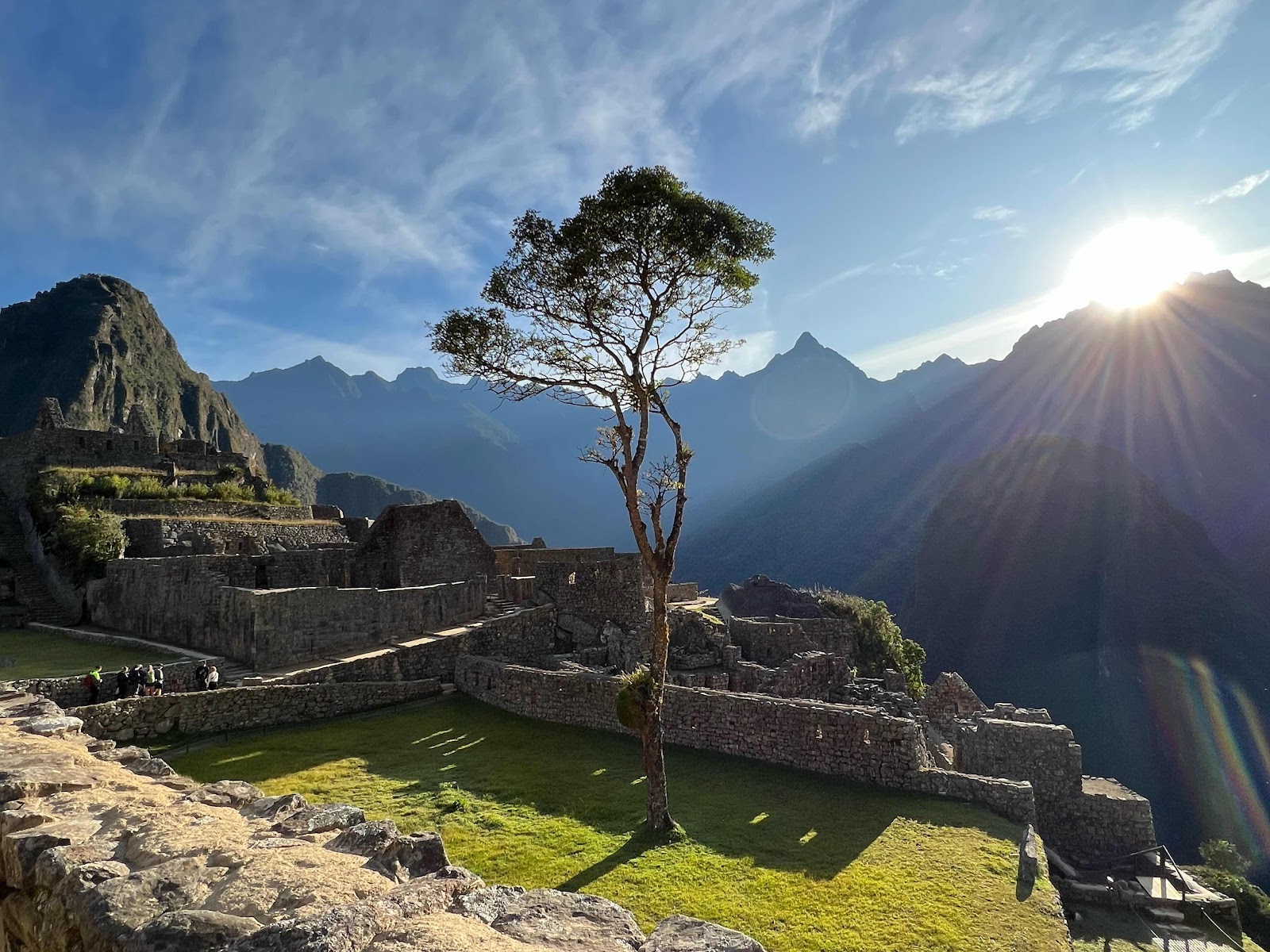
After a delicious dinner and a well-earned shower, we slept hard in a delightful hotel and once again woke up before the sun rose. We were in line for the bus back up the hillside a few minutes after five. Fredy took us through the holy city telling us more history, pointing out building marvels, and letting us pause for infinite more photos. Machu Picchu came alive with birdsong and swallows flitting about. The city was brightly lit soon after our arrival, but it was nearly two hours after our departure from the town that the sun peaked her stunning face over the surrounding mountain peaks illuminating the historical city below.


Inside the city, the stonework itself is a marvel. Some structures were built with stones and mortar. Others, temples no doubt, were built with stones that had been polished down to fit exactly together with no mortar. Through hundreds of years, earthquakes and natural disasters, these structures still stand. It seems we have much to learn from these ingenious architects.


Tickets into Machu Picchu are limited each day, and I must admit that this is helpful to regulate the crowds. You are even limited to the time you are allowed within Machu Picchu, but of course this is hard to regulate. So, those working inside Machu Picchu mostly look out for the tour guides whom they recognize as frequent travelers and when it looks like they’ve been there for a while, they urge the tourists to leave. So, as a gift to us, after a detailed, nearly two hours within the park, Fredy left us to our own devices. Jess and I went as slowly as possible through the remaining part of our designated circuit. We wanted to soak it all in, watch the sun hit different aspects of the holy city, and feel the warmth of the day. Knowing that this was probably our only time to visit this mystical city, we took our sweet time and wandered through ruins and up and down staircases hundreds of years old.


It’s hard for anything to measure up to a morning like that, so the rest of our day was spent at a leisurely lunch of quinoa and alpaca pizza as we watched cats sunbathing on rocks along the riverside, meandering through market stalls and people watching in a small square before catching the train that would bring us back to Cusco.

I didn’t realize before I came how special experiencing Machu Picchu truly was. I’m a bit embarrassed by that, but also incredibly thankful that I made it a priority. It was an experience of a lifetime!