Did you know that you have the right, as an American citizen, to pursue happiness? Let that sink in. Our founding fathers found that right so important that when declaring independence, they included the right to pursue happiness with life and liberty. It doesn't mean that we all have to be happy, nor that we will all reach what we think will make us happy, but we have the right to reach for our own happiness.
I have spent Independence Day in a variety of ways over the last ten years. There were fireworks over the lake, watching the skies light up around Vulcan with friends, leading field day games and American history lessons as a teacher in a British school, watching Will Smith fight off aliens and throwing tea in a river while traveling through England (because well, why not?). All of these have been different, meaningful in their own way and all were in pursuit of some sort of happiness.
Today was no different. We left the busy, hectic Hanoi in search of a quiet, relaxing kind of happiness. The traveling aspect with the large group of tourists from bus to boat to bus did not make our journey to Cat Ba Island terribly pleasant, but now we are here and well, I believe it was worth it. When planning our trip, we knew we wanted to end with a relaxing beach, something we don't always include in our travels. We started our trip that way and while we are not quite at the end, our next few days on this beach should promise to be rejuvenating.
Our resort is on a quiet, private beach just a short drive from the town. When we arrived around lunch time, the beach was silent, almost eerily, but by mid-afternoon, throngs of tourists took over the other end of the beach. Thankfully, they left before the sunset and Jessica and I were able to watch the skies change over the ocean with only a handful of people on this, our private beach.
I do love my country despite the turns it has been taking lately and despite the fact that I love leaving her for the summer. I love that my country allows me the opportunity to come and go freely, traveling to new places to learn about new people and customs. This trip has made me thankful to be an American. Don't take that in a way that means I've hated my travels, but instead, it's made me appreciate things we have. I appreciate that we have free education for our children, that we can speak out against our government without fear, that we have good trash and recycling programs and that we are free to worship as we choose. I am thankful that we have the opportunity to travel, to learn, and most importantly to pursue happiness. I pursued happiness today, I hope you will as well. Happy Independence Day!
Much like Bangkok, our senses were overloaded in Hanoi. We arrived in the evening, were picked up at the airport by a hotel driver and once again were thankful that we weren't driving. Our driver navigated narrow streets and scooters in all directions with ease, but our eyes were wide open, trying to take in all the neon lights and quickly moving vehicles around us.
Our hotel, the Golden Legend, in the heart of the Old Quarter was a haven amongst the chaotic city. We were met at the car and called by name by Jenny, the lovely receptionist, then given refreshing watermelon juice. She talked with us for about fifteen minutes going over a very detailed map and pointing out highlights for us. Because of the heat and the chaos, we ended up spending a bit more time in our hotel room than is typical for us, but I can't say enough nice things about the staff. Our home away from home was always a pleasure to come "home" to.
Our senses were so overloaded after our drive in that we just opted to stay inside the room, locking the outside world outside until we could face the city in daylight. Finding a cheesy, English chick-flick was a welcome gift for our evening in.
Face the city, we did. The next morning we ventured out toward a couple larger tourist attractions. Once we navigated crossing roads, we made it to the Citadel. In reading about this old city within the city, the old military capital that dates back to over 1,000 years ago, I expected to see more than we did. It was a pretty, quiet retreat within the city, but the buildings were fairly modern and there were few signs explaining the history of this place. We found a similar situation at the Temple of Literature, the first university in the country where students had been studying for nearly 1,000 years. Statues of Confucius and stone tablets marking early scholars dot the grounds, but otherwise, we just enjoyed the architecture of the few small buildings that made up the campus.
Our walking tour of the city continued walking by the Ho Chi Minh Mausoleum and Museum and a tiny little pagoda or temple in the shape of a lotus flower.
Men in full military wear guarded the mausoleum and presidential palace, but don't worry, we were on our best behavior. We wandered to the road that cuts the larger lake into two, getting a good view of the extensive city, but disappointed by the trash and smells along the way.
Jenny had recommended the Women's Museum, a five story history of Vietnamese women. We enjoyed learning more about local marriage and clothing customs, many differed greatly in the hill tribes. Most impressive were the stories of the women fighters who had courageously fought in the many wars this country has seen in the last century. There were military, including guerilla groups made up entirely of women fighting both for freedom from the French and in the American war. Statistics were astounding, and this country is obviously appreciative of its female warriors.
In the evening, we went on a Hanoi Street Food tour. We had so enjoyed the one in Chiang Mai, and this one, too, did not disappoint. Mimi, our guide and mother duck to her five tourists, was great. She is twenty and is in school studying tourism, so she loved learning from us just as we enjoyed learning from her.
We tried about eight different items, and I'm not sure I could choose a favorite. Two of the dishes were meats (pork and beef) with noodles in a broth. We added our own mint leaves, lime juice, garlic and chili peppers to perfect the taste to our tastebuds. We enjoyed pork and mushrooms in rice paper (that we "helped" to make), crab spring rolls, coffee with egg topping, and desserts of doughnuts, sticky rice ice cream and black rice with yogurt. I'm so glad we did this because we got to try so many great foods and we went into places we never would have entered, like this place:
Under that bright red banner, the alley-looking entrance, we went in there, walked up a flight of stairs and had some amazing fried foods. Hanoi has some delicious foods to offer, there are no two ways about that, but figuring out where to go and how to get there is quite the trick.
The next day we started with a visit to Hoa Lo Prison known to many as "Hanoi Hilton." Jenny had warned us that it did not paint a pretty picture of America, but we felt it was something important we needed to see. The prison was built by the French in the late 1800s. For many years, the prison housed Vietnamese who were fighting to gain their independence from France. Resistance was strong, and the rebels fought hard for control of their own country. Conditions in the prison must have been horrendous, especially the isolated holding cells where death-row inmates waited for the guillotine and the holding cells for those tough, rebellious women.
Then, we came to the American War (yes, that's the same one we call the Vietnam War). I feel like I need to give a disclaimer here. I know very little about this war. Some of my students were reading a book about the Vietnam War this year and I had to do some research to give them some background information. I realize this war was not that long before my time, a generation older than me knew the horrors of this war all too well. What I understand most about it was how horrific the fighting was and how difficult it was to fight a war in the way it was fought in this terrain. (Seeing the tropical terrain and limestone peaks, I truly cannot imagine.) Seeing the prison was difficult, especially seeing the hatred that was portrayed toward my own country. But I also know that history books are not universal. All countries tend to write their own story in a favorable way, a sort of rose-colored glasses view of their own country. The truth is probably somewhere in between. However, I know in saying all of this that I know people who fought here or who had close family members who fought here and I in no way want to discredit the service they gave to our country.
The "Hanoi Hilton" displayed pictures, videos and stories about American bombs targeting churches, schools and hospitals. They displayed photos of planes that were shot down, including Senator John McCain's plane. His pilot suit is even on display in the museum. (He did not have my vote back in 2008, but he certainly has my respect, even more so after this trip.) Photos of the "Hanoi Hilton" showed American pilots being treated by physicians, playing basketball and ping-pong, decorating Christmas trees and other similar activities with smiles on their faces. Obviously, loosing your freedom while fighting for your country is horrible, no matter what, but these images in no way matched what I found with a little researching. Wikipedia discusses extreme torture methods that happened here at the Hanoi Hilton. I wasn't there. I don't know what really happened, but it was a great reminder that history books are written by people and we all add our own bias, even if unintentionally.
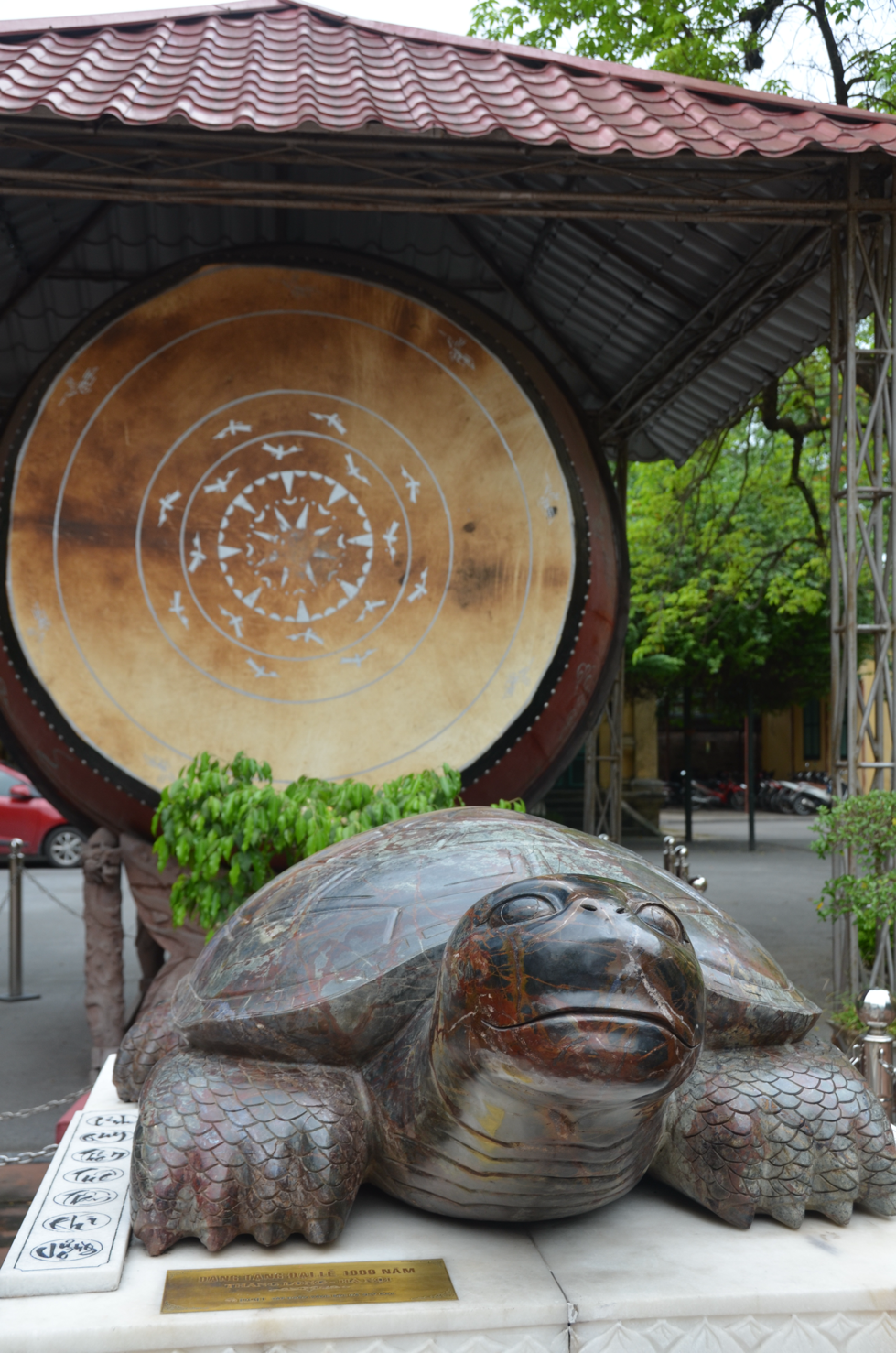
After a sobering morning, we wandered around the small lake in the center of the Old Quarter. It's steeped in legend about a turtle who carried a magical sword an emporer used to defeat the Chinese down into the depths of the lake. There's even a temple on island in the lake to commemorate this.
This even was highlighted in our evening performance of the Water Puppets, a special Hanoi tradition. Musicians played traditional instruments and sang folk songs while puppeteers from behind a screen operated puppets that came out and performed in the water.
The short skits were traditional folk stories. My favorite ones involved the four holy beasts of Vietnamese culture: phoenix, dragon, turtle and a sort of unicorn-like creature. Beautiful, simple, and cheesy, but it was a great way to spend our evening.
We found a crowded corner and went to a restaurant on the 4th floor so that we could watch the traffic pass by in awe and amazement. I told Jessica that I couldn't even compare it to ants as they tend to move in logical, methodical lines. She agreed, but suggested it was more like ants right after you disturbed their home. Yep, much more accurate.
Hanoi is a charming city with fun shopping, a young, vibrant, lively feel, but it wore us out, in large part because our senses were overloaded. Smells wafting from the streets of fried doughnuts, trash, and fresh meals being prepared confused our olfactory sense. Constant car horns, sales people convincing us to buy their goods, taxi drivers offering rides, men and women gossiping on corners made for a very loud city. As for touch, the many silk scarves were much more pleasant than the brush of strangers on crowded corners and pushy sales people. Taste was the sense that never once was disappointed: pho, garlic fried rice, doughnuts, spring rolls and banana crepes with honey. Our eyes though. It was impossible for them to take in everything around us: women carrying baskets on their heads, spoiled precious poodles being carried, babies standing up on scooters, women carrying baskets on either end of a bamboo pole, masses of people, colorful trinkets for sale and endless wonders in a new city.
Well, because frankly, she feared for her life. I thought crossing the busy European streets were hard, but I was way off. Here, in Hanoi, scooters rule the road. It is estimated that over 9,000 new scooters join the Vietnam roads each day. In this city of seven and a half million people, it feels like every single one of those citizens owns a scooter.
In the Old Quarter, the center of town for the past 1000 years, the roads are narrow as are the buildings. There is a lot of charm here, and one would think that simply walking down the sidewalk would be a safe, easy way to get from place to place. However, the sidewalks are covered with parked scooters, and if they aren't, they're fair game for scooter travel. No worries, we'll just walk on the road. But it's not even that simple. Scooters travel any which way they choose, whether it be the wrong way on a one way, the wrong lane on a two way, around cars or even a U-turn in the middle of a busy road. We even watched a car do a U-turn on a four-lane, one-way road.
Jessica and I have spent a large part of our time in Hanoi trying to cross roads watching from all 360 degrees around us. There are some traffic lights at four-way stops that include the little green and red men giving us instructions on when to cross, but let's remember that scooters make their own rules, so if they want to stop, they do, but they also may choose not to.
The traffic has fascinated us, so we have done some research. We were pleased to see more people wearing helmets here, but even that isn't perfect. It is now a law that people wear helmets, and although about three quarters of the people we've seen have been wearing them, the law isn't really enforced. Also, it appears that only about 20% of the helmets worn meet safety standards. Oh, and the law only requires people over 14 to wear a helmet, so practically no children are wearing them. Yes, people are supposed to have a license, but as that is not really enforced, it is not necessarily the case.
We participated in a delicious Hanoi Street Tour (more on that later!), and one of the best parts was having our guide help us cross the streets. This precious little university student would get to the side of the road, throw up her arms and yell, "sticky rice!" Our small group would gather around close to her, "stick" to her, she'd put out her hands and carefully lead us across the street. She told us at the beginning not to watch the traffic, but just to stay close to her and look forward. We did just that and we're very thankful. We called her our "mama duck" and really wanted to keep her with us for the rest of our time here. She did teach us not to put our hands out in a stop position as that angered the drivers, but rather to put our hands out and down as if about to curtsy in a dainty way and make eye contact with the drivers.
Our bravery and quick steps have improved over our short time here. We've learned to join in with others crossing the streets (safety in numbers) and we are certainly stepping into the street with a bit more confidence. However, we always seem to hold our breath and make squeals as we cross to the other side. I have no doubt that the Old Quarter, the touristy part of town where we are is the more hectic part of town, and in a way, the traffic has its own charm, but I think we'll be glad to be in places where crossing the street doesn't seem like such a dangerous ordeal.
We've only spent a week in Laos, and several of those were in a tree house and two of those days were on a boat with fellow travelers, so I can't even pretend to be an expert on the people of this small country, but I do want to share a little about what I've observed.
The Laos people are a kind, cheerful group of people, but their mentality is definitely different than what we have encountered so far. My travel book described the Laos people by saying that if the work wasn't fun for them, they didn't do it. We also saw somewhere that Laos PDR stood for "Please Don't Rush." Both of these seemingly generalizations seemed true. In Huayxai when we needed a short taxi ride, we had to go in search of a driver, then he seemed upset that we were pulling him away from his friends, you know, to pay him. The boats seemed to leave on their own time, not on a true schedule. In Luang Prabang, we wanted to go see the waterfalls, an almost hour away, but a huge tourist attraction. We assumed we would catch a taxi there and then pick up one that was waiting to bring us back, right? Nope, instead, we paid about $20 for the taxi to drive us an hour, wait for four hours while we explored and then bring us back. (Don't worry, we only paid him half upon arrival since we thought this might be a scam, but he was their waiting.) This seemed to be the way of life because the multitude of taxi drivers were all friends and enjoyed spending the time together waiting.
The Laos people are also quite superstitious. I've already mentioned how they gave us better deals at the market because we were "lucky number customer," but they also thought our money was lucky. When we paid them, before putting the bills away, they would tap items in the booth with the bill. We inquired as to why this exercise and they simply said, "for good luck."
The Laos people are also savvy and seemed to take into account that we tourists may not know as much about how things operate or the general cost of things. Keep in mind that the average monthly salary of the people of Laos is equivalent to what I took out of the ATM, so when possible, they were trying to bring in a little more cash, and to be fair, an extra dollar or two here and there certainly didn't break my bank. However, if you're traveling here, have an idea of what things should cost and bargain or at least stand your ground. The people were not at all pushy or forthcoming, so I never felt uncomfortable, just be aware that you can probably get even more for your buck if you have a firm grip on the conversion ($1= 8,194 LAK) and know what things should cost.
We enjoyed our time in Laos, and the people we encountered, but we're also excited for our next adventure!
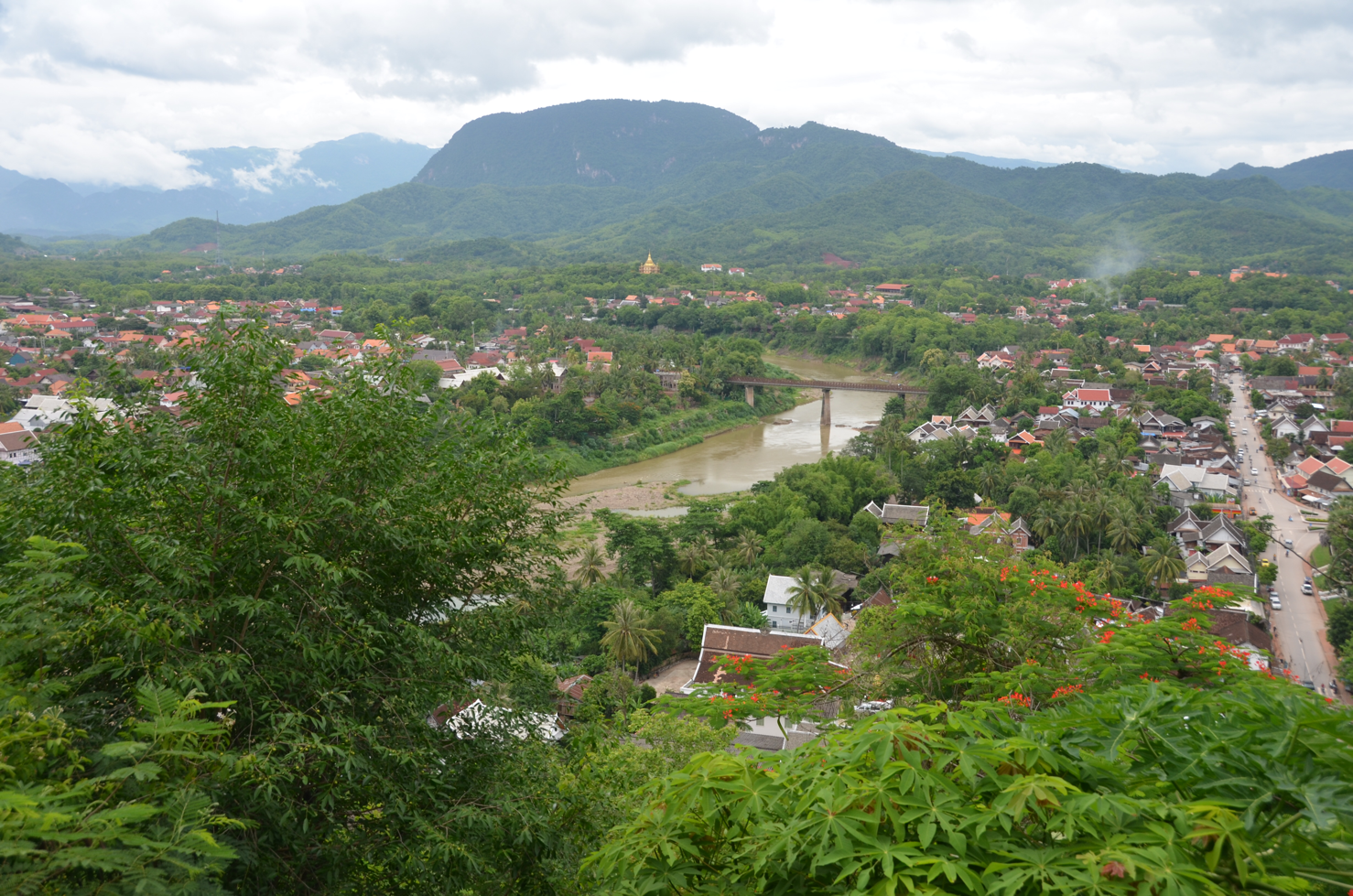
After being in rural parts of the country, Luang Prabang was a welcome sight for sore eyes. The town's main street looks almost as if it were plucked out of Europe and many of the transplanted locals speak with French accents. Stands for fruit smoothies and air wafting from bakeries created a tempting atmosphere. Luang Probang is situated almost on a peninsula where the mighty Mekong and one of its feeders meet. Our hotel was in the old quarter, just a block off of the main street with a view of the tributary.
In the evenings, part of this main street is blocked off and full of locals selling goods for us tourists. There were elephant pants, brightly colored embroidered pieces, jewelry, items made from old bombs, wooden bowls and all sorts of treasures looking for tourists to take them home. Jessica and I must be incredibly lucky people because each time we looked to purchase something, they offered us a cheaper price saying, "lucky number customer." We'll be buying lottery tickets soon. I'm certain they didn't say this to everybody, right?
We decided to go out of the city to the waterfalls for part of the day and opted to go early on our own, not in a tour, to avoid some of the crowds and it was a grand decision. Our photographs of the cascading waterfalls barely have anyone in them! The falls ran over rocks and pooled into sea-green collections before spilling over to the next one.
The tallest waterfall of all could have rivaled a business building with white water rushing down. Of course we chose the path that led up to the top of the waterfall, not wanting to miss anything, especially not a view! While the view of the surrounding area was lovely, standing right on top of the falls did not actually allow for views of the falls themselves. Thankfully, we found a way down that included more wooden steps as opposed to the muddy rocky climb on the other side.
The pools collected water and eager swimmers that had arrived by the time we came back to level ground, but we, too joined in on the chilly swim. The water was cool, refreshing, clean and full of hungry little fish. It was almost like our fish spa experience in Chiang Mai, but these hungry guys were larger and had a harder bite. One of them even seems to have left a bit of a mark! Nevertheless, swimming in waterfall pools was a treat!
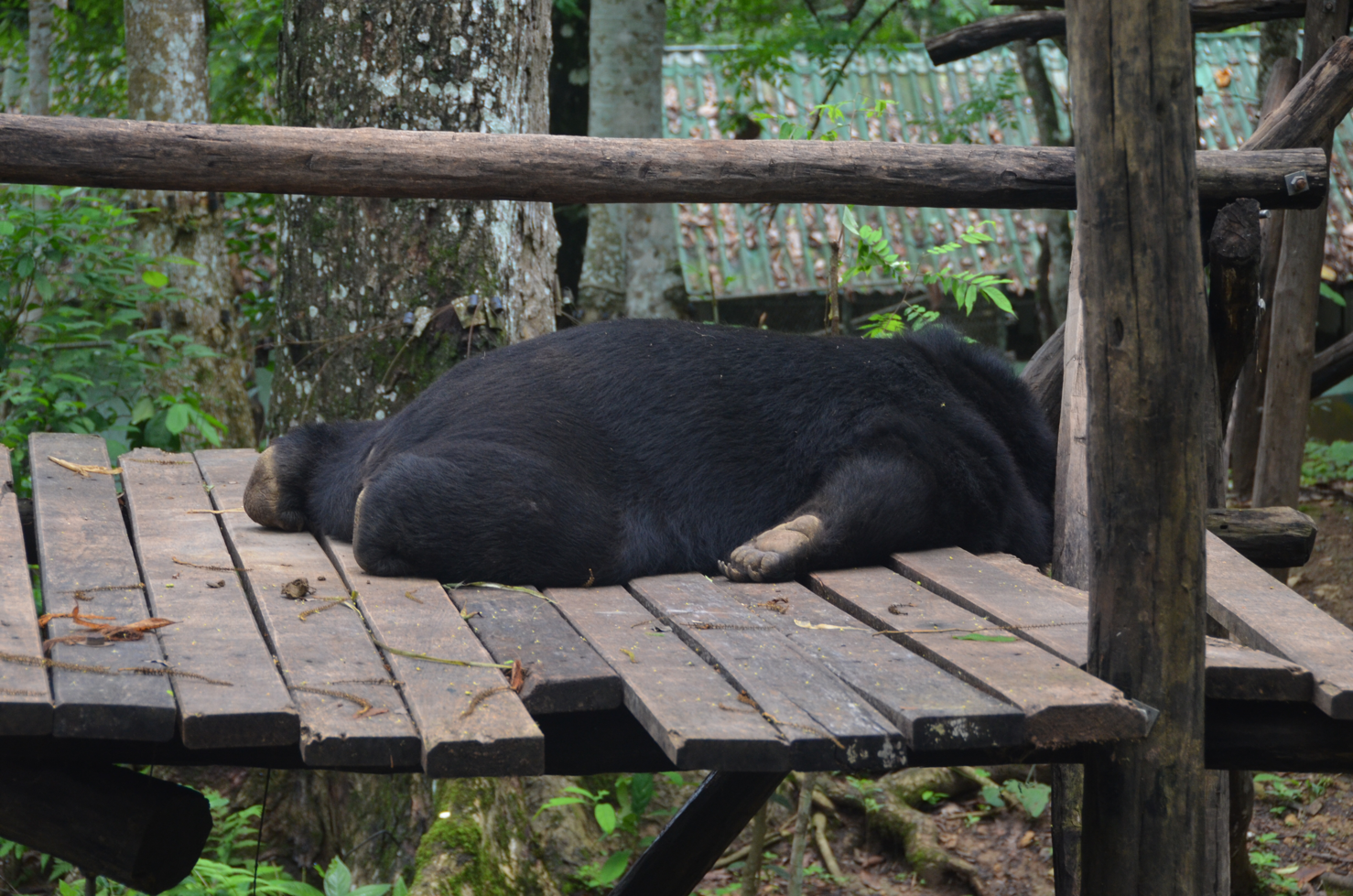
The park also hosts an Asian bear sanctuary. Like the elephants we saw a few weeks ago, these bears were rescued from poachers and street performers, but as such could not be released into the wild. Instead, they are given a place, free from the threat of poachers, to live out their days. The young ones enjoyed playing with the large rubber balls and the older ones enjoyed lounging in the hammocks.
As we had enjoyed our Thai massages so much, we decided we should give equal opportunities to Laos massages, and while we are at it, why not a pedicure? A luxury, sure. Nothing we needed, but when you are 33 and you're traveling and an hour and a half in a spa, plus a tip is only $15, well, you take advantage of that.
One thing I wanted to do in Asia was to take a yoga class. At home, each Wednesday morning, a small group of teachers meet in the gym for yoga with Mollie, our cheerful, thoughtful and caring yoga instructor. It's a highlight of my week, and I wanted to try that in a part of the world closer to its origin. A funky bar a few minutes walk from our hotel, Utopia, also hosts yoga in the mornings. We sat on purple yoga mats overlooking the tributary as our instructor led us through a challenging, invigorating class, all in English. She did a beautiful job of helping newcomers to the practice as well as reminding us to listen to our bodies and only go as far as our bodies would allow us. I had never had the desire to do hot yoga before, but as the class was outdoors, in the humidity, I feel quite confident I experienced one today. The sweat dripped from my forehead and ran down my back, but I was still very thankful for the opportunity.
We strolled through the morning market, a place for locals rather than tourists, a place where locals buy their fruits, vegetables, fish and meats.
The walk to the end of the "peninsula" was an easy walk. Boat rides were offered, quiet restaurants hang over the side of the river, and exotic trees created a pleasant covering.
The old Palace in the center of town is now a museum, and we wandered barefoot through the palace, admiring the gold leaf furniture, murals painted on the walls, and acknowledging stark differences between this and other palaces we've visited. We climbed the hill at the center of the old town that had great views of the surrounding city, mountains beyond, and the Mekong below.
One program I had read about before arriving was Big Brother Mouse, and I should have done more research ahead of time, as I would have loved to participate. The program's goal is to get Laos children reading. They publish books, visit villages to deliver books and offer opportunities for locals to learn English. During certain hours of the day, the "school" is open for travelers to stop in and visit with local children, just to help them learn and practice the language. Travelers can also go visit hill tribes with the organization and deliver books. Although we were unable to do either of the above because of timing, we were able to visit the facility where children built trains of Jenga blocks, laughing together and books were available for purchase as well as a box for donations.
Our food in Luang Prabang was quite tasty. Breakfast came, complete with croissants, and as breads have not been all that common in our travels so far, they were quite the treat! Pastries, fruit shakes, and a banana-peanut butter-chocolate shake provided many of our day time meals. Laos, Thai and French fusion foods made for great dinners. The spring rolls made with a zesty sausage and the French bread accompanied by green pepper humus were some favorites.
We've enjoyed this little town, this quiet city that seems practically empty during the day, but somehow lights up at night. It's been a great way to enjoy Laos as well as relax a bit.
After adding the Gibbon Experience to our itinerary, the next task was to see where to go from there and just how to get there. We had been told about Luang Prabang, a French settlement in Laos (it was once colonized by the French) that sounded like a lovely place to visit. So, we raesearched ways to travel from Huayxai to Luang Prabang. Trains and airplanes were not options. There was a fourteen hour overnight bus, a nine hour boat ride or a two day boat ride. Obviously, nine hour boat ride seems like the best option... until reading further into it. My travel book says, "Be aware that deaths are not uncommon given the recklessness of the drivers; if you do choose to go ahead with the trip, bring earplugs and close your eyes." Less appealing now, huh? I've already shared my thoughts on buses, so we opted for the slow boat, and it has been a fairly pleasant way to spend the better part of two days.
We had heard about a boat that was a bit more luxurious, including stops at caves and food, but that one was not leaving when we needed it to. The man at our hotel where we bought our tickets said if we paid a little more we could be guaranteed some of the better seats. Perfect, no problem. Yeah, he pocketed that money. All seats are the same and they are all first come first serve.
We were told the boat departed at 11, but boarding was at 10:15-10:30. We raced around getting breakfast, packed up, retrieving somewhat cleaner clothes and purchasing snacks, then boarded about 10:30. The boat was really quite large. There were a few seats at the front which faced one another, and then about twenty rows with a pair of seats on each side and a wide, six-foot wide aisle across the middle. The seats are old bus seats that are mostly bolted to the wooden floor boards making it feel like a large, open air bus. There was a room in the back for our luggage so that we didn't have to keep it in our seats with us.
The boat filled, but locals said it didn't depart until 11:30. Oh well, we were glad to have seats and ones that were next to one another.
The Mekong River that we are traveling down provides so very much for so many people who live in this region of the world. It has been compared to the Nile and the Amazon in ways that it brings life to so many. It is a wide, calmly flowing river the color of mud. Pockets of trash gather where currents collide and small logs drift alongside our boat. I assumed since so many people depended on this river that the river banks would be quite full of people, but I was very wrong. Instead, many of the banks remain perfectly empty. There are pockets of small communities, but those are incredibly small and also, not all that common. Those communities have homes that I would call more huts. They're made of wood and most show no sign of electricity. Near the pockets of people it is common to see cows, water buffalo, goats and chickens wandering along the shoreline. There is also some of the land in these areas that evidently is used as farm land, complete with a small shelter that provides the farmer relief from the rain as well as a great place to nap when escaping the summer sun.
In these pockets we've seen some people as well. Some are out on the shorelines, seemingly waiting for boats to pass as their entertainment for the day. Children laugh, smile and wave at the passersby, many of the young ones are without clothing and many of the young boys are busy chasing one another along the beach or doing flips in the water trying to impress us all. Fisherman pass us frequently in small, narrow boats.
We had heard that this trip was scenic and a beautiful way to travel. I would have to agree. The shorelines are a mixture of sandy beaches and black, rocky points. The lush green surrounding hilltops are often covered in low-hanging clouds. The gentle breezes caused from the movement down river have meant we've been very comfortable. Gentle waves and a slow-moving boat have kept my motion sickness at bay. In a way, it is similar to a train, airplane or bus that we are basically bound to our seats for a long duration, but we have fresh breezes blowing in and beautiful scenery to occupy us. An audiobook has been a great way to occupy most of my time. It has rained several times, but they have been gentle rain and we haven't gotten any wetter than a refreshing gentle mist on our faces.
The boat stops at a one-road town called Pak Beng for the night. The most difficult part of the journey may have been getting off the boat and onto the shore. The step off the boat was a large one, and then we were balancing on craggy, slippery rocks while wearing a backpack on both sides. The hotel we had booked was thankfully only about 100 yards from the dock and only about halfway up the hill. We had a delicious Indian dinner and were surrounded by mainly familiar faces as it seems most people staying in the town were on our same boat.
Before we de-boarded the boat, the man had shouted to everyone that we departed at eight the next morning. We wanted to make sure we once again got seats and so we were down at the boat around 7:30. It was then that we heard the locals talking about the boat leaving at 9. Oh well.
Our boat, however had been replaced by one that was a great deal smaller. There were probably about twelve rows of two pairs of seats and the aisle was just a little wider than that of an airplane. Each time we assumed the boat was full, more and more people came on. The boat was about half tourists and half locals. There are a few stops along the way aside from the main destination and sometimes local passengers and supplies got on and off at these stops. At one stop, about three people got off and more than twenty got on. I'm honestly not sure where everyone went to. There seems to be a room in the back of the boat where people kept disappearing to, but I'm not honestly sure what was back there. I'm just thankful we kept our seats, despite the fact that sitting for nine hours on an old bus seat is not the most comfortable. But, we made it safe and sound to the adorable town of Luang Prabang that has great charm!
In March, Jessica and I went camping in the Smokey Mountains. One afternoon, while sitting by the creek, reading our travel book, I came across something called the Gibbon Experience. My excitement in reading about it grew with every sentence and I knew it had to be on our itinerary. I will be forever grateful for that moment.
Houayxai is a small town just across the border in Laos. It holds little attraction on its own, rather than being a passing through point, or the connection to the National Park and the Gibbon Experience.
We had read lots of reviews online, but still did not know wholely what to expect. We were excited but rather anxious for this experience.
We started our time with a short safety video in the office then loaded into trucks (those with the benches and cover in the back). Driving through valleys, rice fields, up curving mountain roads and onto a dirt road, we made the two hour journey to a small village where we met our guides.
The website had listed the hiking on the Classic tour, the one we had chosen, as difficult. I believe I would have changed that to strenuous. I did not take into account that the tree houses, at such high heights, needed to be reached. Climbing was difficult in large part because it was so much up, and also, due to some rain, the hike was a bit slippery. It was made even more difficult when we added our harness for the zip line around our waist and thighs. The hiking was also beautiful, though, as we hiked through lush greenery, down narrow paths in the forest floor deep below the tall trees above us.
Let me pause and tell you a bit more about the Gibbon Experience. Their motto is "A childhood fantasy with a serious purpose." This organization is not just a tourist destination, but an organization that is trying to make a real difference in the area. It operates in the Nam Kan National Park, a region set aside in the late 20th century to protect land from deforestation and the wildlife that call this place home. Gibbon Experience employs locals, even some former poachers, to act as guides through the forest and teach people about conservation. As one of our guides told us, it is very difficult to get hill tribe people to grasp why not hunting tigers and other endangered animals is so important for the future. They work to educate locals, even school children about the importance of conservation and sustainable agriculture. In many ways, it reminded me of my beloved Heifer International. How do they get money for these important causes and bring awareness to people? That's where the tourists come in. They want visitors at the park to change their perspective, and what better way to do that than to zip line through the jungle and sleep high in the trees in a tree house? Yep, every childhood fantasy come true, and I was one of the lucky ones who got to participate.
With a harness around me, I nervously stepped on to the first wooden platform where the guides helped me attach the two pieces of my harness to the cable. My stomach churning with excitement and nerves, I stepped off and flew into the air. It didn't take long before the butterflies escaped and I was left only with a sense of amazement and wonder as I zipped from peak to peak over a valley that was over 100 meters below. It was breathtaking, incredible, liberating and stunning.
Zip lines felt amazingly safe. They were marked as one way so that we'd never meet in the middle, once we arrived somewhere, there was a clearly marked cable where we could put our safety rope. There were guides stationed periodically, but not at each station, so we mostly loaded ourselves, but it was incredibly easy. The part that I did not take into consideration was that to get from one zip line to another was often a fairly strenuous climb in between.
After monkeying around for a bit, we split our group of 12 into 8 and 4 and headed to our perspective tree houses. And yes, the way to get into our tree house was by zip line. Magical.
Our tree house (number 7), forty meters above the forest floor, was three stories tall. We entered on the bottom floor where we left shoes on all sides of the tree that supported our home and on the opposite side of the zip entrance was the most incredible bathroom one could imagine. To be fair, it may not have been the most luxurious, but I'd dare to say it had one of the best views of any in the world. There was a working sink and toilet (squat toilet, but those are common here) and a rainforest shower head. Showering there, facing the seemingly unendless green before you was an awesome experience. The second night, although there was light in the bathroom, when I showered the world around me was black, but sparks of fireflies and lightening in the distance was equally as majestic.
On the second floor, the main floor, it was one large circular room surrounding the tree. There was a table and stools for all of us to eat and play cards. In the middle, attached to the trunk was a full sink where we could get drinking water and wash dishes. Several lights powered by solar panels allowed our card games to continue into the night. A packet explaining animals we might see, binoculars for exploring the trees and a box to protect our food from small nibbling creatures were all provided. Four pairs of two mattresses were laid around the edge of the room covered in large canvases that provided some privacy as well as protection from mosquitoes.
The third floor was more of a tower room, a fun lookout tower with a trap door floor and one mattress in case a guide needed to stay the night.
Cooked just up the hill a little way, our meals were zipped into us and then made incredibly presentable.
They were all different and all quite tasty. In the evenings and each morning, our guides would come to make us tea, coffee and hot chocolate. Sliced fresh fruit was often served as a snack or dessert.
In our tree house, Jessica and I had nearly ten years on our fellow residents, but we all had a great time getting to know one another. There were two girls from Belgium. Charlotte who had studied to become a physical therapist, worked for a year, then took off and had been traveling through Australia and this part of Asia and the Pacific for nearly two years. She would stop periodically for a month at a time to work at hostels or in cafes, but was savvy with her money and just one week away from returning home. Veelna who had graduated from university recently and was traveling through this part of the world for several months. We had three young Canadians who had just graduated from university and were all in the fencing club together, enjoying a few months worth of travel before they begin their career. Mathias, who was traveling with the two other fencers was our token male in the treehouse and was a great sport. There was also a fellow American from Virginia who was currently taking several months to travel around this part of the world.
Our first evening, Jessica and I stayed up for a while playing cards with our new Belgian friends. We played Uno with some new rules, like when a 0 is played, everyone gives their hand to the player to the left and when someone plays a 7, they trade hands with one player of their choosing. It made the game even more fun and made it last for quite sometime. We also played Hearts, a game my family and I had been bringing out again recently. Veelna and I both knew the game and were able to piece together the rules and explain it to the others. Without knowing really what she was doing, Jessica shot the moon on her very first hand of Hearts.
At 6 the next morning I awoke to strange, unique jungle sounds that almost sounded like a car alarm, the sound of gibbons! The black crested gibbon that lives in this part of the world is endangered and rarely seen, but oh, we heard the song of the gibbons, in fact, it was a sound that woke me up. That's a joy I believe few have experienced. Although they sounded close by, it was very foggy and we could not spot them.
After breakfast, our guides took us on a trek through the jungle to visit the other tree houses and zip along the way. The journey was strenuous, but the views provided and the zip lines along the way were well worth it.
Each treehouse had its own charm and appeal, but after seeing them all, we still agreed we had the best. We first went to treehouse 3, where the other four people from our group were staying. Their house was much smaller than ours, all on one level, but their view was pretty amazing. The house hung out over a valley of sorts, making it feel even higher. They said they had great views of the sunset, but as they were high above some trees, I think we had better chances of seeing creatures.
Next, we took some of the longest and highest zip lines out to treehouse 5, one in a truly stunning setting. If you Google the Gibbon Experience online, this is the treehouse you see. It is on a very tall tree that seems to tower others in the valley so that it stands out apart from the rest of the forest. The zip line into this treehouse was much longer than the ones into others. It, too, had a lookout tower, but much of the main floor was similarly designed to ours, plus a bathroom on the same floor. On our way back to our tree house we were able to go back and forth on some of the longest zip lines, zipping across one, climbing up to the next, back again and repeat. I must admit that due to lack of skills, and the blame I'll give to my small size, there were many times that I did not make it to the end of the zip line. Feet pulled up close and head leaning back, without my backpack seemed to be the best arrangement, but there was not always a rhyme or a reason. Most times, I ended just thirty meters or so from the platform and would monkey climb with my arms to bring myself in. Twice however, I stopped much further than that and the guide kindly met me halfway to pull me in. They were always helpful, grabbing feet to pull us in or giving us a bamboo pole to grab so they could pull us in.
After lunch back at our own treehouse, we ventured onward, across zip lines and up and down mountains to treehouse 1, a huge treehouse with incredibly planned architecture. You zip in on a platform by the bathroom, then step up a few steps to a large living space with the same table, stools and mini-kitchen that ours had. On the same level, there was a double mattress at a great lookout point. Up a floor, another double mattress with its own view and up one more floor two double mattresses. Can you imagine the joy architects have in designing these creations?
It was at this treehouse that our guides, with incredibly keen eyes spotted movement in the trees. We watched for nearly an hour, commonly seeing branches move, and every now and then spotting langur monkeys gliding through the trees or swinging on the branches. Every now and then, one, including the little baby ones, would sit to just hang out on a branch. Almost silent, we allowed them to continue their daily routine and just enjoyed watching them.
We let them be, headed back to our treehouse for showers, dinner, games and some storytelling. Our guides, locals to the area, showed us some "stick" games similar to toothpick challenges I do with my students involving moving sticks around with specific rules to recreate a new design. Mor, our young, free-spirited, recently married guide typically just laughed and smiled through our time together, probably laughing at how difficult we found climbing the mountain, or how uncoordinated we looked on the zip line compared to him. In large part though, I also think that is a great way to communicate when language is not easy. Thongchanh, our older and wiser guide typically took the lead, and although he was always sure to keep us safe, he also was able to have fun with us. He told us more about the National Park, its founding and the purpose for it. He told us about his growing up near these woods and the one and only time he saw a tiger. He told us about the wide variety of jobs he's had from being a primary school teacher, to working in a hotel in the city we now head to, being a trekking guide for another nearby national park and the difficult task of creating the zip lines. We asked about how the country was affected by wars in the area, the government and his religion. The country is a democratic communist country where people vote for local officials and then those officials vote for a president. The people in the hill tribes and rural areas of Laos are not Buddhist as 65% of the country is, but rather he is Animism. As best I can understand, they believe in spirits and the worship of different spirits such as the sky and the mountains. I loved listening to his life story and appreciated his openness.
After he left, a game of spoons amongst the eight of us sparked. I have such great memories of this high-speed, chaotic game. My friends and I frequently played in high school with whatever items we could find such as pens or chapsticks. On a mission trip to Panama, we taught our bus driver to play and he soon beat us, repeating for the rest of the trip in his beautiful accent, "Who iz ze champion?" The game went on for several hours in our treehouse, no doubts our screams and squeals scared some of the animals. The meek and kind new comers to the game soon learned that one had to be assertive, sneaky and sometimes downright vicious to ensure one got a spoon at the end of each round. There were lots of laughs and only a few scratches before we finished up our game.
It was then that we looked at the night sky. It had been cloudy the night before, but our second night, between the tops of the distant trees and the overhang of our treehouse, we could see the stars. We turned off all the lights in our house, each sat with our legs dangling through the railing, over the side of the treehouse watching fireflies flicker and watching for shooting stars. Mumford and Sons played in the background, and in the quiet, calm of it all, many voices joined in. I thought of another time I had listened to this band, a time that I set out on a day's journey on my own in England to see the White Cliffs of Dover. It was a time I felt supremely independent, and I loved sharing the songs, this band with another group of travelers, younger, in a different stage of their lives, but never the less, also seeking and feeling that independence. I should also mention that there were also several Moana sing-a-longs in our tree house.
Clouds snuck in and covered the stars and we took that as a sign to go to bed. We had heard reports of how loud the jungle was at night, and yes, there were noises, but nothing all too surprising for this Alabama girl. Frogs, cicadas, and the fluttering of bat wings were really the only sounds I heard. None of them woke me nor kept me up, but if I awoke, the sounds always made me smile.
As for weather, we were incredibly lucky. It is the rainy season here, that's why it is the tourist low season. That doesn't mean it rains all the time, but more like our Alabama summers with frequent pop up storms. The first evening, it rained just a bit after we had settled into our treehouse. On our walkabout the next day, it rained just a bit, but that seemed to blend in with the sweat dripping down my chin, but was even cooler, so it was simply a welcome relief. When we left treehouse 1 after watching the langurs, it had become dark and we heard thunder rumbling, but the skies managed to hold back until we reached our own home away from home a good forty five minutes later. We saw more rain from the safety of our vehicle on the way back to town.
The bugs were annoying, relentless and incredible. Mosquitos were present, but truly only relentless at dusk and dawn, but burning mosquito coils (similar to a citronella candle) helped tremendously. Leeches were the most unpleasant. When I think of a leech, I think of a large slug-like creature. Not the ones here. In fact, I'm glad I was shown one as I may have picked it up thinking it was a large inch worm. They were frequently on our shoes, and largely due to the ickiness of them, we had big reactions to finding them. A couple people in the group, Jessica included, had leeches sneak in through their shoes and socks and attach themselves. They didn't leave large marks, nor could they even really be felt, but rather they just sucked off a layer of skin and made blood flow. Icky, yes, but nothing that should deter one from the jungle. We also saw some incredible bugs. At night, especially as it was dark and our lights were on, the jungle bugs flocked to us. There were bright green grasshoppers the size of a mouse and a rainbow of colored moths, many even with shining golden eyes. Thankfully, the largest spider over ever seen was spotted out in the jungle at a safe distance.
That brings me though to the lack of wildlife that we did see. This national park is close to where the Jungle Book took place. There are tigers, panthers, bears, leopards, wolves, deer and so much more. I didn't see a single reptile of any kind. I saw a handful of small, bright green birds, but not many, and not ones that I'd consider greatly tropical. I saw a squirrel, but he didn't look all that different from my brown ones back home. We did see a small rat the first night, but he quickly scampered away. But I did, for an incredibly brief moment spot a gibbon. As we were completing our zip lines, we began to once again hear the sounds of the gibbon songs, coming from nearby. Just minutes away from the small huts where we'd leave our harnesses behind, the guides spotted a few in some nearby trees. Most of what I saw was movement, but I did see those long arms on a dark body as he moved from one high branch to another.
One would think that going into the jungle, zip lining over high heights and sometimes being left on our own, I'd feel unsafe. I never once felt unsafe. Our guides, like geese parenting their goslings, protected us in a line, one in the front to guide us and one in the back to protect us. Our treehouse was close to the kitchens where they slept, not close enough that we could hear one another talk, but close enough that they could certainly hear our screams if something went terribly wrong.
I cannot recommend this experience enough. Yes, it was a bit expensive, but I believe that the money we spent goes to a good cause. I lived a childhood fantasy for the past three days, and I have no doubt the Gibbon Experience will be a highlight in my life for a very long time.
Apparently, three days in the jungle wasn't enough time with these incredible people, so after we showered, we met back at BarHow and enjoyed six hours together, drinking, eating and conversing with our new friends. Two Americans, two Belgians, a Slovakian, a Northern Irish man, two from Guernsey and a German who joined in sat around discussing a wide variety of topics from politics to music to Disney movies to healthcare to how to give all people equal opportunities, but mostly sharing a whole lot of laughs.




 Under that bright red banner, the alley-looking entrance, we went in there, walked up a flight of stairs and had some amazing fried foods. Hanoi has some delicious foods to offer, there are no two ways about that, but figuring out where to go and how to get there is quite the trick.