Sunday, June 13, 2021

Theodore Roosevelt National Park

When I told people I was coming to North Dakota, they almost all said, “Oh, Mount Rushmore!” I would say, “No, I’ve been there, but that’s South Dakota.” They would say, “Oh, the Badlands!” I would once again say, “No, that’s South Dakota.” (More on that in a minute.) Then, they would say, “Well, what is in North Dakota?”


Before planning for this trip, I probably would have had similar questions. Very few people I know have been to North Dakota, but that’s part of what makes it so intriguing to me! Thankfully, Niki, our 50 by 50 inspiration, had been here and had tips galore to share. Her advise steered us to a little known National Park. Theodore Roosevelt, our conservationist president, loved this part of the country. He ranched here, escaped here, and learned about conservation here. It is because of him that we have an expansive National Parks system, and so it seems only fitting that this park was named after him. 


This National Park is not a massive one. An hour and a half around a loop drive can show you a majority of the southern part of the park, but we all know that a drive around means you miss out on so much more.

One of my first questions to a ranger was about the Badlands. I have visited the Badlands National Park in South Dakota, and yet, this area had also been referred to as the badlands, so I asked for clarification. It seems there are several sections of badlands in the Dakotas, named such, I believe, for their lack of ability to harvest nor pass through on ox and wagon. The ranger proudly boasted though, that the badlands here are the oldest.

Jessica and I both love camping and hiking. There is something rejuvenating about it. So, we decided from the start that we wanted several nights at the park. Setting up our tent, blow up mattresses and chairs always takes a little bit of effort, so you want to make sure you’ve got time to really enjoy the home you just built. Our site had bison droppings and a snake slithering toward it when we arrived, truly welcoming us properly. My favorite times at our campsite were our evenings of playing cards, strolls around the campsite, watching stars appear, reading with no distractions and watching bison wander calmly through. Camping allows for the smaller pleasures in life to become the highest priorities.

The weather made our time in the park a little more trying with highs in the upper 80s and 90s, two full days of wind gusts in the upper 20s, and strong thunderstorms two nights (one with a tornado watch), but we made the most of it and found lots to enjoy in this great park.  Like most places with lower humidity, shade made a huge difference, but the terrain of this park did not provide a lot of shade. There were trees, yes, but aside from the cottonwoods in our campsite, they were more sporadic, and also quite “limby,” so getting under their shade was problematic.

The park is made up of a seemingly endless amount of buttes as far as the eye can see. A butte may appear like a mountain, but the difference in their categorization has to do with how they are formed. Mountains grow up from the ground while buttes are broken down from erosion. So, at one point, all of this land was the same height, but years of erosion have created buttes and canyons. The tall buttes have clearly distinguishable lines of color showing age and periods of erosion.

Wildlife in the park was plentiful! There are no bears in the area, so that made life a little easier taking away that fear. Bison were everywhere, sometimes on their own, sometimes in large groups of thirty or more. They wandered across the road and through campsites, showing that this land was theirs and not ours. We did some research and learned that these are bison, not buffalo, even though for years, Americans have used the terms interchangeably. 


Prairie dogs were in huge supply; their towns were marked on the map of the park. Some of my favorite parts of hikes were the walks through their towns. They scurried about, chirped at us and wagged their tails before going back into their burrows. This is a favorite video of ours, so we walked through the towns calling “Allen” and “Steve,” but no one responded. Researchers have determined that prairie dogs have a complex language system and even have different sounds for color and number. We heard many a variety of chirps and squeaks! 


We spotted deer and rabbits (one that even hopped toward me on the path before stopping to scratch his ear within a yard of me, so I almost gained a pet bunny!). Prong-horns were a common site as well. Through some research, we learned that they are not actually antelope. While they look fairly similarly, antelope are of a different genetic make up found in Africa. A major difference is that antelope have antlers (that come and go), but prong-horns have horns. So, the classic song has two out of the three animals named incorrectly. 


One of our favorite creatures to spot was not an uncommon one, but they are rare to see in the wild. When this became a park in 1954, a few of the horses living here eluded capture. Their descendants are now carefully managed, but still remain wild and free to roam the park. There were birds a plenty, and they happily sang throughout the day. Crickets, too, usually an evening sound, could be heard throughout the day across the grasslands. We saw a snake, but thankfully at a safe-distance and with no visible rattle. We heard coyotes at night, but never saw them. And the elusive porcupines kept to themselves.

Our first hike was one from Peaceful Valley Canyon. We had to cross the Little Missouri almost immediately (little being a key word). It was no more than ten yards wide and at its deepest was about a foot and half deep. So, besides the difficulty of taking on and off our boots, it was pleasantly refreshing. The rivers here are muddy, because of continuous erosion. We walked through prairie dog towns and winded through the valley of the buttes, but perhaps unwisely we chose the ten mile loop instead of the five. Parts of the trail were tricky, crossing over tiny muddy tributaries, but mostly, it was fairly flat, walking through sage brush and prairie grasses. The most remarkable part of the trail was after just a slight climb we ended up on a prairie plateau with nothing visible for as far as the eye could see. It was a drastic change from the desert/tundra-like valley we had just walked through. It was also a reminder that this whole area at one point had been like that. The tall land provided us with sweeping views of the landscape and made the hot long trek well-worth it.


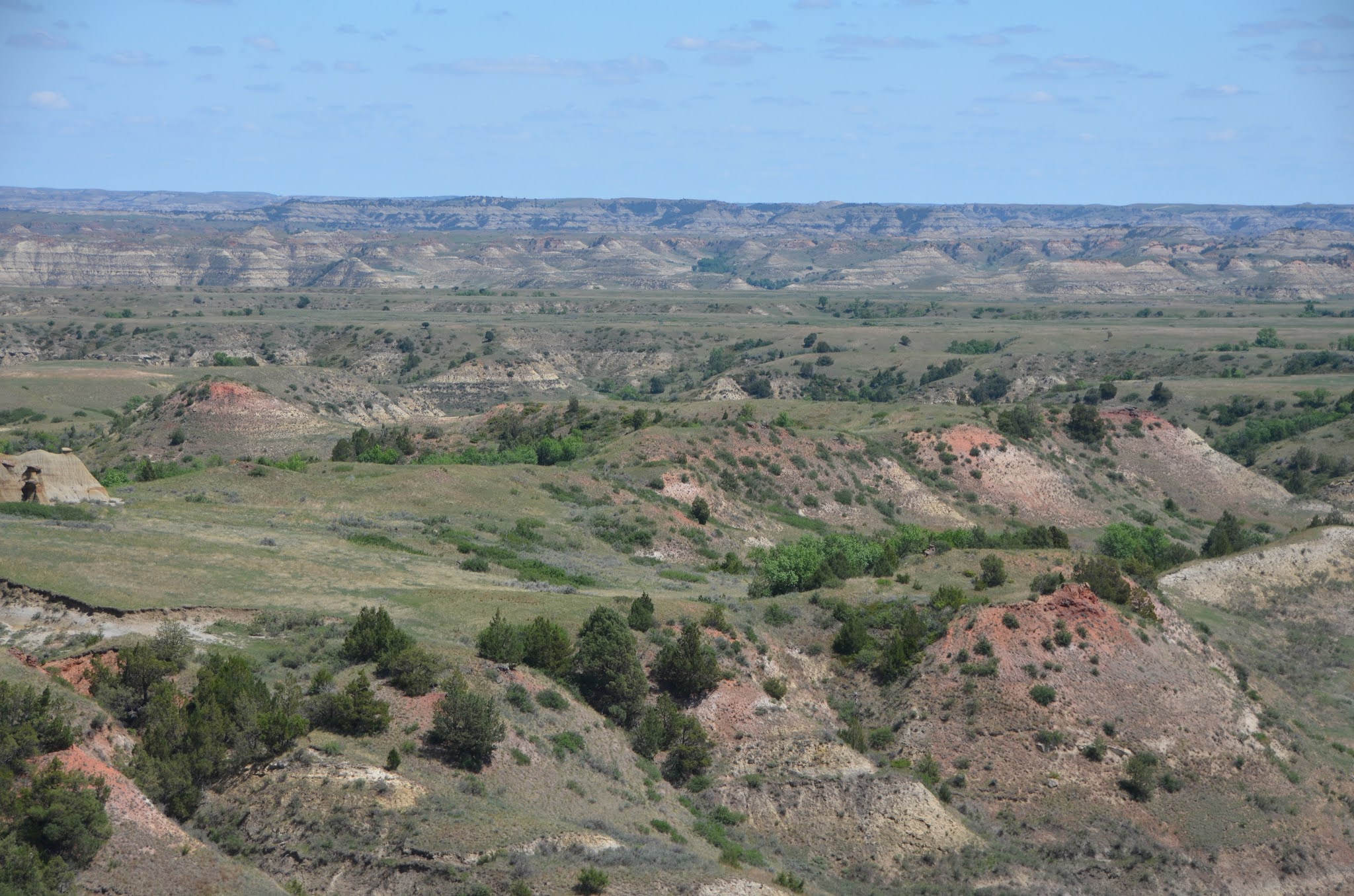
The petrified forest was another part of the park that we wanted to see, and it did not disappoint. The starting point for the trail is a little out of the way, along a dirt road that is not accessible after heavy rains. There are two small sections of the park that are parts of petrified forests, and we chose to visit the southern one. For about a quarter of a mile along the trail, you find petrified tree stumps and logs littering the ground. It was fascinating to see, and mind-boggling. Chips of “wood” are scattered about but if you touch them or attempt to lift them, you see that in fact, they are stone, despite their appearance. From a little internet searching, what I understand is that this area was once (millions of years ago) a warm climate with lots of water, not too dissimilar to the Everglades. Heavy rains buried the trees under lots of mud, depriving them of oxygen which helps them to deteriorate. Instead, minerals that help in rock formation attached to the trees and slowly, while keeping the appearance of trees, they turned to stone.


The one near perfect day that we had, with clear skies and highs in the mid-70s we should have spent hiking, but we chose a different rejuvenating option. We chose to have a lazy start to the day, then spent the afternoon with our chairs down by the river, watching bison doing the same thing on the other side. We chose to read, they mostly lazed about and tried to rid themselves of the flies. Sometimes just being is the best way to enjoy nature.


We spent more time in the town of Medora than we originally planned because of the weather. Niki had described it as “a sweetheart of a town,” and she was not wrong. Year-round it boasts a population of about one hundred twenty people, but that swells during the summer months. There are about a dozen gift shops, ice cream parlors, fudge shops, a candy shop, a handful of restaurants and a putt putt course and playground perfectly themed to the area. An art gallery and small museum about the inventor of Mr. Bubbles was a great deterrent on a hot blustery day. There is a large manor where the founder of this town, a wealthy Frenchman and his wife (who the town was named after) once lived. There also, shockingly, is a booming theatre industry, where, during the summer months, multiple performances occur each day in multiple venues. On a particularly hot blustery day, we chose to spend $15 to sit in air conditioning for an hour, and enjoyed it much more than we anticipated. A Theodore Roosevelt expert, and look-alike, shared knowledge of the President, his love for this part of the country, and interacted with the audience in a truly captivating way. We missed out on the ever popular Medora Musical, but then again, we must leave something to come back to!

Playground in Medora

Everyone that we met in this town blew us away with their kindness. The shop-owners, wait staff in restaurants, and rangers all went above and beyond, carrying on conversations and greeting us with warm, genuine smiles. The woman in the office for the Roosevelt Presidential Library, where we sort of accidentally inserted ourselves, could not have been friendlier and shared information with us about the upcoming build (scheduled to open in 2025). The gentleman in the candy shop led us to the Theodore Roosevelt play along with other helpful hints.

On our last day, we chose to drive an hour to the North Unit of the park, still under the same name, but a total separate piece of land. More buttes, vast landscapes, and canyons formed by the Little Missouri greeted us in the North. There are supposedly a herd of long-horns there as well as big horned sheep, but they wisely sought refuge elsewhere in the heat of the day. Cannonball Canyon was a unique geological area where, somehow, of which I still don’t understand, round, reddish rocks have formed and appear to litter the ground. 

We chose a four-mile loop hike in the park that took us through strikingly different landscapes in a short amount of time. Starting at the base of the buttes, we ended up climbing through a dense forest before arising on top of a butte with incredible views. A lookout point shows where the river takes a sharp curve because an ancient glacier blocked its way. And now the slow moving river floods frequently providing a perfect place for cottonwood trees to thrive.

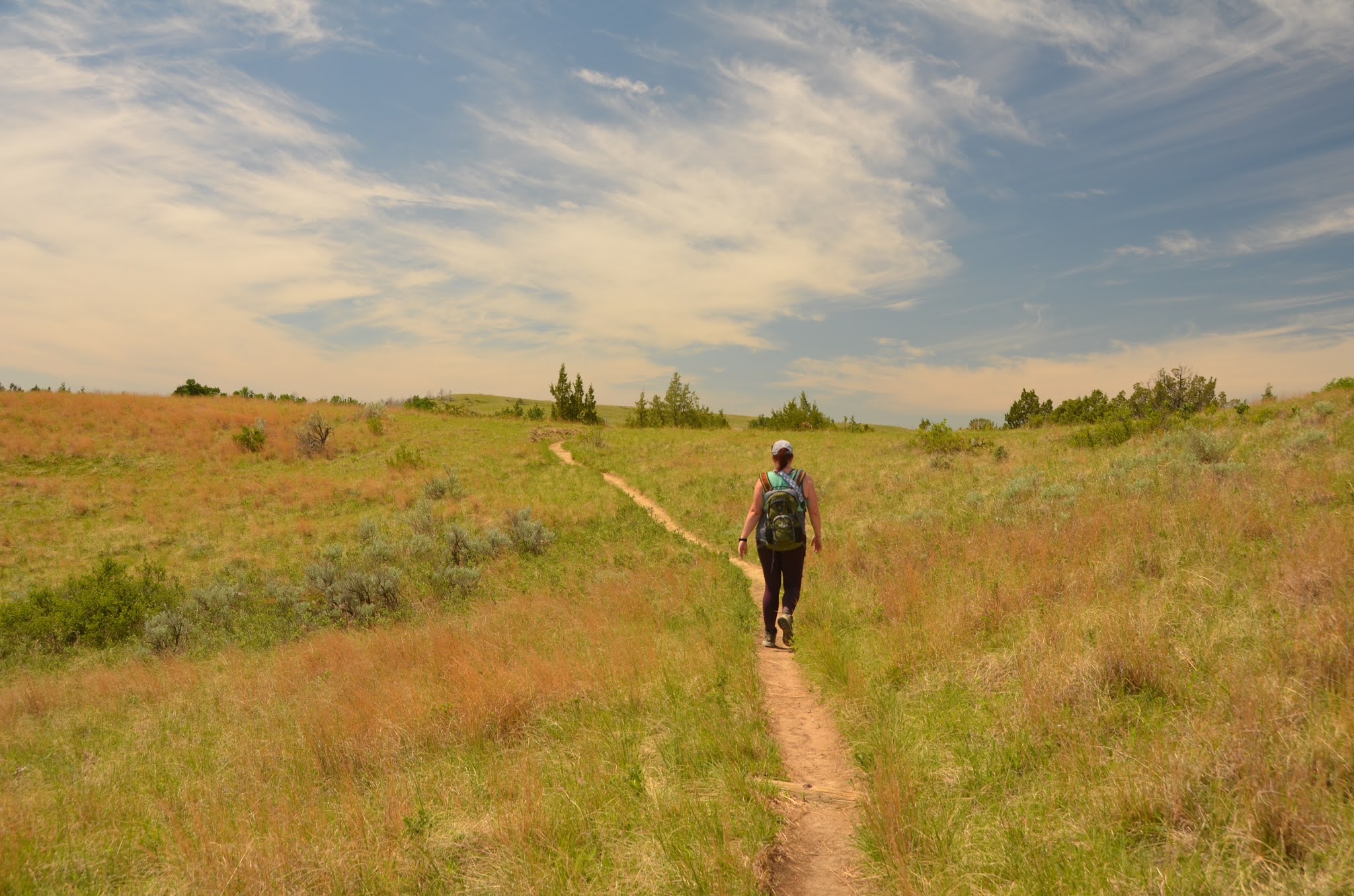

On our last night in the park, we drove further into the park to watch the sunset from a high peak, Buck Hill. The light danced across the canyons and buttes, creating soft golden hues. Anytime I get to watch the sunset seems like a gift, and watching it from such a stunning vista was a lasting gift. Not only was the view and the color of the sky incredible, but the amount of wildlife we saw on the road to and from added to the excitement. A herd of bison, including many young ones crossed on the road in front of us. Turkey and deer used a similar crossing spot. Horses seemed to know that their silhouettes were best admired in the setting sun, and so they strutted around and did their best to make drivers stop and notice them. An owl swooped low on the road just in front of us, but the porcupine stayed hidden. 


I’m not sure if and when I’ll make it back to Theodore Roosevelt National Park, but I’m so very thankful I’ve gotten to see the beauty it provides of this unique landscape and thriving wildlife. Let me know when you’re ready to come, I’ll happily help you plan your trip!

Monday, June 7, 2021

Where the Buffalo Roam, Where the Deer and the Antelope Play

I'm not sure if those lyrics have ever felt more real than they did today. We saw buffalo (perhaps raised ones, sure) munching on prairie grasses and deer and antelope feel right at home in wide-open fields. They all felt so comfortable even, that when a small crew of them considered crossing the road, and I came to a complete stop, they took a full minute to consider their options and calmly chose instead to stay on the same side of the road.

State 46
State 46

Our goal today was to get safely from Colorado into our next destination of North Dakota.  One route took us through Nebraska, which was a new state for me.  So, that meant it was important to ensure we did something there, because driving through doesn't count.  Our first stop was Scotts Bluff, a National Monument in southwestern Nebraska.  After miles and miles of continuously flat lands, we approached obtrusive buttes, jetting straight up from the plains.  Scotts Bluff was once an important landmark for the pioneers who set out on the Oregon Trail, helping to guide their journey as it was easy to spot.


Like all National Parks properties, it was well-taken care of with great signage.  We were able to drive up to the top of the Bluff and walk around for a few minutes where the views went on for miles.  In fact, Chimney Rock, another milestone on the wide-open prairie was clearly visible twenty-three miles away.  There were a few longer trails that we could take, but we had a long drive ahead of us, and, well, the nice ranger warned us from the start about rattlesnakes, so, that was enough of a deterrence.


Scotts Bluff was a perfect stop for Nebraska, but there was much more fun to be had in Nebraska!  When Atlas Obscura mentioned Carhenge, we knew we needed to stop.  Jim Reinders had lived in England for years, and like the rest of us, he became enthralled with Stonehenge.  So, upon his return to his small town of Alliance, Nebraska, he decided to honor his late father with an art tribute of extraordinary standards.  With his family's help, they constructed Stonehenge in just a few days.  We could see it a mile away, and remarkably, it truly resembles the real thing that sits across the ocean.  Tacky?  Sure.  Bizarre?  Absolutely.  Astounding?  For sure.  Definitely worth the slight detour.


After that, it was five hours of open road through northern Nebraska and South Dakota.  We made a pit stop for a mouth-watering burger in Rapid City (mine included fried cheese curds), but otherwise, it was wide-open.  By wide-open, I mean we went miles without seeing a tree.  We went miles without seeing any sort of structure other than a fence.  And yet, even more remarkable was the distance that we could see.  Vast expanses of open fields, rolling gently into the sunset as far as the eye could see.  

Excuse the bug-filled windshield

Our cow game was a huge success today, the only difficulty was knowing when one herd ended and the next one began to count our points fairly.  

State 47

Tomorrow, we set off to the Theodore Roosevelt National Park where we hope to roam and play with even more buffalo, deer and antelope (and if we're lucky, a porcupine, too!).

Saturday, June 5, 2021

Traveling to Denver

The drive from my house to Jessica's house is about 18-19 hours, a trip that I made last summer during the height of the pandemic so that the two of us could still spend some time together over the summer.  We went camping in Colorado where we were able to social distance like champs!  One would think that making the trip again, a year later, would be daunting to some.  But no, I love the excuse to see the countryside through the windshield and great audiobooks with some pop-music every now and then keep me going strong!

For me, there is something about crossing the Mississippi River.  It's not something I see frequently, but it sets a boundary for me, a home of familiarity for me.  Crossing it, I feel like the hobbits who crossed the border line of the Shire for the first time.

That being said, I sort-of bee-lined it out of the southeast, knowing that those states are close to me, and I can visit them anytime.  Although, I must admit that it is those places closest to me that sometimes don't get the attention they deserve.  Driving through rural, western Arkansas made me want to make a special trip sometime to see the Ozark Mountains and try out the Arkansas wine country (I'm confident it's like Napa, right?).

Last year, Kansas was a new state for me, so I took my time traveling down interstate I-70, stopping in Wamego (the self-proclaimed home of Dorothy and the yellow-brick road), America's Most Artistic Giant Toilet, a giant statue of the legendary Johnny Kaw, World's Largest Czech Egg, the North Pole of Kansas, and the World's Largest Easel (and painting).  You're already planning your trip to Kansas, aren't you?

So, this year, I once again wanted to enjoy Kansas.  Driving the hundreds of miles straight across the state on I-70 is not the most thrilling of ways to see the state, especially since I had already taken all of the little detours close to the interstate just last year.  My mom recently sent me a blog post about the best road trips in each state, and I realized that the Prairie Trail Scene Byway was not too far out of the way, so I took that side trip which weaved through one-stop-sign towns through the middle of Kansas.  

I stopped for a minute in Canton where the sounds of birds far-outweighed the sounds of cars.  The town's claim to fame is having the last built Carnegie Library and two water towers: one for hot and one for cold water.  Which begs the question, why don't we all have that?

Cold and Hot
Cold and Hot


My next stop was a much livelier town, whose proximity to the interstate no doubt contributes to its success.  Lindsborg, which in Swedish translates to Linden Castle, is a thriving tiny town with a population of a few thousand people.  This "Little Sweden" is proud of its heritage.  Dalas (Swedish painted horse statues) adorn the sidewalk, each uniquely created and painted to match the storefront.  My favorite was the one painted like a grapevine in front of the local newspaper.  Yes, I thought it was going to be a wine shop when I approached, but reading the "Heard it Through the Grapevine" description then made perfect sense!  There were local art shops, cafes, a Swedish bakery, restaurants, gift shops and a toy store.  Main Street was bricked, adding nostalgia, and every person greeted me with a warm welcome.


When given the opportunity to take a two-lane road or an interstate, for roughly the same amount of time, I will always choose the two-lane.  I love an opportunity to see the countryside, with less concrete.  Driving Highway 4 across the center of Kansas (I passed a town that was the geographical center!) was a delight!  There were enough cars around that I never felt unsafe, but for an hour of my three hour journey, the only car on my side of the highway that I encountered was one that was passing a tractor.  The tiny flat towns that dotted the landscape provided fuel when need be and a sense that I wasn't alone.  (Although, keep in mind that listening to a thriller about women going missing in a small town is not the best when stopping alone in small rural towns.)


One way that I found to entertain myself on the long, flat stretches was to spot something tall up ahead, usually a slender silo or a water tower, and then see how many miles until I reached it.  Many things were three, four or five miles.  Two different destinations I spotted on the horizon were eight miles away.  Eight.


My next destination was fourteen miles on a gravel/dirt road where I had to dodge the prairie dogs that scurried eagerly across the road.  But, Monument Rocks, a National Natural Landmark was well worth the detour.  Pulling up alongside these imposing chalk pyramids, in the middle of prairie lands, completely alone, was extraordinary.  They are on private land, but you are allowed to walk amongst them and wander among these towers where swallows have created colonies.  A couple other people arrived, but sharing this natural wonder in the middle of no where was not difficult.


I-70 finally beckoned me back, and I must admit that slowly watching the Rocky Mountains come into view is an astonishing site.  I'm thankful now for a few days with Jessica before we set off on another long driving day.  But if you haven't truly seen Kansas yet, give it the time, even just the vast expanses of fields is an amazing site to see.

Friday, June 4, 2021

RANDOM STATES

It's become a tradition.  Instead of asking, "So, Rebecca, what are you doing for the summer?", it has become, "So, Rebecca, where are you off to this summer?"  Usually, my response is met with praise, excitement and a tinge of jealousy.  This year, I have gotten more looks of confusion, even though, let's face it, most of us are up for going just about anywhere right now.

My dear friend, Niki, shared a challenge with us years ago that she was working on completing: See 50 states and 50 countries by the time she turns 50.  I loved this challenge, and immediately accepted it as my own.  Well, I'm at the point now, with 45 states under my belt, that now I'm headed to see some that are not usually on the top of anyone's bucket list.  Sure, I still have Hawaii left to see, but I wasn't sure how to work that into a road trip as of yet...  Thankfully, my ever-faithful travel buddy, Jessica, has accepted this challenge as her own as well, so I do not have to venture out on my own!  While the world continues to deal with a global pandemic, we decided it was not the best of times to travel internationally, yet, so, we decided it would be the perfect year to check off some of those "random states."

I decided to drive out to Denver instead of fly to Jessica, partly because of the fun of road-tripping and seeing new places, but I will admit, a larger part of it is so that I do not have to worry about limiting my packing.  I am a horrible packer, a what-if packer.  If one is needed, then three must be necessary.  Plus, we're going to be doing a lot of camping on this trip, and well, the way we camp is not the kind that fits in a backpack.  Most people refer to the kind of camping we do as "car camping".  Meaning, we sleep happily in a tent, but the car, loaded down with everything we could possibly need, is parked right next to us.  So, fitting all of that into a suitcase and onto a plane seemed a bit out of the question.  In fact, fitting all of that into my tiny hatchback car seemed a little bit of a squeeze.  So, my parents, VERY generously, let me borrow their minivan.  Trust me, I can even hear the jealousy in your fingertips as you're scrolling and reading that.  I know you're picturing yourself driving cross-country on the open road in a sexy minivan with sliding back doors and cup holders for all of the sippy cups.  Sure, it may not be the most appealing thing for a single gal to drive, but when you're idea of packing light means only taking half your belongings, then packing for a month-long trip with camping gear, a minivan is perfect. 

While there may not be a whole lot of "destinations" where we are headed, using websites like Atlas Obscura and Road Trippers gave us a plethora of destinations, most of which include seeing the largest of something.  I guess, in wide open spaces, might as well create the "World's Largest ___" whenever possible.

You've probably got some guesses as to where these random states may be, but for now, I'll leave that for the upcoming posts.  I am notorious about letting my blogs slip, not finishing the entire trip.  I'm determined to see this one through this year, even if it means finishing it from my couch upon my return.  I love blogging on my trips, as much for myself, as a record of my travels, but I truly appreciate you following along as well.

Let the tour of "Random States" begin!

Thursday, November 14, 2019

On the Border


"Give me your tired, your poor,
Your huddled masses yearning to breathe free,
The wretched refuse of your teeming shore.
Send these, the homeless, tempest-tost to me,
I lift my lamp beside the golden door."
-"The New Colossus" by Emma Lazarus

A couple summers ago, I had the pleasure of visiting the Statue of Liberty once again, climbing up her stairs and admiring her majesty.  The poem, a symbol, recognizable words, evaded me, but it was important to me that I found it.  A very friendly National Parks Ranger escorted me to the poem, in the depths of the museum, near Lady Liberty's feet, it stands.  The poem was written well over a century ago, but it is still there.  It has not been edited.  Seclusion of certain groups has not been added.  It does not say, "give me your brightest, your wealthiest, your healthiest."  It says, "give me your tired, your poor."

I saw the huddled masses yearning to breathe free this weekend in a tent city in Matamoros, Mexico.  I saw the homeless and tempest-tost, and yet, they are not being welcomed by Lady Liberty's loving arms.

A year ago, I followed Rachel, my "do-er" friend who always finds a way to help to McAllen, Texas.  (Last year's McAllen post)  We worked at the Humanitarian Respite Center in McAllen, Texas for a long weekend.  At the time, the tiny center, no where near equipped to handle the influx of immigrants did an astounding job of feeding and clothing people who had just crossed the border legally and putting them on buses to their loved ones scattered throughout the country.  Earlier this year, they were able to move into a new, expansive facility, equipped with space that could not have been fathomed last year.

This summer, the Center welcomed upwards of 1,000 people a day.  Yes, 1,000 people a day.  We planned our trip then, eager to get back and do whatever we could to help, knowing that helping 1,000 people on a daily basis takes an incredible amount of money and man-power.  Then, within a month, the number of immigrants the Center hosted daily dissolved to under 20 a day.  Why?  Because of the new, stricter laws put into place by the administration.  So, the trip that five of us had planned, changed course, but we were still eager to go and do what we could.

We were scheduled to leave Thursday evening and arrive late in McAllen.  Our first flight was delayed, meaning we would miss our connected flight.  With some quick thinking and calls to customer service, we got a flight into Dallas late Thursday, a hotel at the airport and a flight out early the next morning.  Nothing ever runs as smoothly as planned.  Our flight continued to be delayed, and finally landed in Dallas around 11:30pm.  The hotel was close to the airport, but not in the airport as we had at first assumed.  Meeting up with the shuttle proved more complicated than we had planned, and so it wasn't until a quarter to one that I curled up on the floor of our hotel room to get a solid four and half hours of sleep before getting up to get on another plane.  As the plane began its descent into McAllen, and my eyes struggled to stay open, I realized that the difficult twelve hours I had just experienced did not even begin to compare to the days, weeks, months of hellacious travel that many of those I was headed to meet had endured.  Sometimes, we all need a little perspective check in our lives.

We hit the ground running with shopping errands given to us by one of the "on the ground" volunteers we had met last year.  We purchased dozens of sets of long underwear for children, knowing that the temperatures on Friday were dipping and were especially chilly to these people who rarely see cold weather, along with tarps to go under and on top of the tents. Mayra, the local angel who daily takes items across to the immigrants, greeted us and we followed her to Brownsville, Texas, about an hour south along the border.

Our team: Rachel, Lydia, Emily and Betsy
There is not a tent city in Reynosa, the town across the border from McAllen.  We are not completely certain as to why this is, as the local volunteers had a variety of answers, and even they were a bit uncertain.  Some said that Reynosa was more dangerous and not as welcoming to the migrants.  Some said that it was because there was a detention center there, and people were more likely to be arrested and held.  Some said it was because if asylum seekers were given an interview, it would be in Brownsville, so they settled close by.

Each of us anticipated driving across the border, partly because we assumed the tent city was a short distance away, but instead Mayra parked the car and we got out, pulling wagons of blankets, long underwear and tacos made by another group of volunteers.  We paid a dollar in quarters and then walked the short, five minute walk, across the Rio Grande into Mexico.  One would think that such a short walk, one would hardly notice the difference, but before even exiting the bridge, we could see the sprawling tents covering the hillside of what was once a city park.  Some of the tents backed up to the government buildings where they applied for asylum.  The guards on the Mexican side sometimes examined each of our items carefully, asking lots of questions about prices and amounts, but other guards saw what it was for and barely batted an eye.

Short pedestrian bridge into Mexico.

First time in Matamoros

I have seen and heard a couple different estimates on just how many people are living in this tent city, but it appears somewhere between 1,500 and 3,000.  They are living in tents, no matter the summer heat nor the winter chill.  They are living in a place that in no way is equipped to handle the huddled mass.  Port-o-potties are in the center, and one can imagine the stench coming from them as the sun bakes them throughout the day and the flies that circle close by.  Showers?  Well, the Rio Grande is right there.  Water?  Barrels with spouts provide water, but of what cleanliness, I know not.  Trash is partially under control, partly because Mayra gives out trash bags when she arrives, and those who return with full bags of trash seem to have a better chance of receiving one of the items she has brought with her.

Part of the tent city
Distributing Long Underwear

It appears that when people arrive, they present themselves to Border Patrol and are given a date of when to appear for their interview.  For whatever reason, some people are given a date a few weeks away, and some are given a date months away.  I saw multiple people carrying around official papers with "Notice to Appear" at the top, guarding the papers and seeking help in filling them out.


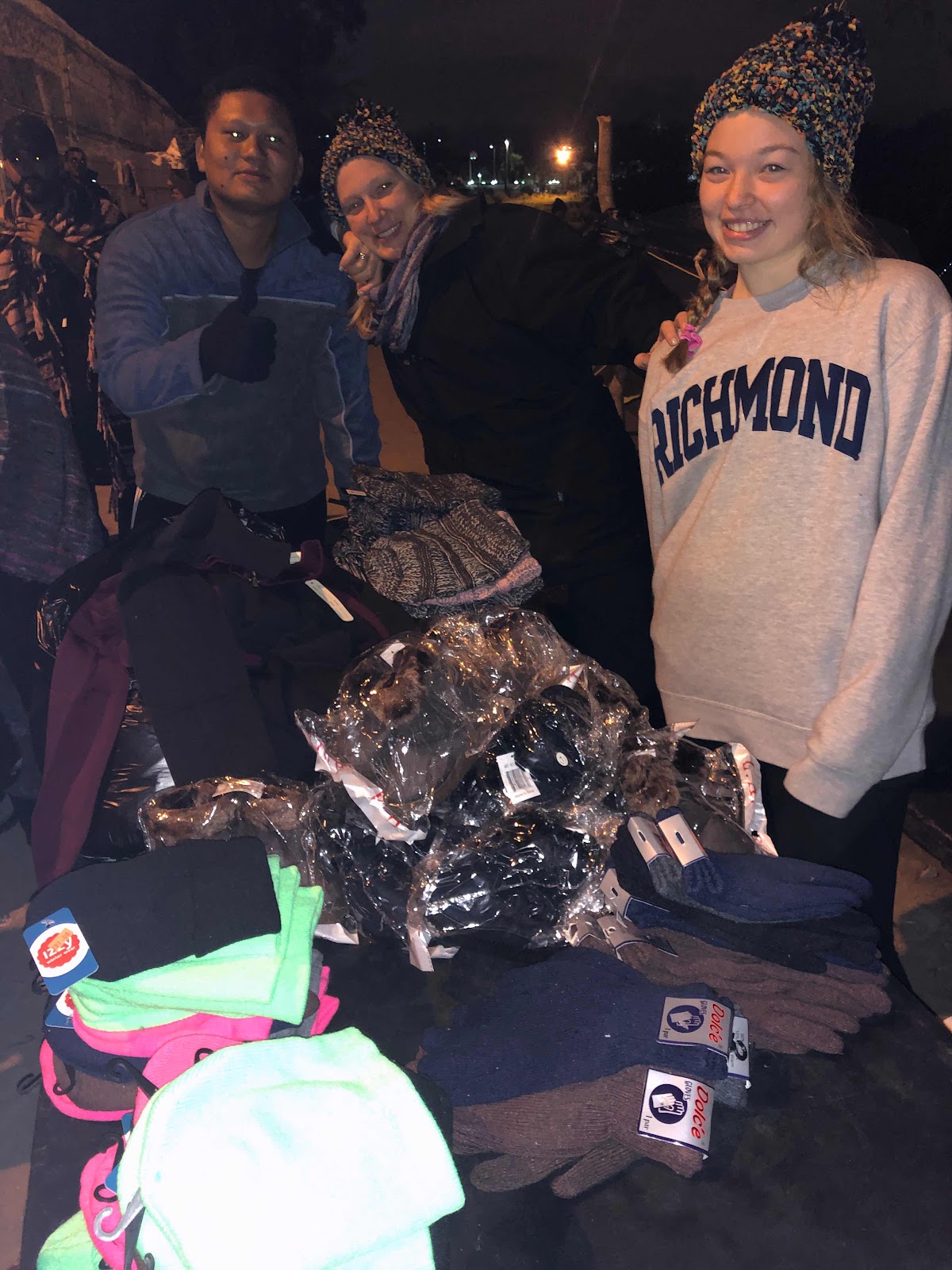
After distributing the items, we went back into Brownsville for dinner, but realizing how chilly it was getting, decided we could help again.  We went to the Mercado in town and purchased dozens of hats, gloves and socks, hoping they would bring warmth.  Even in this process, we faced a moral dilemma.  We were able to purchase hats and gloves for .50 and $1, most likely meaning they came from sweat shops where these people were running from.  And yet, if that meant we could help to keep them warm, shouldn't we still purchase them?  There were many times throughout the weekend where I felt that all we were doing was giving a man a fish, rather than teaching him to fish.  No, we didn't get to the root of the problem and help solve the crisis, but can a man who is starving even have the strength to learn how to fish?


Putting gloves on a hand that likely has never felt gloves, nor had the need for them before.
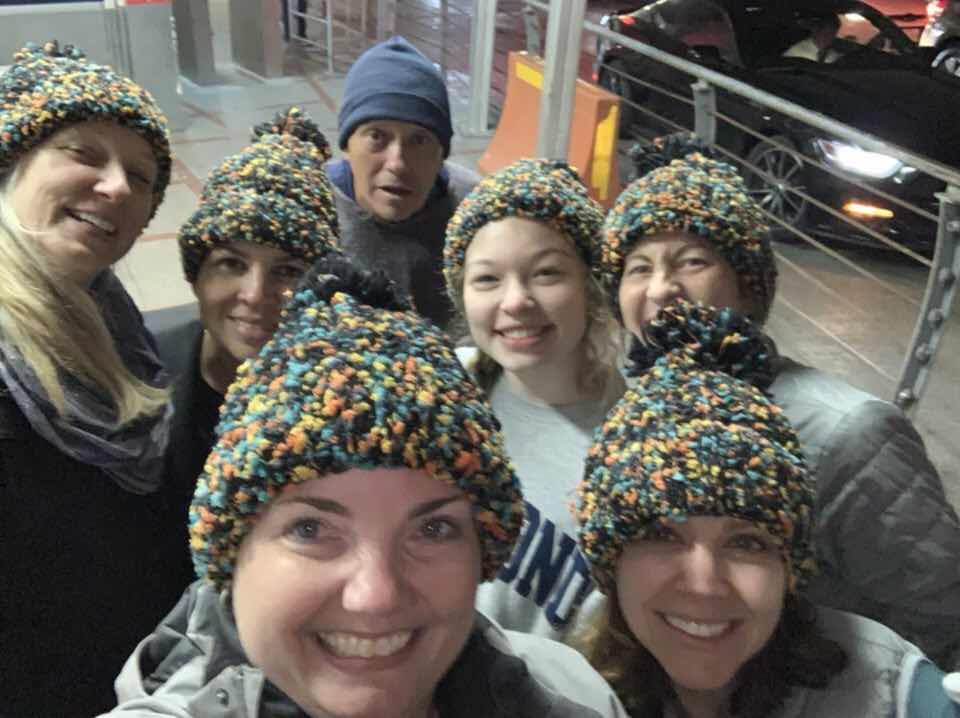
Even we were unprepared for the cold, so we purchased matching hats (which, yes, of course, we left in Matamoros).   Team: Rachel, Mayra, Willy, Betsy, Lydia, Rebecca and Emily

Exhausted and worn out, yet sleeping in comfortable beds in a safe place, in the beautiful home of a wonderful founder of the Humanitarian Respite Center, we slept soundly, and somewhat guiltily.

On Saturday morning, we went back to the Respite Center to meet up with Willy, whom we had met with Mayra the day before.  Let me first tell you about Willy, one of my new favorite people.  When he was 18, he met a young American woman on vacation in his home country of Guatemala.  They fell in love, and he followed her to New Jersey where they married, had three kids and he became a US citizen.  Knowing that education was the most important thing he could provide for his children, Willy worked long, hard hours as a pastry chef in a 5-star hotel, and was able to send them all to Catholic school.  They are now grown, with lucrative jobs and Willy and his wife have separated.  Last year, he came to McAllen with his dioceses and realized how much needed to be done.  So, he sold his home and car and moved to McAllen.  He has very little, and gives so much of himself to help anyone and everyone who may need the help.  When he was young, he said he really wanted to be a missionary, but he fell in love, and well, that changed things in the Catholic church.  So now, he felt he was getting to fulfill his lifelong dream.


We worked with another team of volunteers on Saturday morning, some nuns, some medical missionaries, and some like Willy spend much of their time and energy there.  We passed out sandwiches and milk (chocolate milk brought wide smiles of delight).  Once all were fed, came some necessities like diapers, formula and baby wipes all purchased, bagged and sorted by other volunteers.  We learned of a makeshift clinic on site, and were thrilled to visit them and learn of ways that we could financially contribute to their work at the border.

Crossing Saturday morning, wagons in tow

Distributing milk and sandwiches.  Please notice the adorable one in the green hat proudly wearing the long underwear given out the night before.

Interactions with those living in the tent city grew as our faces became more familiar.  Two young men told us they had been taxi drivers in Honduras, but showed us a photo of a friend of theirs, a fellow taxi driver who had been shot while driving.  They ran, fearing for their lives.  We met Edwin, a 21-year-old man awaiting his interview.  He is there alone.  It seems that women are more frequently granted asylum, and so his sisters were already waiting for him in Virginia, but he had to be patient.  One can only imagine the stories that they could all tell.  What fears and horrors caused these young mothers to decide to walk thousands of miles with young children in tow.
Edwin, enjoying the book and dictionary Rachel found for him.

Thanks to the incredible generosity of our friends and family members, we spent Saturday afternoon shopping and even renting a cargo van to haul more supplies from the Respite Center to the border.  Willy was so excited about the possibility that he loaded up the vehicle finding more and more things for us to take.  We purchased vitamins, ibuprofen, bandaids, alcohol wipes, and children's board books for use in the clinic.

Should I be worried that no one at Costco batted an eye when we checked out like this?

Willy was so excited about the cargo van, that he continued to load us up!
Interesting fact: cargo vans echo a lot.  Also, they drive a lot like a pick-up truck.  I'm thankful for my days as a pick-up truck driver and how useful those days continue to be.

Arriving back at the "casita" later than anticipated, we got right to work with bagging hundreds of diapers into bags of a dozen and putting children's vitamins into small bags of seven, the dosage for a week.  At some point, delirium set in, and although we were faced with incredible dire circumstances, we found ourselves in near tears from laughter.  What we saw and experienced was draining both physically and emotionally, but this time with friends, with gummy vitamin residue on our hands was crucial.  It kept us going and kept us from falling apart.

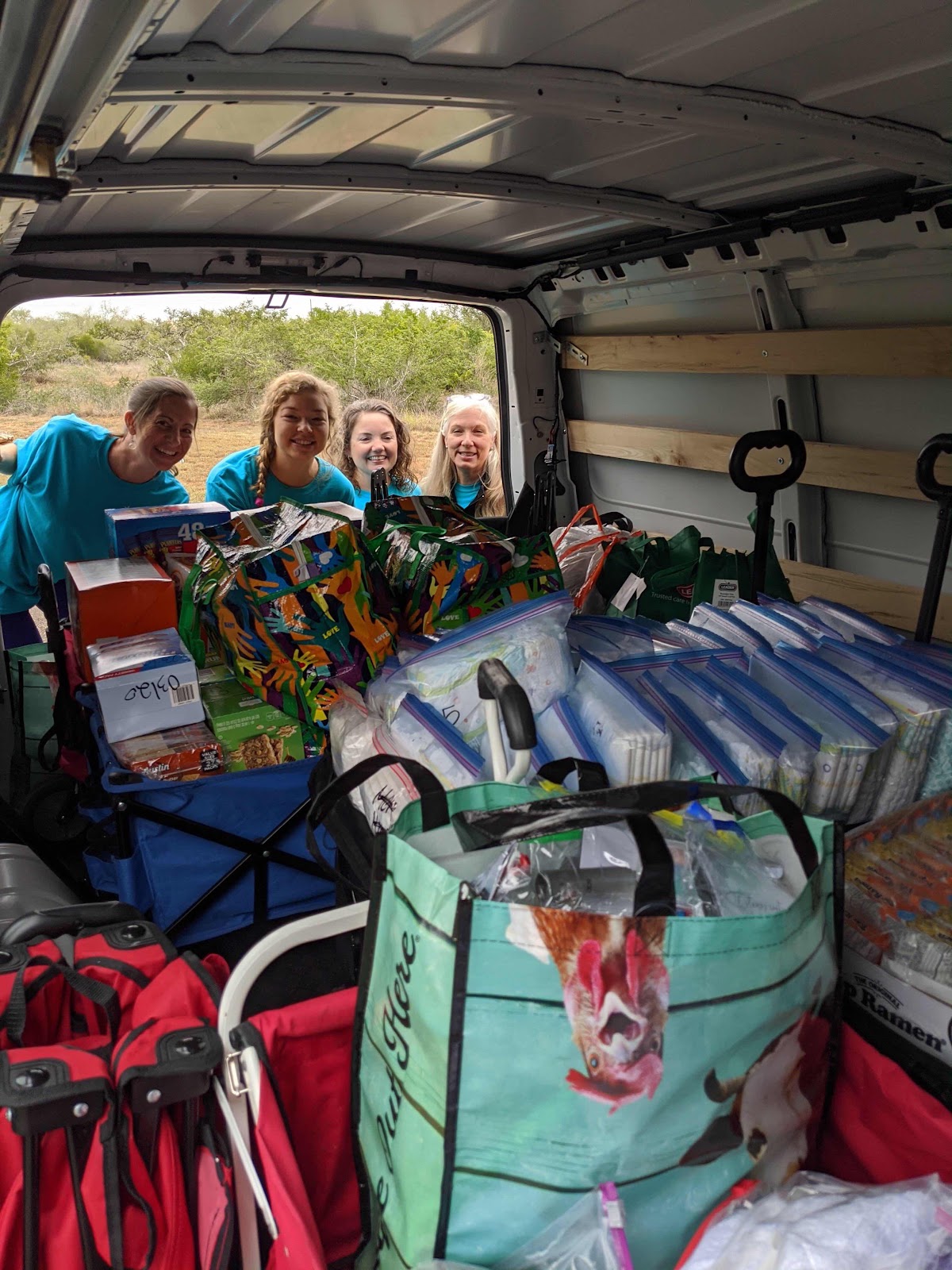
The U-Haul cargo van that we assumed was much too large was quickly packed to the brim with wagon loads of items we had purchased and items Willy was eager to deliver.  We took a seemingly endless supply of toothbrushes, toiletries kits, reusable bags, chapstick, deodorant, large diapers, snacks and the medicine we had purchased.
Cargo van pre-organization
Cargo-van post organization

Upon arrival, we had decided that we wanted to distribute the items in an assembly line of sorts, starting with a bag and putting one of each thing in the bag.  This idea seemed to quickly disintegrate because half of our team had to return across the border to retrieve even more wagon loads (and Emily even traversed a third time for even more supplies).  Lydia, a beautiful young woman whom I was lucky enough to teach and since travel with, and I looked at each other with a moment of panic.  But before we could even comprehend a new plan, two young boys jumped up and took places in line eagerly helping to pass out items.  They were kind, cheerful and incredibly efficient.  I'm sure they joined us for a multitude of reasons: there is little else to do, they got to share in smiles as they passed out items, and sure, we watched them tuck away some chosen items, but we could not have cared in the least.  Lydia speaks Spanish, but aside from greetings, I can say incredibly little.  Truly though, aside from smiles and some pointing, little else was needed.

That little smile was worth all the miles we traveled.
Remember that seemingly endless supply of toiletries?  That loaded cargo van?  Every time I looked up, the line was the same length, no matter how many bags we made and distributed.  We gave away hundreds of toiletries bags and then three wagon loads of snacks.

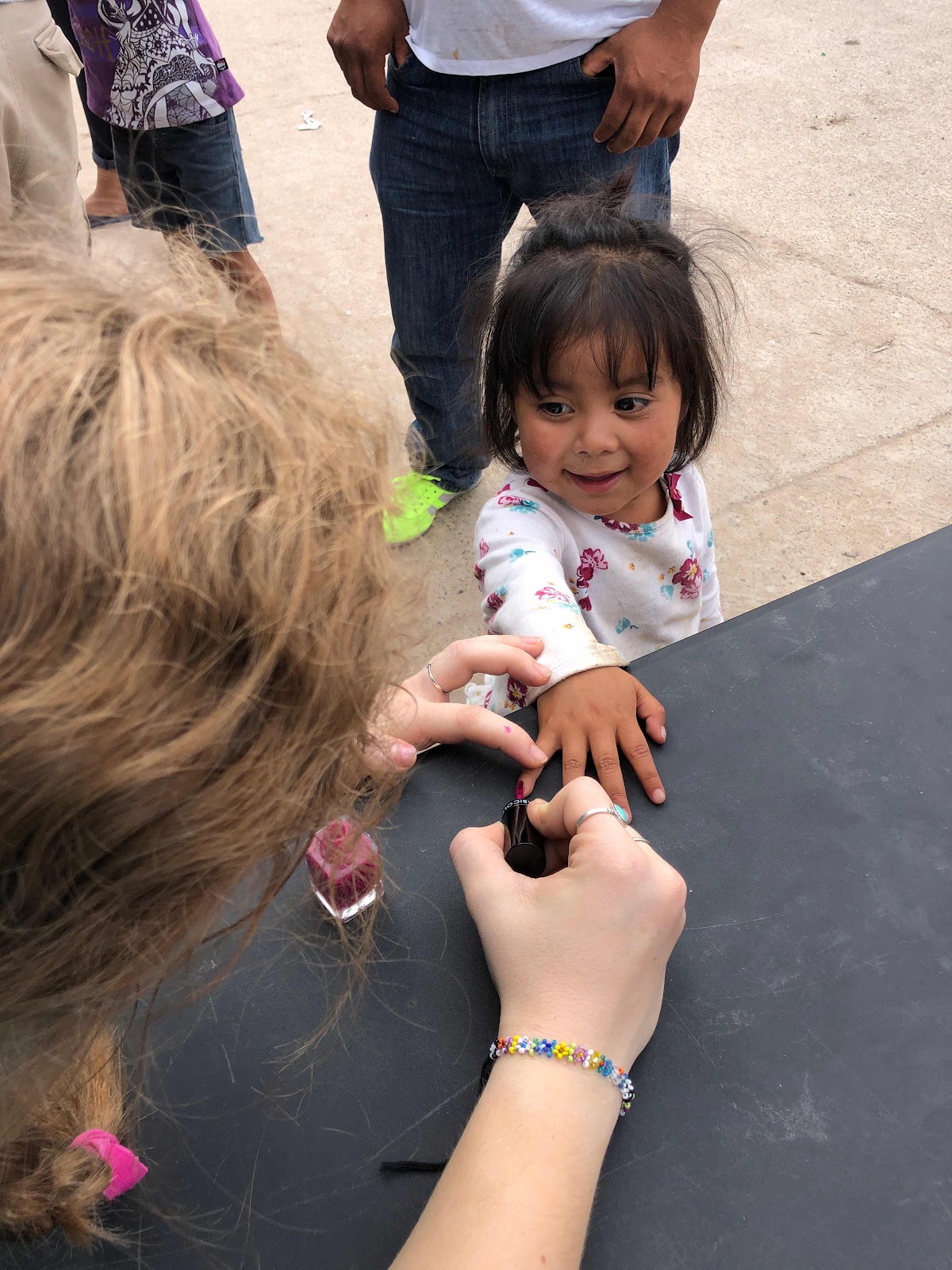
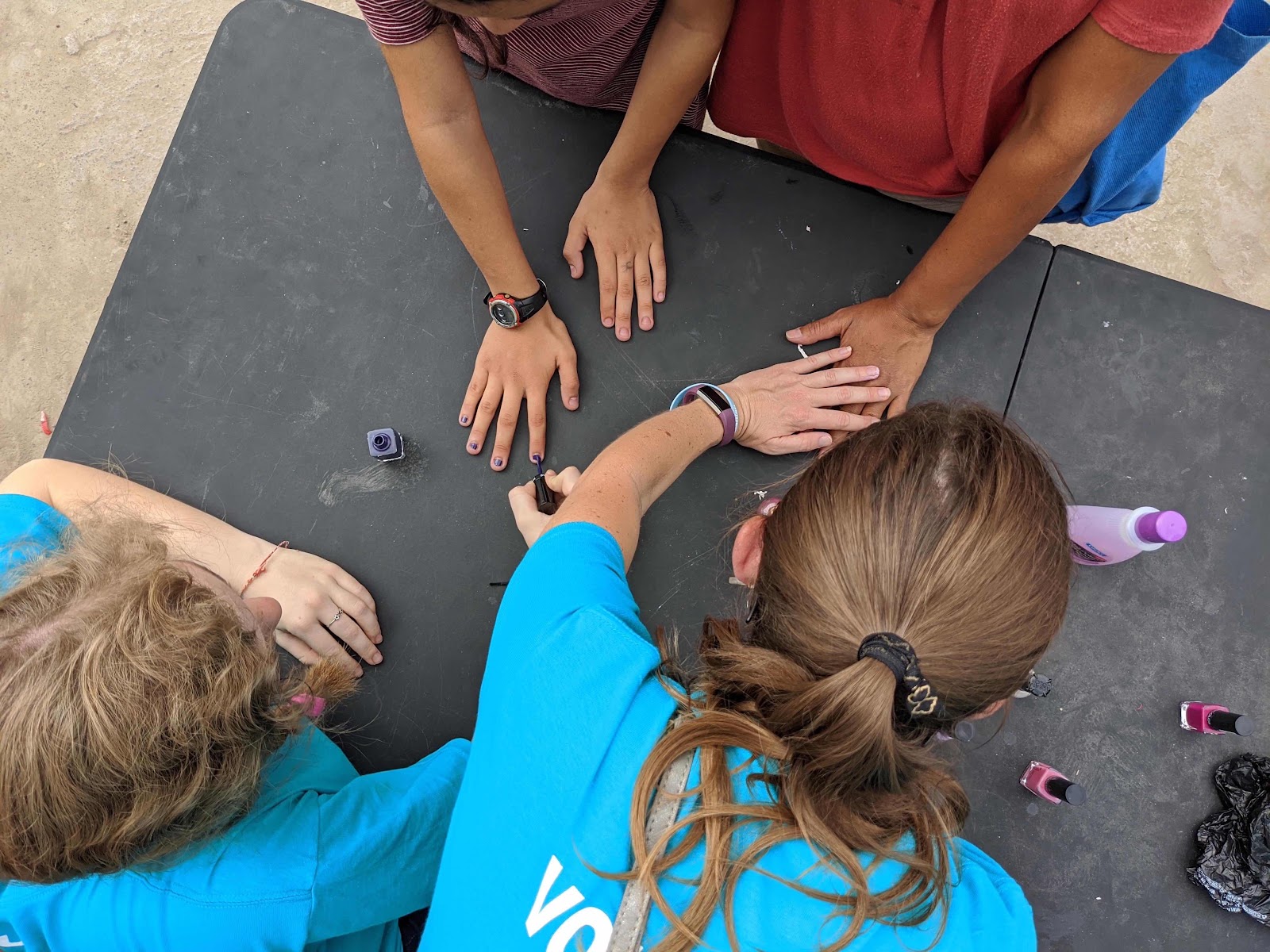
Once all of the necessities were handed out, we brought out the non-essentials, the things that help to make our lives a little brighter.  Kickballs were quickly enjoyed both as soccer balls and volleyballs, giving children something to do and bringing smiles to their faces.  The ever ingenious and thoughtful Rachel had had the idea of bringing finger nail polish.  I believe this was my favorite part of the entire weekend.  The group painted dozens of hands, bringing smiles to the faces of women and girls.  I like to think that in these moments we showed our greatest humanity.  Sure, their hands were dirty and we could have been fearful of germs, but in our actions, we showed that we are all human, and we realize that they, although in very different situations, are just like us.  Betsy even got down on the ground and painted some toenails, the ultimate sacrifice to show love to a stranger.
Betsy's servant heart at work

Professional volleyball moves
As we passed out different items over our time, whether decorative toiletry bags, hats or gloves, we noticed multiple people who seemed picky or wanted more than one.  At first, I admit that I was frustrated, wanting them to be grateful and just take one.  But then, I had another gut check, a realization that I needed.  Am I not choosy in picking items for myself?  Do I not have a plethora of winter hats as opposed to one?  Do I have dignity and perhaps even some vanity in worrying how I look?  Absolutely, to all of the above.  I realized then that I had no right to judge, and only worried that I would give an entire collection of items to someone if only they asked.

Matamoros


It takes a village.


Matamoros, with the bridge to America in the background.

After purchasing more hats and gloves to be delivered the next day, when cold, wet temperatures were headed back, we said our goodbyes to Willy and Mayra, thanking them for all of their work that they do day in and day out to touch the lives of those living in Matamoros.  Our lovely hostess, Hermi fed us dinner and helped fill in some of the gaps of things that we did not understand about what is happening.  She and several others are the founders of the Humanitarian Respite Center and have worked tirelessly to help those entering our country feel welcomed.

And then, without much hassle at all, we came home.  We came home to safe neighborhoods, warm beds and families who love us.  Leaving what we saw behind, trying to go back to normal is difficult.  Interacting with people who have so little, and yet are so gracious and hopeful is equal parts heartbreaking and inspiring.

We saw, through the incredible generosity of our friends and family members, that so many people want to do something, and yet don't know what to do.  We, in fact, still have some money to spend because of this generosity, despite the amount of things that we purchased.  We are currently awaiting an estimate from a local doctor for flu vaccinations, and then will decide where to spend any other money we may have left over.

But there are LOTS of ways that you can help financially, educationally and politically.  We encountered lots of people and lots of organizations doing the right thing and helping people.  Did they perfectly blend together?  No, of course not.  As with any groups of people working in the same area, trying to accomplish the same goals, there were often egos that got involved, but overall, every person I met had the best of intentions and their hearts were in the right place.

These are some people and organizations that we met and worked with along the way that you can contribute to:
River Ministries - This was the team we met running the makeshift clinic.
Team Brownsville - These people provide two meals a day and an hour a week of school for the children.  (This report was on NPR about them.)
Catholic Charities - The Humanitarian Respite Center is a blessing, and with any luck will soon be welcoming hundreds more people once again.
Mayra's Wishlist - Mayra has created a wishlist of items on Amazon that she distributes.

Educate yourself (as I will continue to!) about just what is going on, the dangers people go through to get to the United States and what we can do to help.  I recently read Enrique's Journey written by Sonia Nazario, a Pulitzer Prize Winning author, that documented a young boy's journey and his assimilation into the United States.  It was horrifying and eye-opening.  I also recently read The Only Road, a middle-grades fiction following two kids escaping to safety into the United States.

Since most of the people that I met were from Honduras, I began researching more about Honduras and what we, as US citizens can do to support the country and make people want to stay in their own homes.  Honduras is violent and corrupt.  I went to the country with Heifer International, and thoroughly enjoyed my time there meeting local people and seeing the work that Heifer was doing, but even at that point, a coup happened, and we were forced to stay indoors at times for safety.  It seems that problems compound one another there, but most of it starts with a corrupt government.  Corrupt leaders keep much of the money themselves, driving their country into deep poverty with 66% of the population living below the poverty.  Murders go un-investigated because of fear, bribes and lack of police.  Even teachers were "bought" by a leader and although they had some of the highest salaries around, they weren't doing the work or were not even certified teachers.  Even the medication is sub-par and often barely worth more than a placebo.  This New York Times article by the same author as Enrique's Journey explains a lot.  It also helped me realize that without necessarily meaning to, America has caused many of the problems that fuel the violence in Honduras because of our country's dependency on illegal drugs.  We are fueling the gangs and drug cartels.  Sonia Nazario also mentioned this organization helping to end corruption and the positive work that they have done so far.

Our Congressmen need to hear from us, their constituents.  Tell them that we want more done for those huddled masses yearning to be free at our southern border.  Help them to also see that putting funds in the right hands of support in Honduras could mean that fewer people will want to leave their home.  Instead, the administration has "punished" Honduras for allowing so many people to leave their country by cutting support to the country.  You can read more about that here.

You can also go!  Go, see first hand those who are suffering.  Meet people, hear their stories and then share with others.  Matamoros, Mexico is said to be very dangerous.  I cannot necessarily attest to that as I barely went 100 feet into Mexico, but I never once felt unsafe.  Sure, there were moments of angst when I was a bit nervous or worried that our large influx of items may start a riot, but they never did.  People were patient, kind, and appreciative.  I will be happy to pass on the contacts I've made there, or you can contact the agencies I mentioned above.  But I believe that the more people who see the situation first hand, the more things will change.

Take your own team to the border!  You won't be sorry, and you won't forget it!

Overall, though, remember that we are all children of immigrants.  Remember that at some point in our own histories, we have been members of those huddled masses yearning to be free.  And remember, that just like you, these people had no choice into the country in which they were born.  Let us all be like Lady Liberty and shine a lamp welcoming the tired, the poor, the homeless and tempest-torn.