I’ve been fortunate to travel to many different places and visit many cultures around the world. Truly, all have been kind and welcoming to foreigners. Thailand stood out to me as the most overwhelmingly kind, and they still do, but the Japanese have challenged my high ranking. The Japanese are incredible people, and they are one of the largest reasons people fall in love with this place. It is an incredibly quiet, peaceful place with organization, high expectations, and a community spirit. 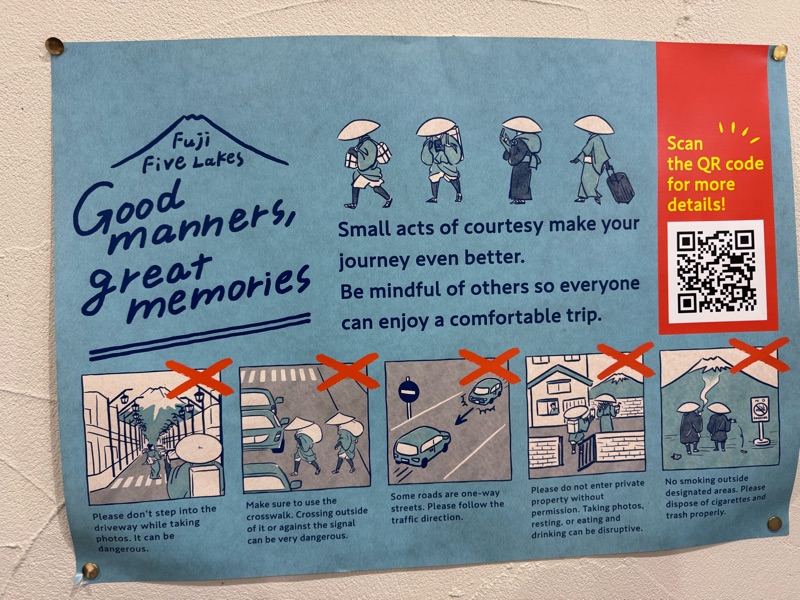
It is a crowded place, so there are often lines, but there is absolutely no pushing nor arguing over places in line. Everyone knows to walk on the left, whether on the sidewalk or the stairs. In escalators, the left side is for standing and the right is for walking. Sometimes these directions are posted, but often times it is just an understood rule. When waiting to board a subway, everyone waits just to the side of the door, and everyone is let off before anyone tries to get on board.
I have realized now that at home I am overstimulated by the volume of things. I worry about that adjustment when I get home. It is so quiet here. It’s a crowded place, but people speak softly, whether on trains, in restaurants, or even on crowded streets. One night, we watched a group of Japanese teenagers standing around in a circle. There was no adult with them; they were smiling, and yet from twenty yards away, I couldn’t hear a peep from them. In contrast, one night we heard a group of American teenagers from a great distance coming down the road. The difference was stark and embarrassing.
I knew I wouldn’t blend in here. My skin color, hair, and features don’t blend in in many Asian nations, and of course my accent sticks out like a sore thumb. However, what made me stand out more surprised me: the color of my clothing. The Japanese, while very fashion conscious and elegantly simple, rarely wear color. Looking around, it is rare to see anything outside of the black-and-white spectrum, in fact, Black is by far the dominant color. My elementary school teacher wardrobe of flowers and bright colors does not at all blend in, but I’m okay with that. 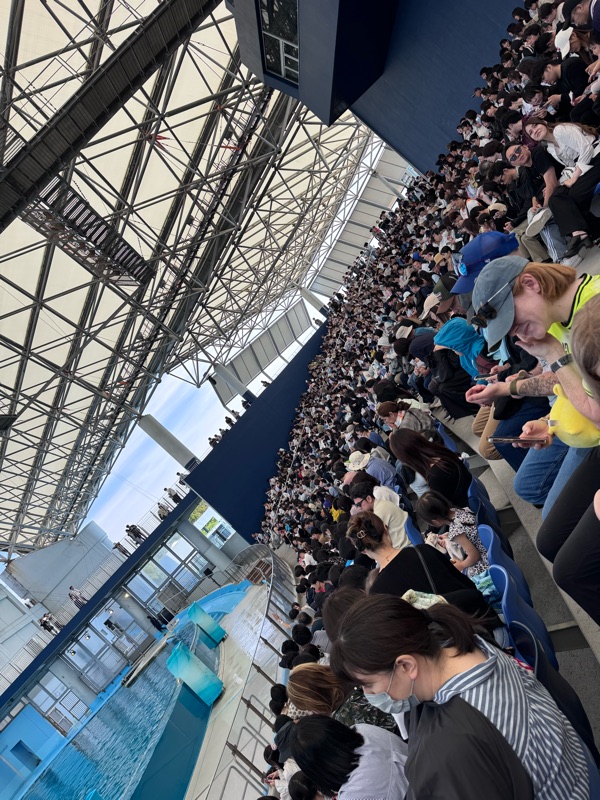
Our food tour guide in Tokyo, Lloyd from Uzbekistan said, “After you’ve lived in Japan for a while, you can’t survive in the real world.” He wasn’t just referring to the delicious food and the incredible toilets, but he was particularly talking about the goodness of the people. He said that in other countries he knows people keep their backpacks close to their front and don’t have their phones or wallets visible at all. Here, he said he knew of a lot of people who had lost their phones on the subway and had gone to the Lost and Found department of the subway the next day, and they were always there. He heard the same thing about a wallet. In fact, many people when getting on the subway move their backpacks to the front, but it is only to ensure that they don’t bump into other people. 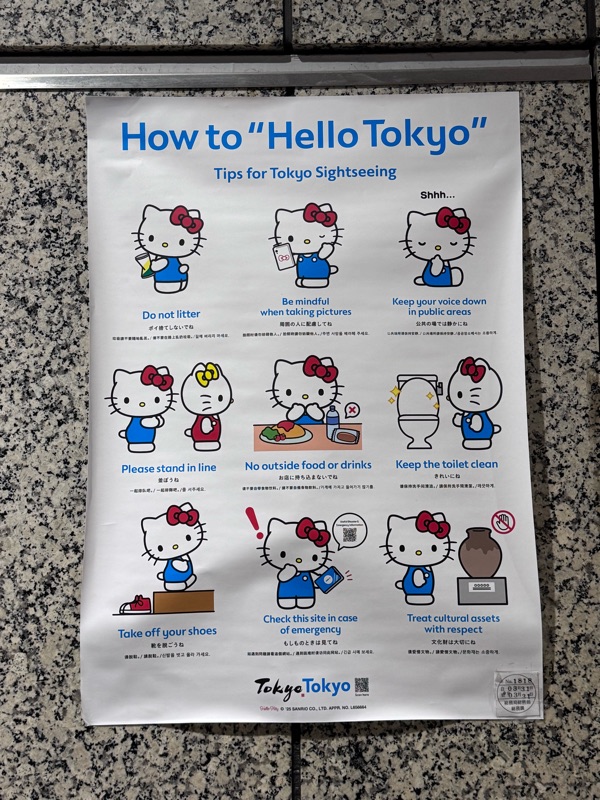
In the same way, perhaps by law, but certainly by custom, when parking, cars are reversed into spaces. This makes it safer for everyone, particularly on the narrow streets and small parking lots. Just a courtesy to other drivers? Highly likely.
As rule followers, people in Japan, when crossing crosswalks, only cross when the light tells them they can. This is all of the time. Even when the crosswalk is simply crossing a road the size of a side sidewalk, and there are absolutely no cars around. The Japanese people patiently, and without complaint, wait. When cars are turning, if anyone is anywhere on the crosswalk, the pedestrian always gets the right of way without complaint or honking from the drivers.
Japanese have incredible pride in their country and it shows in how they care for their country. Have you seen the news about Japanese World Cup fans cleaning up the stadium after games and the players cleaning the locker rooms? It doesn’t surprise me at all. Dog owners walk with not only plastic bags to pick up large messes, but also a bottle of water to wash away the little ones. People keep the street in front of their homes clean. I don’t just mean ensuring there is no trash, but I mean sweeping up leaves so streets are spotless. A few years ago, there was a terrorist attempt in Japan where someone planted a bomb in a trash bin. Now, there are no public trash bins, and yet, shockingly, there is no trash. People carry it with them and then do their best to find the appropriate recycling bin or trash receptacle for it. (Tokyo did have some trash, but it also had lots of tourists, so I’m sure it was us and not the Japanese leaving these messes.)
Now, in some ways, these conservative, generous people do have some tendencies to judge when things are not as they should be. Everyone gets yearly physicals here, and if you are overweight (by a fairly tough scale I believe), there is not only some quiet public shaming that is involved, but also a tax. No wonder we never encountered any overweight Japanese people, despite the fact that if I stayed here long term, I may be one. Rob told me that he asked a Japanese co-worker how to say, “Bless You” after someone sneezes. She said they don’t say anything, but what they might say basically translates to, “Don’t do that in public.” When we were taking sushi lessons, our instructor taught us the Japanese phrase for “Good Job!” She told us there was not a Japanese equivalent for “not a good job,” just sort of a pity smile.
But the people in Japan truly are some of the most polite and kind people I’ve ever met. (Most even have clear umbrellas to ensure they don’t run into other people.) One might think that a group of strict rule followers would appear uncomfortable, perhaps oppressed or bitter, but that is not these people. They are thankful for rules, they appreciate them, and they are happy to be in a society with other rule followers.
We noticed a lot of the older generation of Japan was very hunched over. Mind you, they were still walking around, not wheeling around, but with a strong forward hunch. After weeks here, we realized why. When people say goodbye or thank you, they bow. All that is needed is one quick partial bow, but if you watch people telling each other goodbye, it often looks like a conversation between lovers who don’t want to be the first to hang up the phone, so the bows continue.
The Japanese really do everything better. The food, the bathrooms, the technology, the organization, but mostly just their connectivity to the greater good of the society they’ve built.
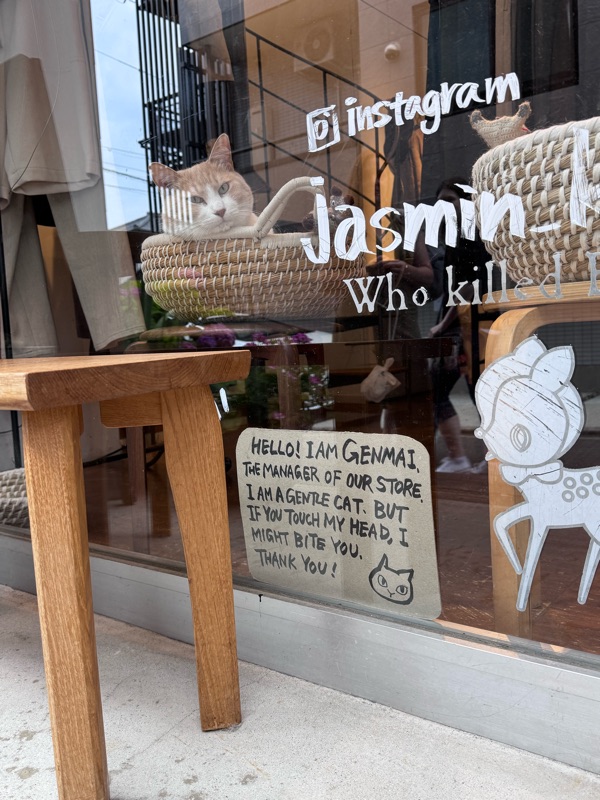
(Even the cats are polite!)

No comments:
Post a Comment