About a year ago, I listened to a book. I honestly didn’t know much about it, but a lot of people I knew were reading it, and it was my favorite genres of historical fiction, so I gave it a try. Little did I know how much Island of Sea Women would impact me. The story was difficult. It was gut wrenching at times and the fact that I had so little background knowledge made the understanding of names and places challenging, but the Haenyeo women fascinated me. I began researching the island of Jeju, and well, it is all thanks to a book that we are here now.
I’ve decided to split our week here into a few different posts, and on this one, I’ll be sharing about some of the history of this island. You may already know much more than I ever did, but as much of its history was hidden for decades, it needs to be told.
First, let’s start with the unbelievable Haenyeo women. Haenyeo translates to “diving women,” and that is exactly what these women are. They dive, with only goggles and flippers for support at huge depths of up to ten meters and often are underwater for two minutes collecting what the sea has to offer. There’s not a lot of clear cut answers as to how this came to be, but there are many ideas. Diving has long been a way of livelihood on this island, but it was in the seventeenth century that it became an industry dominated by women. It was thought that women’s bodies were better suited to diving because of fat content and a “higher shivering threshold” than men. Also, many men had died in war and deep sea fishing accidents. There also seemed to be certain rules and taxes put on boats, where female divers were a bit of a loophole.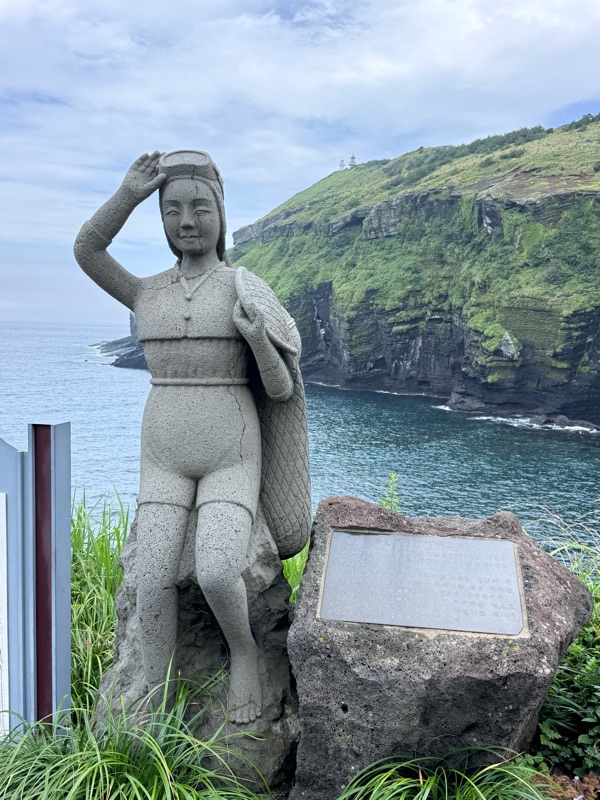
So, for over three hundred years, women have been diving in Jeju to feed their families. It created a unique society where women were the breadwinners, and yet not the decision makers. Women would bring home food for their family as well as sell items at market to buy other necessary goods. They learned to love the gifts of the sea such as abalone, sea urchins, and a variety of seaweed. Today, there are still women, some into their 80s that do this as a way to provide for themselves and their families. These women are incredibly strong, proud of their heritage, and sisters. For generations, they have watched after one another in the water, ensuring that they’re diving partners return to the surface each time. They alone understand the hardships and the difficulties of their lifestyle. Ceremonies mark significant events in the life of a woman. A sort of dressing room around a warm fire provided not only a place of refuge during long days at sea, but ann opportunity for bonding with one another. Girls, as early as thirteen officially became divers. Today, not at all unsurprisingly, these women are not being replaced by a younger generation. The next generation is moving to big cities and getting degrees for a variety of other careers.
Because this unique lifestyle is so revered and recognized, there are multiple museums on the island giving more information about these strong women. There is also a demonstration that several Haonyeo women do daily. I felt fortunate that the weather cooperated enough for us to witness this. I will admit, that in a way, I felt as awkward as I sometimes do watching a Native American performance. Are we putting their culture and lifestyle on show? Is it more of a fish tank where we are staring in and fascinated by what we see? Or is it a sign of cultural respect that we are here and want to learn more? I’m still not 100% sure, but the four older women that we saw sing and dive, had smiles on their faces and seemed to be thankful that they could still carry on the traditions of generations of women from this island.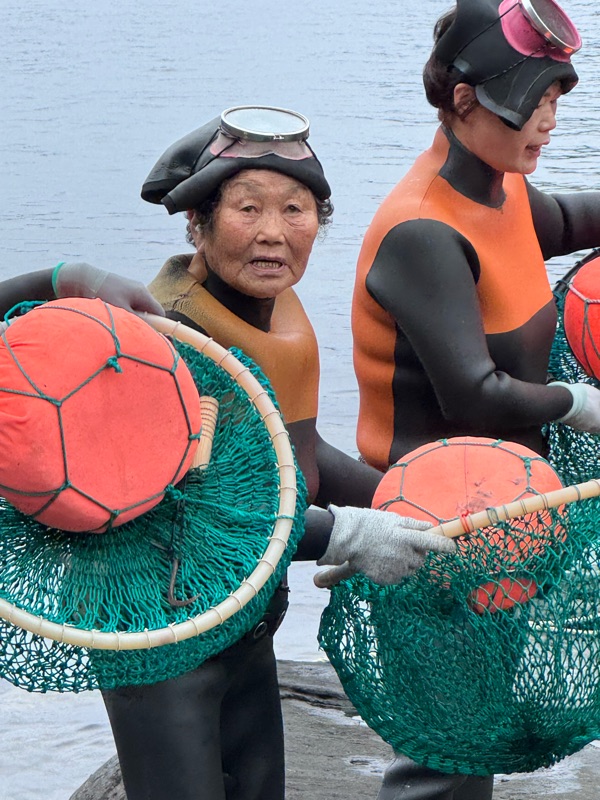
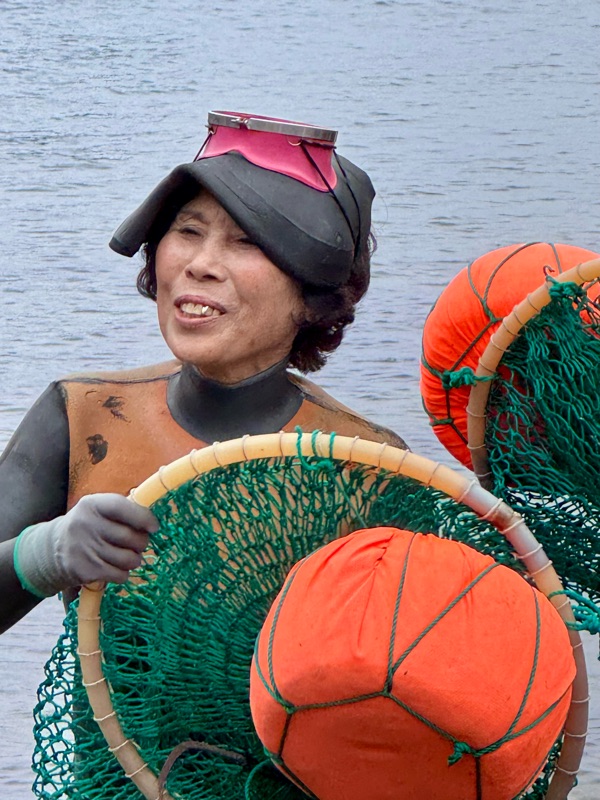
We stood on a seashore with well over an hundred other observers, and the hillside above us was also stacked with tourists. The four women, at least in their 70s, had on traditional wetsuits, and the one large goggle. They performed a short song and dance with their nets before going into the waters nearby. While the waters nearby were not very deep, so they did not get to show off their incredible lung capacity, even in only a few minutes of diving, we watched two women grab an octopus each, and bring it in. (Yes, I have also fallen in love with Remarkably Bright Creatures, and so while I don’t love watching those catches, it was very impressive!) 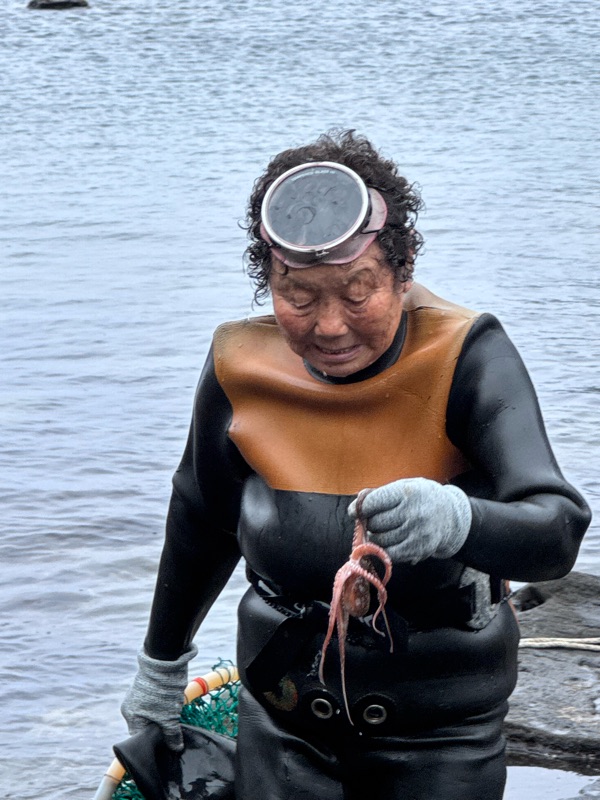

These women, because they are in the sea day in and day out, have also been careful observers of climate change. They have noticed the changes in their waters over the years and have adjusted what they collect because of those changes. They also have been recognized as some of the world’s leading experts on how to fish and gather appropriately. As they gather daily, they are careful to ensure that certain times of year they avoid or leave things of a certain size to make sure that there is more to come in the future.
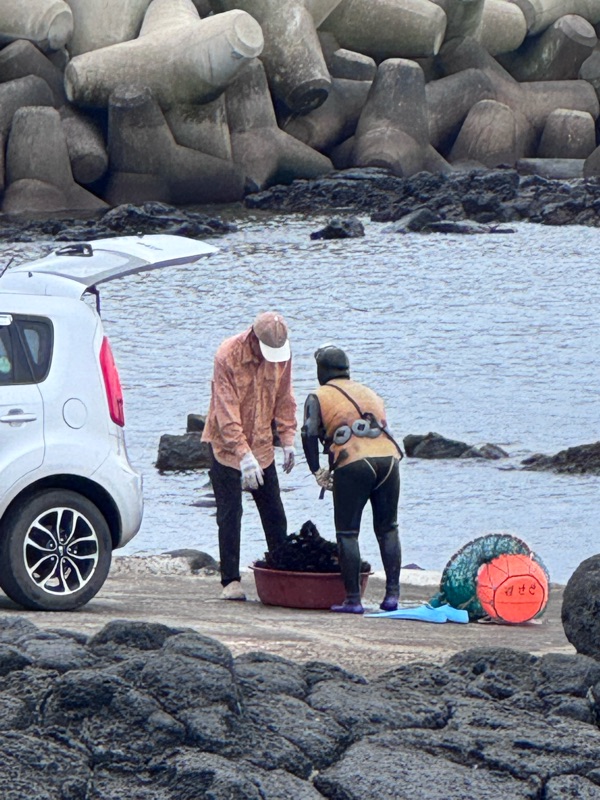
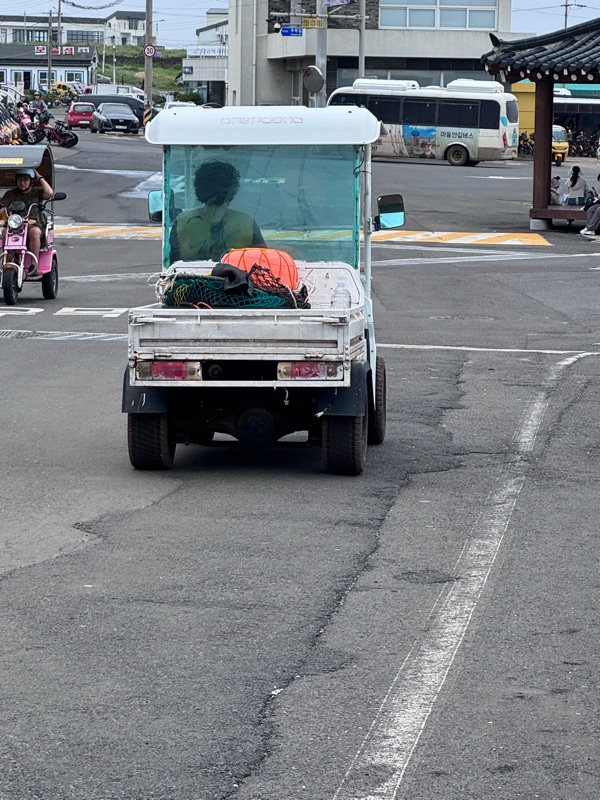
One day, we went to the tiny island of Edo. Just a 10 minute ferry ride from Jeju mainland. It was here, that along the coastal road, in multiple different places, we saw Haenyeo women dive. Not for show, but because that was their livelihood. Later in the day, we saw some of them, hauling their huge nets in and even loading them into carts to drive them home or off to the market. I loved the opportunity to get to see these women in action for real. 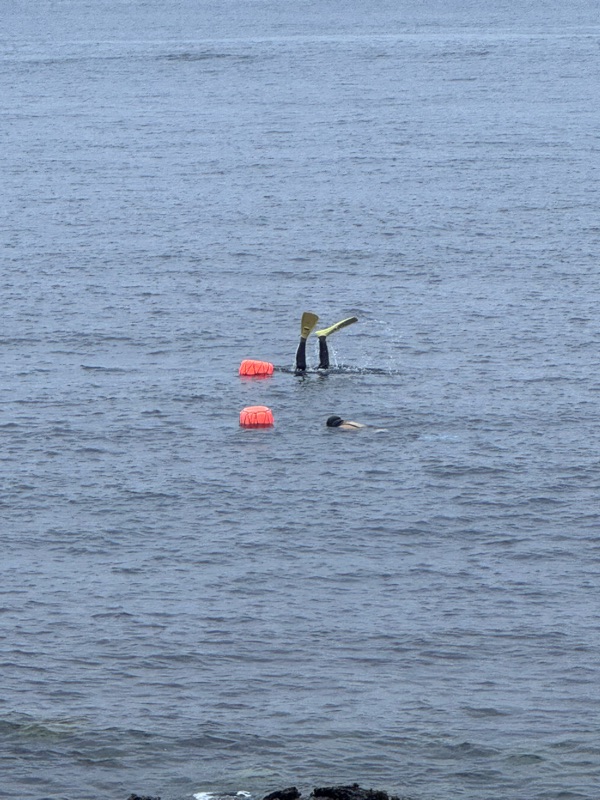
This island is also steeped in significantly horrific history as well. Its location is such that for years, countries have wanted to control it. The island, with a central volcano, only takes about five hours to circumnavigate by car, is not all together large, but it is sixty miles off the coast of South Korea, so location is truly key. It was controlled by the Mongolians (who used it as a breeding ground for horses which is why there are still so many here today), the Japanese, even briefly the United States, before returning it to its Korean heritage.
During World War II, the Japanese used the island as a military base and carried out atrocities against citizens like kidnapping women for work in factories or other truly unimaginable horrors. (We are almost finished listening to The White Chrysanthemum which blends this history with that of the Haenyeo women). After the Japanese surrendered, the United States actually took over control of the small island briefly. Our countrymen stayed here during the Korean War as well. It was during those times, with the support of our government, that thousands of people on this tiny island were murdered.
History is complicated and there’s never only one side to the story, but here is a brief history of what I understand. People on Jeju Island did not like the idea of Korea becoming two countries. Not everyone, but perhaps a larger percentage than mainland. In fact, some people from the mainland, who also felt that way, escaped here. There was a protest against the elections that would solidify the two different countries. At that protest, the police fired into the crowd, killing six people, including a young child. After that, as you can only imagine, the people retaliated. There was fighting and skirmishes back-and-forth between the military government, and those wanting a unified Korea. However, it was the brutal tactics by the South Korean military government, aided by the United States, that murdered civilians. Communities were slaughtered just because there were rumors that rebels may be hiding amongst their midst.
Crimes were so horrific that for decades, the truth was hidden from the public. Early in this century, however, more research was done by the South Korean government and information was made public. Formal apologies have been made by both Japan and the South Korean government for what happened here, but not, as far as I can find, by the United States.
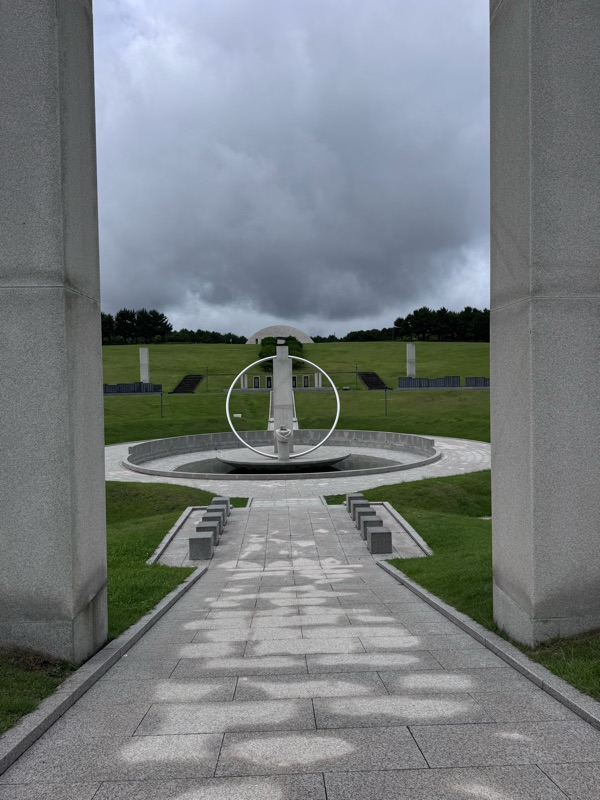
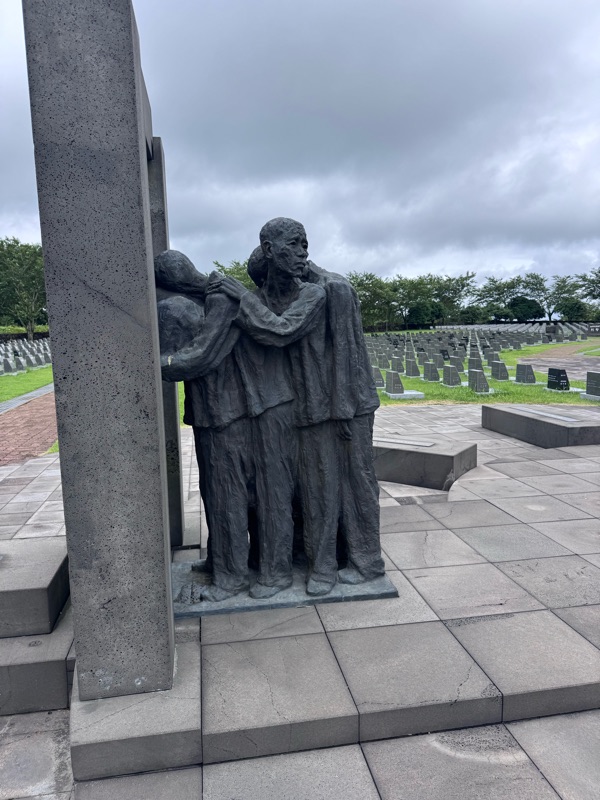
In 2008, Jeju opened the Peace Park to honor the thousands that were killed during the 1940s and early 50s. Because so many people were taken prisoner, and many were buried in mass graves, there are still lots of questions and unknowns about people, but the vastness of this park silently speaks volumes. It is a beautiful park, and I’m glad that we made attending it a priority, but it was truly chilling. 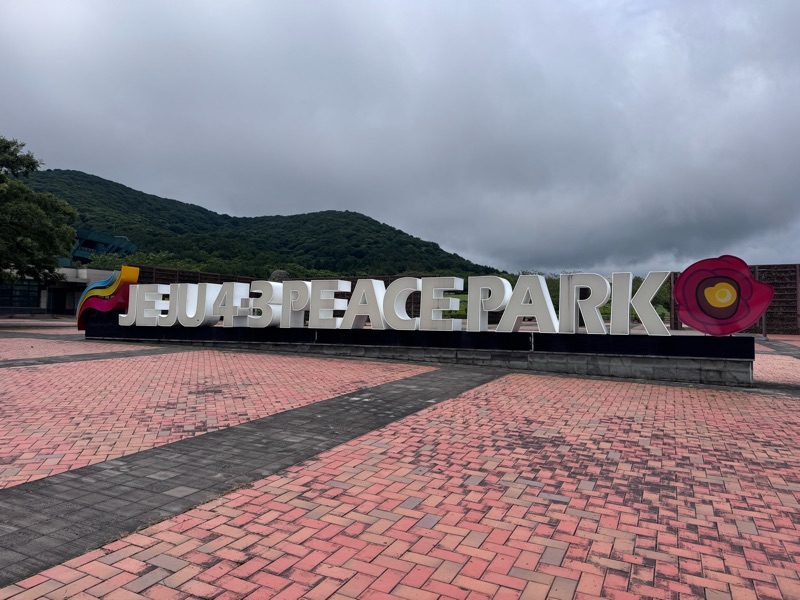
The small island, while part of South Korea, has a culture and history all its own. I’m honored to have the opportunity to visit it to learn more.

No comments:
Post a Comment